


Footwear Market Forecast to Reach USD 560 Billion by 2035, with Nike, Adidas and Puma in Focus
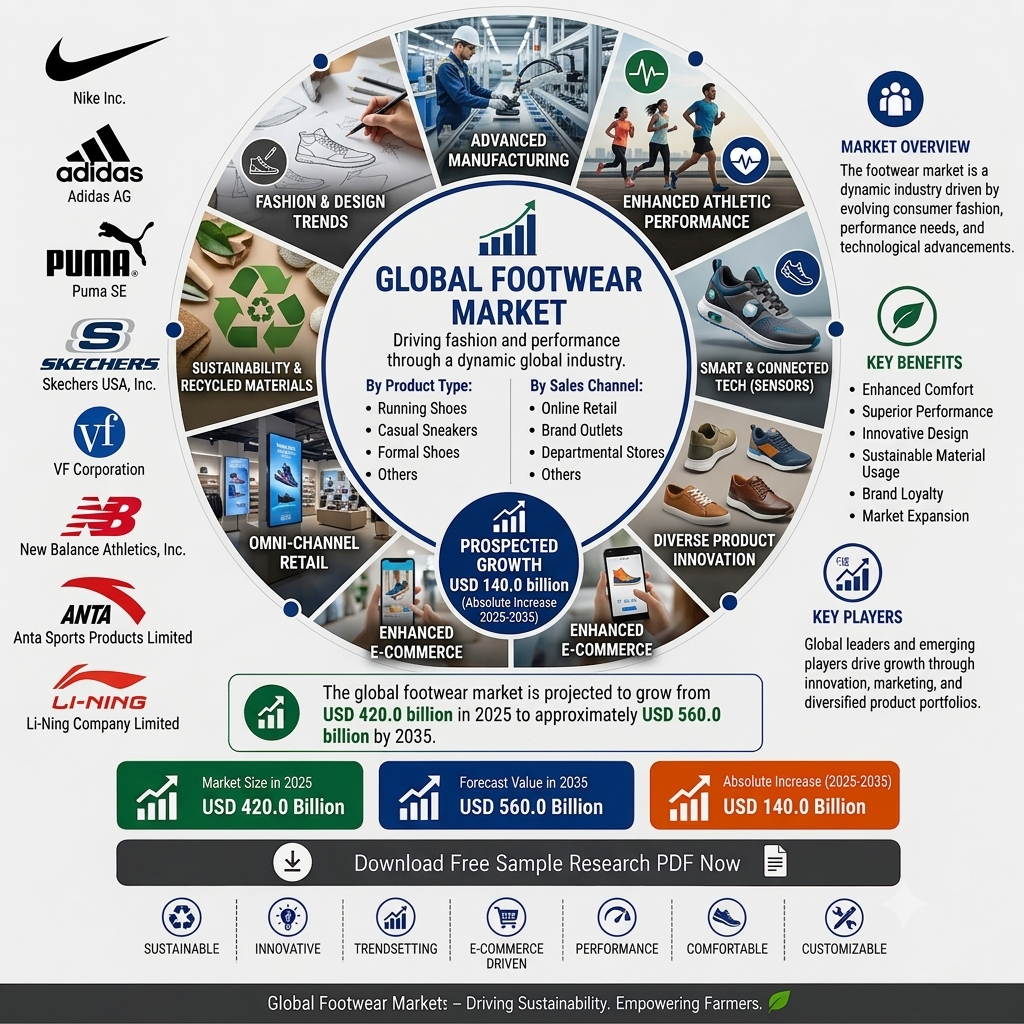
The global Footwear Market is projected to grow from USD 420.0 billion in 2025 to approximately USD 560.0 billion by 2035, expanding at a 2.9% CAGR during the forecast period, according to Fact.MR. The market is expected to add around USD 140.0 billion over the decade, supported by demand for athletic and sport footwear, evolving consumer preferences, and wider access to specialty and digital retail channels.
Footwear manufacturers are increasingly competing on comfort, performance, design, material selection, and brand experience. Athletic footwear remains a major source of demand, while casual and formal categories provide opportunities for companies seeking to diversify product portfolios. Direct-to-consumer models and online retail are also changing how brands reach consumers and manage product distribution.
Request full Report Pricing and sample Report: https://www.factmr.com/connectus/sample?flag=S&rep_id=120
Footwear Market Snapshot
The athletic/sport segment is projected to account for 40.0% of the market in 2025, making it the leading category. Demand is supported by consumer interest in performance-oriented products for sports, fitness, outdoor activities, and everyday use.
By channel, specialty/brand direct-to-consumer (DTC) is expected to hold the largest share at 44.0% in 2025. Direct brand channels allow manufacturers to maintain closer relationships with customers while controlling product presentation, pricing, and brand positioning.
By material, the market is segmented into synthetics, leather, and textiles/others. Material innovation remains an important area for manufacturers as brands seek combinations of durability, comfort, weight reduction, and performance.
Athletic Footwear Remains a Key Growth Engine
The expansion of athletic and sport footwear continues to influence overall market development. Consumers increasingly expect footwear to provide comfort and functional performance across sports, exercise, travel, and everyday activities.
Brands are responding through product development focused on cushioning, lightweight construction, specialized soles, and application-specific designs. Digital technologies are also becoming more relevant across footwear manufacturing and distribution, helping companies improve inventory management, monitor supply chains, and support more customized product offerings.
Online channels provide another opportunity for market participants. Consumers can compare product specifications, designs, materials, and prices across multiple brands, allowing established companies and specialist footwear manufacturers to reach customers beyond traditional retail networks.
United States Leads Country Growth
The United States is projected to register the fastest growth among the countries covered by Fact.MR, expanding at a 3.3% CAGR from 2025 to 2035. A large domestic footwear market, strong athletic participation, and established retail and brand infrastructure support continued demand.
Mexico follows with a projected 3.0% CAGR, while Germany and South Korea are each expected to grow at 2.6%. France, the United Kingdom, and Japan are projected to record CAGRs of 2.5%, 2.4%, and 2.3%, respectively.
Europe remains a major regional market, with footwear revenue projected to increase from USD 102.0 billion in 2025 to USD 136.0 billion by 2035. Germany is expected to maintain its leading position within the region.
Competitive Landscape
The footwear market includes major global brands and established manufacturers competing through product innovation, brand recognition, distribution reach, athletic performance, and direct consumer engagement. Key players profiled by Fact.MR include Nike, Adidas, Puma, Skechers, VF Corp, New Balance, Anta, Li-Ning, Bata, and Deckers.
Nike maintains a leading position through its broad athletic footwear portfolio and global brand presence. Adidas focuses heavily on sports and performance-oriented products, while Puma continues to develop footwear across athletic and lifestyle categories. Skechers, New Balance, Anta, and Li-Ning also maintain strong positions across regional and international markets.
Competition is increasingly influenced by product differentiation, digital commerce, supply-chain reliability, material innovation, and the ability to respond quickly to changing consumer preferences.
To View Related Reports
https://afgbfh.blogspot.com/2026/11/business-process-outsourcing-market-to.html
https://sportgalax.com/read-blog/27288
About Fact.MR
Fact.MR is a market research and competitive intelligence provider delivering market intelligence, competitive analysis, and forecasting across global industries. Its research helps businesses evaluate market demand, understand competitive developments, and identify growth opportunities.

 English
 Arabic
 French
 Spanish
 Portuguese
 Deutsch
 Turkish
 Dutch
 Italiano
 Russian
 Romaian
 Portuguese (Brazil)
