


Next Level Fire and Smoke Detection with Video Analytics Across Saudi Arabia
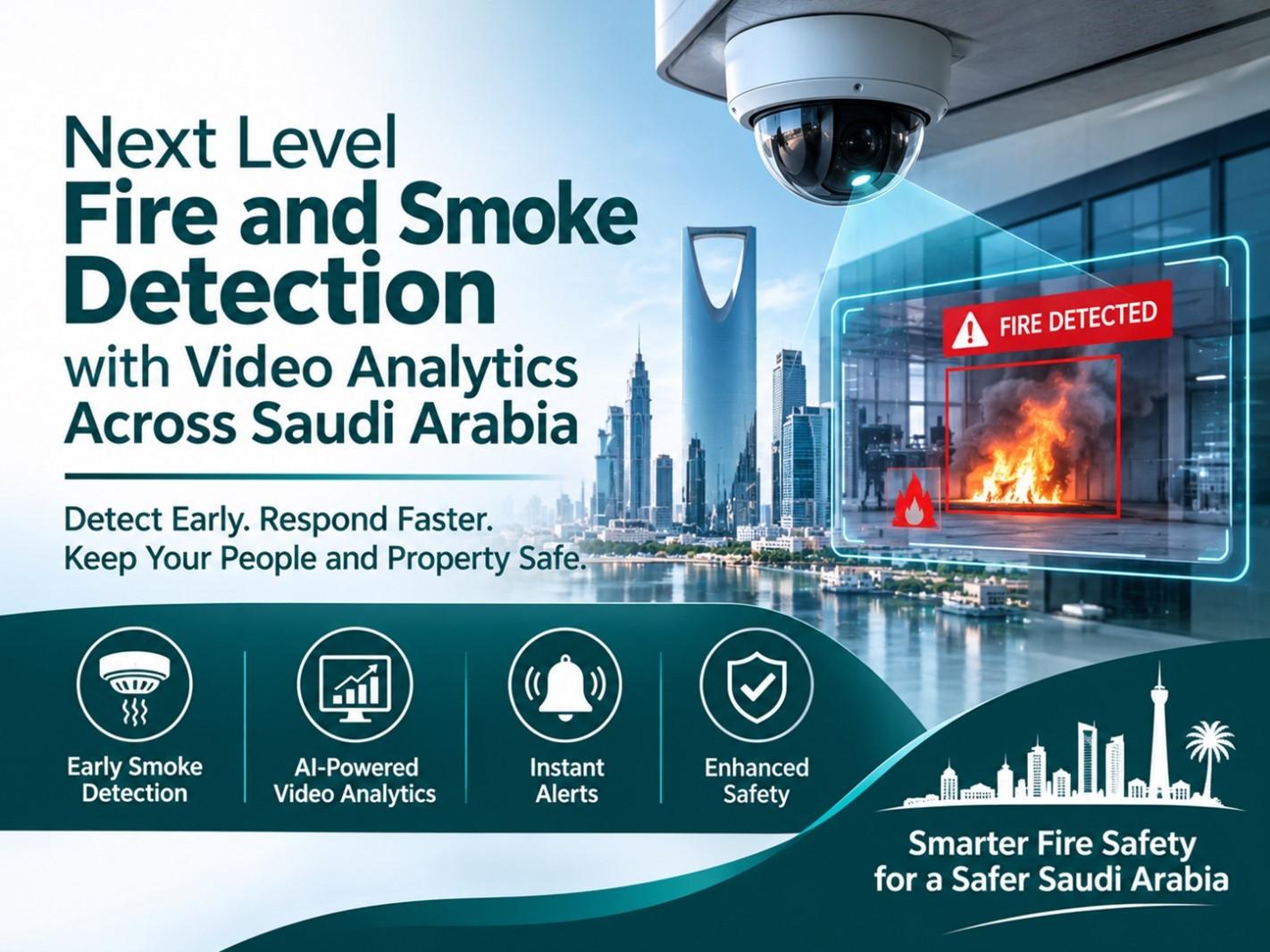
Next Level Fire and Smoke Detection with Video Analytics Across Saudi Arabia
Video Analytics is changing how Saudi businesses find fire and smoke before a small problem becomes a major loss, by turning the cameras already watching warehouses, plants, malls and towers into an early warning network. This guide explains how camera-based detection works, where it delivers the most value across the Kingdom, how it fits with certified fire protection and how to plan a project that stands up to audits, insurers and Saudi Civil Defense.
Why Fire and Smoke Risk Is Rising Across Saudi Arabia
Saudi Arabia is building and expanding at extraordinary speed. Logistics parks, industrial cities, giga projects, hotels, hospitals, data centers and high-rise towers are all opening under Vision 2030, and every one of them concentrates people, stock and equipment under one roof. Long summers with temperatures that regularly pass 45 degrees Celsius in many regions, dust, large storage volumes and the growing use of lithium batteries all raise the chance that a small ignition grows quickly.
The cost of a fire is rarely limited to the damage itself. Operations stop, contracts slip, insurance premiums rise and staff or customers may be put at risk. Boards and facility managers therefore ask a simple question: how soon will we know, and how reliably? The answer depends on detection technology that sees trouble at the source rather than waiting for it to travel through the building.
Standards and authorities shape the answer. Saudi Civil Defense sets life safety requirements, the Saudi Building Code defines fire protection rules for buildings, and the Saudi Standards, Metrology and Quality Organization supports product conformity. Cybersecurity and privacy add further duties through the National Cybersecurity Authority and the Saudi Data and AI Authority. Any modern detection project has to respect all of them from the first design meeting.
Where Traditional Detection Falls Short
Conventional smoke and heat detectors remain essential, and nothing in this article suggests removing them. They do, however, have natural limits. Smoke must travel to a ceiling mounted sensor before it is noticed, which can take minutes in a tall warehouse or an open atrium. Outdoor yards, car parks, loading docks and open sided production areas are hard to cover at all. Dust, steam, cooking fumes and welding can trigger nuisance alarms, and a detector tells staff that something happened without showing where it is, what is burning or how fast it is spreading.
Cameras fill exactly these gaps. They already cover large areas, they see the source rather than the symptom, and they record what happens next. The missing piece is software intelligent enough to watch every feed continuously, which no human operator can do across hundreds of cameras and long night shifts.
How Camera Based Fire and Smoke Detection Works
Teaching Cameras to Recognize Fire
AI-Powered Video Analytics uses trained neural networks to study each frame for the visual signatures of flame and smoke: flicker, color patterns, rising plumes, spreading texture and movement that differs from steam, dust or reflections. Models are trained on large collections of real fire scenes and tuned for local conditions such as bright sunlight, haze, night time infrared images and industrial lighting. Because the model examines behaviour over time rather than a single image, it can tell a drifting smoke plume from a passing cloud of dust.
The Software Layer That Runs Everything
Video Analytics Software ties the model to the practical needs of a site. Operators draw zones on camera views, set sensitivity by area, define schedules and choose which events create alerts. A central dashboard shows every camera, every alert and every response in one place, while edge processing on the camera or a nearby appliance keeps latency low and reduces network load. Open standards such as ONVIF allow one platform to work with cameras from different manufacturers, which protects existing investment.
Speed That Matters
Real-Time Hazard Detection is the benefit most buyers notice first. Analysis runs continuously on live streams, so an alert can reach a control room within seconds of the first visible smoke. In large spaces, that head start can be the difference between a bucket of water and a major incident. It also gives security staff a live picture to guide responders, rather than a bare alarm number on a panel.
From First Smoke to Final Report
A useful way to judge any system is to follow one event from start to finish. The sequence below shows what a well-designed deployment does at each stage.
Stage One: Detect
A camera covering a warehouse aisle notices a faint plume rising from a pallet. The analytics engine classifies it as probable smoke, marks the area on screen and creates an alert with a short clip attached. The whole step takes seconds, and the operator does not have to be looking at that camera when it happens.
Stage Two: Verify
Verification is where the quality of a system shows. Operators see the clip and the live view side by side, and the platform can compare nearby cameras to confirm the event. Persistence checks, zone rules and learning from earlier events help deliver Reduced False Alarms, which keeps teams trusting the system and prevents the costly habit of ignoring alerts.
Stage Three: Respond
Once an event is confirmed, Automated Emergency Response takes over the routine steps. The platform can notify the control room, sound local sirens, send messages to the on duty team, signal the fire alarm panel, release exit doors, pause equipment or guide a responder with a camera view and location. Automating these tasks removes delay and avoids the confusion that comes from phone trees and memory under pressure. Life safety decisions such as evacuation always stay under human and certified system control.
Stage Four: Review
After the event, Detailed Incident Reporting captures what happened and when: the first detection time, the clips, who acknowledged the alert, which actions ran and how long each took. Facility managers use these records for post incident learning, insurers use them to assess risk, and auditors use them to confirm that procedures worked. Reports can also reveal patterns, such as a recurring hotspot near a charging area, so problems are fixed before they repeat.
Where It Delivers the Most Value in Saudi Arabia
Warehouses and Logistics Hubs
Tall racking, mixed stock and long travel distances make logistics parks one of the hardest places to detect fire early. Cameras mounted along aisles and loading docks watch for smoke at the source, and zone rules can be tuned around forklift exhaust and dust. Managers also gain a clear record for insurers who ask how stock is protected.
Industrial and Energy Sites
Plants, workshops, utilities and processing facilities have open air equipment, heat sources and hazardous materials. Camera based detection covers yards and structures where point detectors are impractical, and it adds a visual record that helps operations and safety teams investigate abnormal events. It supports certified detection in hazardous areas and never replaces it.
Malls, Hotels and Towers
Large public buildings combine crowds, kitchens, back of house storage and complex layouts. Early visual confirmation helps staff reach the right floor quickly, and clips guide responders through unfamiliar buildings. Hospitality managers also value the ability to check an alert quietly, before guests are disturbed.
Data Centers and Battery Storage
Technical facilities depend on continuity. Cameras covering cable trays, battery rooms and equipment halls give another early view of smoke, while reports help prove due diligence to customers and auditors. Growing battery storage projects add a further reason to look at every available early warning layer.
Local Focus: Riyadh and Jeddah
Riyadh: A Capital Under Construction
Video Analytics Riyadh projects often involve very large sites, from logistics parks and industrial zones to towers, campuses and mixed-use districts. Strong sunlight, dust storms and extreme heat make careful camera placement and model tuning essential, and central dashboards help one team supervise many buildings from a single control room.
Jeddah: Port, Coast and Hospitality
Video Analytics Jeddah deployments must cope with humidity, salt air, haze and heavy activity around the port, free zones, hotels and hospitals. Sealed, corrosion resistant cameras and sensible maintenance plans keep performance steady, and flexible alert rules help busy sites avoid unnecessary interruptions.
Projects in Dammam, Jubail, NEOM and other regions follow the same principles, each with its own climate, building types and regulatory needs. A good supplier adapts the design to the place rather than copying one template everywhere.
Getting the Camera Details Right
Placement and Field of View
Detection quality starts with where cameras are mounted. Lenses should see the places where fire is most likely to start, such as charging bays, electrical panels, storage aisles, kitchens and waste areas, with a clear view and minimal obstruction from racking, signage or hanging cables. Mounting height, angle and distance all affect how early a plume becomes visible, so designers walk the site and test views before final drawings are issued. In warehouses, overlapping fields of view allow nearby cameras to confirm each other, which supports accuracy and gives operators a second angle.
Lighting, Night Shifts and Thermal Options
Saudi sites run around the clock, so cameras must perform in bright sun, deep shadow and darkness. Infrared illumination supports night time monitoring, while thermal cameras detect heat patterns in yards, tank farms and large open areas where ordinary images are less reliable. Glare from glass, polished floors and vehicle headlights should be considered during design, and model tuning should be repeated in different seasons to keep results steady.
Maintenance That Protects Accuracy
Dust, sand and humidity gradually reduce image quality, so lenses and housings need scheduled cleaning. Software updates, model retraining and health checks should be part of the support agreement, with dashboards that warn when a camera loses focus, moves or goes offline. A system that is monitored itself stays dependable for years.
Fitting In with Existing Systems
Few sites start from a blank page, so integration decides success. Camera based fire and smoke detection technology should connect to the existing fire alarm panel through relay or network interfaces, to the video management platform for live views and playback, to access control for door release and to building management systems for ventilation and equipment control. It complements certified fire alarm systems and does not replace them, because the panel remains the legal and life safety backbone. Video image detection is also recognized in fire alarm codes such as NFPA 72, which helps consultants place it correctly in a design.
Security matters too. Cameras and analytics servers are network devices, so they should follow National Cybersecurity Authority controls: segmented networks, strong passwords, regular patching, encrypted communication and role-based access. Because the platform analyzes scenes rather than faces, privacy risk is low, but retention periods, signage and access rules still need to follow the Personal Data Protection Law.
Planning, Pilot and Proof of Performance
Strong projects begin with a survey of risks, camera positions, lighting, network capacity and response procedures. Video Analytics Solutions should then be matched to each area: fixed cameras for aisles, thermal or long-range models for yards and edge devices where bandwidth is limited. A pilot on one building or zone lets teams measure detection speed, alert accuracy and operator workload under real conditions before approving a wider rollout.
Useful pilot measures include the time from first visible smoke to alert, the share of alerts that proved genuine, the time taken to acknowledge and act, and operator feedback. Agree these targets in writing so both sides know what success looks like. Staff training and regular drills are equally important, because technology only helps when people know exactly what to do with an alert.
Building the Business Case
Counting the Cost of Delay
Every minute between ignition and response multiplies loss. Early alerts help staff contain small events with extinguishers or isolation steps before the fire department is even needed, and they give emergency crews better information when they do arrive. Reduced downtime, protected stock and safer people are benefiting that finance teams can estimate using their own site data, without relying on generic claims.
Talking to Insurers and Auditors
Insurers and auditors look for layered protection, tested procedures and reliable records. A documented camera-based detection layer, together with certified alarms, sprinklers and trained staff, shows that risk is managed seriously. Clips and reports from drills and real events give brokers practical evidence to support premium discussions and compliance reviews.
Measuring Return on Investment
Useful measures include faster detection times, fewer nuisance dispatches, shorter investigation time, lower incident losses and better audit results. Track them from the pilot onward and compare them with the baseline before installation. Over time the same cameras can support other safety tasks such as perimeter protection and people counting, spreading the value of the investment across several teams.
People, Procedures and Drills
Technology succeeds when people trust it and know their roles. Control room operators need training on what an alert looks like, how to verify it, when to escalate and how to record decisions. Site teams need simple instructions: who goes to the location, who calls Saudi Civil Defense, who guides visitors and who shuts down equipment. Written procedures should be tested in drills at least once a year, and drills should use the platform's own clips and reports to review what went well and what needs improvement.
Clear ownership also helps. Assign one manager to own the system, one to own response procedures and one to own the supplier relationship. Regular review meetings keep sensitivity settings, camera coverage and contact lists up to date as buildings change, tenants move and new equipment arrives.
Visitors and contractors should receive safety briefings that explain how alerts are raised and how to follow evacuation signage. Transparent communication avoids surprises, builds confidence among staff and supports compliance with workplace safety rules.
Why Work with Expedite IoT
A strong product needs a strong delivery partner. Expedite IoT designs, supplies, installs and supports intelligent fire and smoke monitoring across Saudi Arabia, Qatar and Oman, and our engineers align each design with Saudi Civil Defense requirements, Saudi Building Code fire protection rules and National Cybersecurity Authority controls. For Video Analytics KSA customers, that means a named project team, documented survey and design, commissioning tests, user training and a support plan with clear response times.
Our approach is evidence first. We agree success measures before installation, test on site with real scenarios, and share reports that facility managers can show to boards, insurers and regulators. Readers who want specifications, supported cameras and integration details can review the complete solution page and request a survey for their own site.
A Six Step Roadmap
Survey buildings, yards and processes, and list where early warning matters most.
Review existing alarm panels, cameras, networks and control room workflows.
Select camera types, processing locations and alert rules for each area.
Pilot in one zone and measure speed, accuracy and operator workload.
Roll out in phases, with training, drills and clear escalation paths.
Review reports each quarter, retune sensitivity and extend coverage as sites grow.
Following a clear roadmap keeps budgets focused, protects daily operations and makes supplier proposals easy to compare.
Conclusion
Video Analytics turns ordinary cameras into an always alert fire watch for Saudi sites. AI-Powered Video Analytics and Video Analytics Software spot smoke and flame early, supporting Real-Time Hazard Detection and Reduced False Alarms. Automated Emergency Response and Detailed Incident Reporting then shorten the path from warning to action and from action to proof. Video Analytics Solutions for Video Analytics KSA projects, from Video Analytics Riyadh to Video Analytics Jeddah, work best when planned around local conditions.
FAQs
How fast is Real-Time Hazard Detection compared with ceiling detectors?
In many layouts it reacts as soon as smoke or flame becomes visible to a camera, often within seconds, while a ceiling detector waits for smoke to rise and reach it. Actual results depend on camera position, lighting and room height, so confirm them in a pilot.
How can a site achieve Reduced False Alarms in dusty or humid areas?
Tune sensitivity zone by zone, mask steam vents and kitchen extraction, use persistence checks and confirm events across nearby cameras. Regular tuning and operator feedback keep accuracy high as conditions change.
What should Detailed Incident Reporting include for insurers and auditors?
It should record the first detection time, saved clips, who acknowledged the alert, every action that ran, response times and closure notes. Keep records for the period your policy and regulations require.
Can Automated Emergency Response replace the fire alarm panel?
No. It adds notifications, signals and equipment actions on top of the certified panel, which remains responsible for evacuation and life safety. Trained staff and documented procedures stay essential.
Which cameras work with Video Analytics Software?
Many IP cameras that support open standards such as ONVIF can be used, with thermal or long-range models for yards and large open areas. A site survey confirms compatibility, resolution and lighting before purchase.

 English
 Arabic
 French
 Spanish
 Portuguese
 Deutsch
 Turkish
 Italiano
 Russian
 Romaian
 Portuguese (Brazil)
 Greek
