


How can IVF Lab Design Services improve the management of laboratory air pressure differentials?
INTRODUCTION
Maintaining appropriate air pressure differentials is an important part of contamination control in an IVF laboratory. Pressure relationships between rooms influence the direction of airflow and help manage the movement of airborne particles between different laboratory zones. Poorly controlled pressure can increase contamination risks, affect environmental stability, and disrupt sensitive embryology workflows. Professional IVF Lab Design Services can improve pressure management through scientific room zoning, carefully engineered HVAC systems, suitable air handling equipment, differential pressure sensors, automated controls, and regular performance verification. By integrating these elements during the planning and construction stages, fertility centres can establish controlled environments that support laboratory operations, sample handling, and consistent environmental conditions.
1. Understanding Air Pressure Differentials in IVF Laboratories
An air pressure differential is the difference in air pressure between two connected spaces. It influences the direction in which air moves when a door opens or when air passes through gaps and other openings.
In controlled laboratory environments, pressure relationships are designed to support the intended contamination-control strategy.
The three common pressure arrangements are:
- Positive pressure: The room is maintained at a higher pressure than adjacent areas, encouraging air to flow outward when openings occur.
- Negative pressure: The room is maintained at a lower pressure, encouraging air to flow inward from surrounding spaces.
- Neutral pressure: The pressure difference is kept close to zero between designated spaces.
IVF laboratories often use positive pressure in selected clean areas to help limit the entry of less-controlled air. However, the correct arrangement depends on the room's function, contamination risks, adjacent spaces, and overall ventilation strategy. Negative pressure may be appropriate for specific containment or chemical-handling applications.
A pressure cascade should therefore be designed according to the laboratory's risk assessment rather than applying one pressure strategy to every room.
2. Developing a Scientific Room Zoning Strategy
Effective pressure management begins with a well-planned laboratory layout. Different IVF laboratory activities have different environmental and operational requirements. A clear zoning strategy helps determine how air should move between adjacent areas.
Typical zones may include:
- General access and entry areas.
- Changing and gowning spaces.
- Laboratory preparation areas.
- Embryology work areas.
- Andrology and sperm preparation rooms.
- Equipment and utility areas.
- Storage and support spaces.
The design team should identify which spaces require controlled access, specific environmental conditions, or particular pressure relationships.
For example, an embryology work area may be maintained at a higher pressure than an adjacent less-controlled corridor, depending on the facility's contamination-control strategy. Transition areas can help manage movement between different cleanliness zones.
Room zoning should also consider personnel movement, sample transfer, material delivery, waste removal, and equipment access. Pressure control is more effective when supported by a logical workflow that minimizes unnecessary door openings and cross-movement.
3. Designing an Effective HVAC System
The HVAC system is the foundation of laboratory pressure management. It controls the supply and removal of air and helps maintain the required pressure relationships between rooms.
A properly engineered system should consider:
- Room dimensions and volume.
- Required air change rates.
- Supply and return air quantities.
- Filter selection and arrangement.
- Exhaust requirements.
- Door openings and leakage paths.
- Occupancy and equipment heat loads.
- Temperature and humidity requirements.
The supply and exhaust airflow must be balanced to achieve the intended pressure differential. If too much air is supplied or removed, the pressure relationship may move outside its approved operating range.
Professional HVAC design should include airflow calculations, duct sizing, diffuser selection, return-air positioning, and suitable control arrangements.
The final system must be tested under realistic operating conditions to confirm that the intended airflow direction and pressure relationships are achieved.
4. Using Differential Pressure Sensors for Continuous Monitoring
Differential pressure sensors provide information about the pressure difference between two spaces. They are important tools for checking whether laboratory pressure relationships remain within defined limits.
These sensors can be installed between selected rooms and connected to monitoring panels or a building management system.
Important Sensor Features
- Suitable measurement range and accuracy.
- Appropriate sensor placement.
- Clear digital or analogue readings.
- Configurable alarm thresholds.
- Calibration and maintenance access.
- Data recording capabilities.
- Integration with HVAC controls where appropriate.
For example, a sensor installed between an embryology laboratory and an adjacent corridor can help staff identify whether the pressure relationship is maintained within the established operating range.
Sensor readings should be interpreted alongside door status, HVAC operation, and other relevant conditions. A single reading does not always explain the cause of a pressure deviation.
5. Establishing an Appropriate Pressure Cascade
A pressure cascade is a planned sequence of pressure differences between connected rooms. It helps guide airflow from areas with lower cleanliness requirements toward areas with higher cleanliness requirements, where that strategy is appropriate.
A typical arrangement may include:
- General corridor or access area.
- Transition or gowning area.
- Controlled laboratory support area.
- Designated clean embryology area.
The exact pressure hierarchy and numerical setpoints should be established through engineering calculations, applicable standards, operational requirements, and risk assessment.
The design should avoid unnecessarily large pressure differences. Excessive pressure can make doors difficult to open, increase air leakage, and create discomfort for personnel.
A balanced cascade supports predictable airflow without placing unnecessary strain on the HVAC system.
6. Integrating HEPA Filtration and Air Distribution
Filtration and pressure control work together but perform different functions. HEPA filters remove airborne particles, while the HVAC system establishes airflow volume and pressure relationships.
Suitable filtration can help control particle levels in designated laboratory areas. However, installing HEPA filters alone does not guarantee the required room pressure.
Important Design Considerations
- Select filter efficiency according to the intended application.
- Calculate airflow requirements before selecting filter capacity.
- Provide suitable filter housing and sealing arrangements.
- Ensure accessible maintenance and replacement provisions.
- Avoid airflow obstructions around supply diffusers.
- Verify filter installation integrity.
- Monitor filter pressure differential.
Filter pressure differential indicates resistance to airflow and can help identify filter loading. It does not prove that a filter is free from leaks. Appropriate filter integrity testing should be performed according to the system's requirements.
Air distribution should also be evaluated to avoid undesirable drafts or disruptive airflow around sensitive workstations.
7. Preventing Pressure Fluctuations from Door Openings
Doors are one of the most common causes of temporary pressure disturbances in controlled environments. Opening a door changes the airflow path between rooms and may temporarily reduce the pressure differential.
Repeated or prolonged door openings can make it difficult to maintain stable room conditions.
Practical Design Solutions
- Install self-closing doors where appropriate.
- Use door closers with suitable operating characteristics.
- Consider interlocked doors or airlocks in selected transitions.
- Avoid unnecessary through-traffic.
- Provide clear personnel and material movement routes.
- Position pressure sensors appropriately.
- Train staff on controlled entry procedures.
Airlocks can help manage movement between spaces with different pressure requirements. However, they must be designed according to the room layout, operational needs, and safety requirements.
Staff training is equally important. Even a well-designed pressure system can be affected by poor door discipline.
8. Using Automated HVAC Controls and Building Management Systems
Modern HVAC controls can improve pressure management by coordinating fans, dampers, sensors, and air handling units.
A building management system (BMS) can collect information from different rooms and display pressure readings centrally.
Functions of Automated Controls
- Continuous differential pressure monitoring.
- Fan speed adjustment through variable-frequency drives.
- Automatic damper control.
- High- and low-pressure alarms.
- HVAC equipment status monitoring.
- Historical data recording.
- Notifications to authorized personnel.
For example, if a pressure sensor detects a deviation, the control system may notify staff and initiate a predefined corrective response. Any automatic adjustment must remain within validated operating limits.
BMS integration should also include suitable user permissions, alarm priorities, cybersecurity controls, and backup arrangements for critical monitoring functions.
Automation improves visibility and response, but it does not replace physical verification or preventive maintenance.
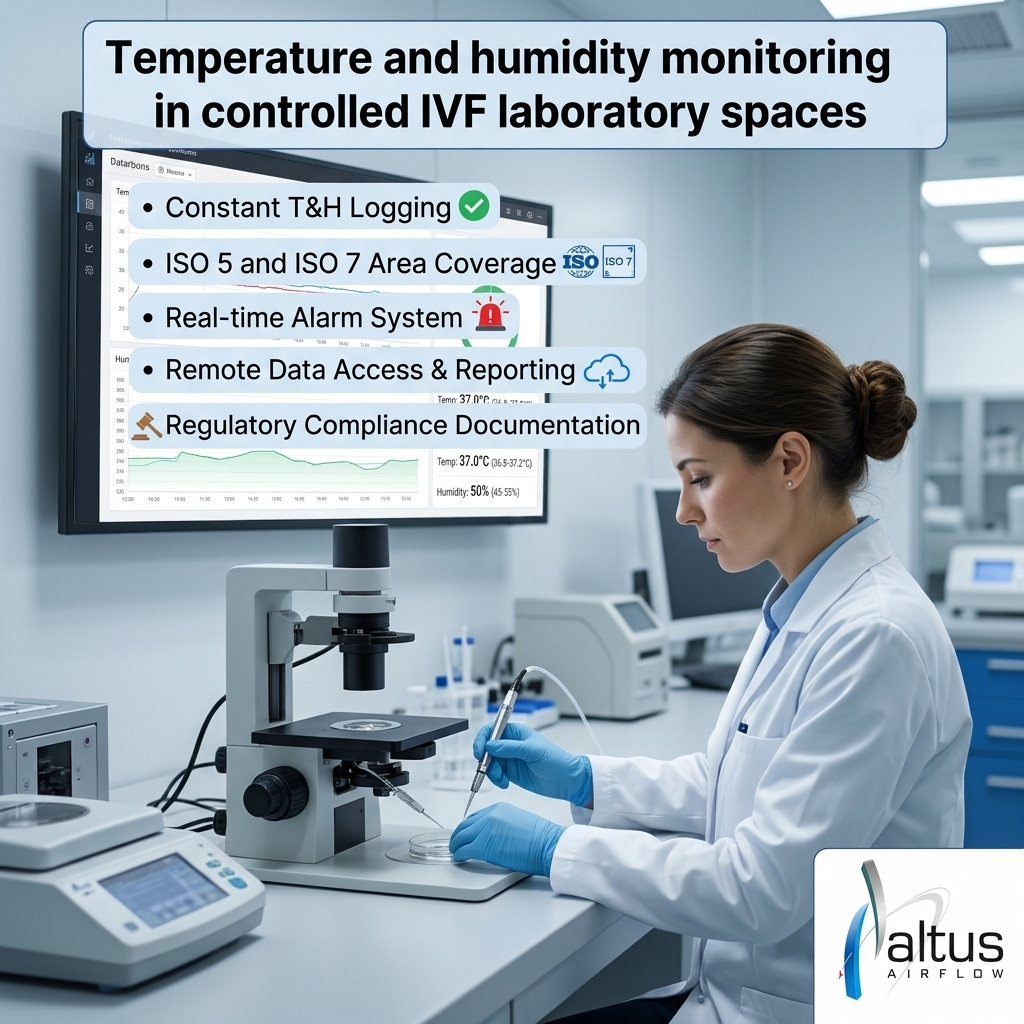
9. Managing Temperature and Humidity Alongside Pressure
Pressure differential management should not be considered separately from other environmental parameters.
Temperature and humidity can influence equipment performance, staff comfort, and the stability of laboratory conditions. HVAC design should therefore coordinate all these parameters.
Important considerations include:
- Appropriate temperature ranges for each room.
- Humidity control according to laboratory and equipment requirements.
- Heat generated by incubators and other equipment.
- Moisture and condensation risks.
- Air distribution around sensitive workstations.
- Continuous or periodic environmental monitoring.
Pressure adjustments should not create unacceptable changes in temperature, humidity, or airflow distribution.
The design team should establish separate acceptance criteria for each environmental parameter and verify them during commissioning.
10. Addressing Pressure Loss and HVAC Failures
Pressure deviations may occur due to fan failure, filter loading, damper malfunction, duct leakage, door problems, or changes in building conditions.
An effective design should identify these risks and provide suitable monitoring and response procedures.
Common Causes of Pressure Problems
- Failure of supply or exhaust fans.
- Blocked or heavily loaded filters.
- Incorrect airflow balancing.
- Damaged door seals.
- Poorly sealed service penetrations.
- Faulty pressure sensors.
- Unexpected changes in room usage.
- HVAC control system faults.
The facility should establish procedures for investigating alarms, checking equipment, and restoring the approved pressure conditions.
Where required by risk assessment, critical HVAC components and monitoring systems may need backup power. Emergency procedures should explain how laboratory activities are managed when environmental conditions move outside approved limits.
11. Maintaining Proper Sealing and Modular Construction Quality
The physical construction of a laboratory influences its ability to maintain pressure differentials. Uncontrolled leakage through wall joints, ceiling connections, doors, and service penetrations can make pressure balancing difficult.
Modular construction can support controlled installation through prefabricated panels and coordinated service openings.
Important Construction Requirements
- Properly sealed wall and ceiling joints.
- Suitable door gaskets and frames.
- Sealed electrical and utility penetrations.
- Cleanable and durable surface finishes.
- Correct installation of access panels.
- Coordinated HVAC and architectural details.
- Inspection of joints before commissioning.
The complete installed assembly should be assessed. A panel's material specification alone does not establish airtightness or cleanroom suitability.
Access panels should allow maintenance without compromising sealing. Following maintenance, affected areas should be cleaned and the required environmental performance rechecked.
12. Conducting Air Balancing, Testing, and Commissioning
A pressure management system should be verified before the laboratory becomes operational. Commissioning confirms whether the installed HVAC and monitoring systems achieve the approved design conditions.
Important verification activities may include:
- Measuring supply and return airflow.
- Checking room-to-room pressure differentials.
- Confirming intended airflow direction.
- Inspecting door operation and sealing.
- Verifying sensor calibration.
- Testing high- and low-pressure alarms.
- Checking HVAC control sequences.
- Reviewing environmental monitoring records.
- Documenting deviations and corrective actions.
Testing should cover relevant operating conditions, including normal occupancy and representative door-use scenarios.
Where cleanroom classification is required, applicable ISO 14644 requirements may be considered alongside the facility's intended use and other relevant regulatory or technical requirements. Pressure testing alone does not establish cleanroom classification.
13. Implementing Preventive Maintenance and Documentation
Long-term pressure stability depends on regular inspection and maintenance. Sensors may drift, filters may load, dampers may become misaligned, and door seals may deteriorate over time.
A preventive maintenance programme should include:
- Periodic sensor calibration.
- Filter inspection and replacement based on condition and approved schedules.
- Fan and motor servicing.
- Damper inspection.
- Door closer and gasket checks.
- Duct and panel sealing inspections.
- Alarm testing.
- HVAC performance reviews.
Pressure readings, maintenance records, alarm events, and corrective actions should be documented. Reviewing these records can help identify recurring problems and improve system reliability.
Reassessment should also be carried out after room modifications, equipment changes, or significant alterations to HVAC operation.
Conclusion
Effective laboratory air pressure management requires a coordinated approach involving room zoning, HVAC engineering, filtration, differential pressure monitoring, automated controls, construction quality, and ongoing maintenance. A well-designed pressure cascade helps guide airflow according to the laboratory's contamination-control strategy, while continuous monitoring makes it easier to identify and investigate deviations. Professional IVF Lab Design Services bring these elements together through application-specific planning, installation, testing, and commissioning. By focusing on reliable environmental control and documented performance, Altus Airflow can support fertility facilities in developing functional IVF laboratory environments that meet their operational requirements.
Frequently Asked Questions (FAQs)
1. Why are air pressure differentials important in IVF laboratories?
Air pressure differentials help control airflow direction between connected rooms and reduce the movement of airborne contaminants into designated clean areas. IVF Lab Design Services establish suitable pressure relationships according to room functions and contamination-control requirements.
2. What is a pressure cascade in an IVF laboratory?
A pressure cascade is a planned sequence of pressure differences between adjacent rooms that guides airflow in the intended direction. IVF Lab Design Services use room zoning and HVAC calculations to establish an appropriate cascade.
3. How do differential pressure sensors improve laboratory management?
Differential pressure sensors provide continuous or periodic readings between selected spaces and can alert staff when readings move outside defined limits. IVF Lab Design Services can integrate these sensors with monitoring panels and building management systems.
4. Is positive pressure necessary in every IVF laboratory room?
No. Pressure arrangements depend on room activities, contamination risks, and the overall ventilation strategy. IVF Lab Design Services assess each space individually before deciding whether positive, negative, or neutral pressure is appropriate.
5. How does HVAC design affect laboratory pressure differentials?
HVAC systems control supply and exhaust airflow, which determines the pressure relationship between rooms. IVF Lab Design Services use airflow calculations, suitable equipment selection, and balancing procedures to achieve the required conditions.
Read Our Previous Blog------>What are the requirements for designing a dedicated sperm preparation area in Modular Ophthalmic OT Setup Services?

 English
 Arabic
 French
 Spanish
 Portuguese
 Deutsch
 Turkish
 Dutch
 Italiano
 Russian
 Romaian
 Portuguese (Brazil)
