


How California Drivers Can Compare Auto Body Repair Shops With Confidence
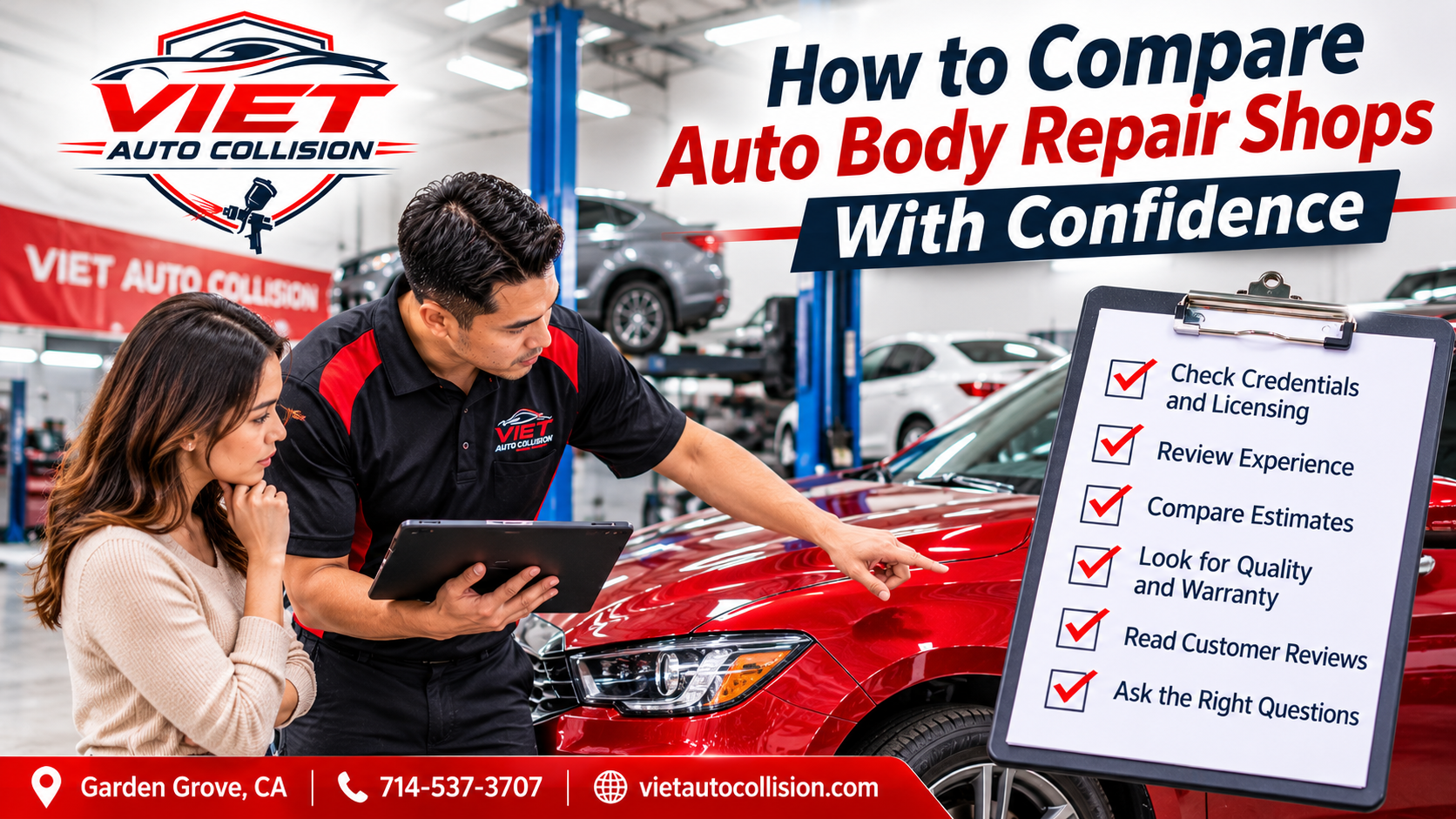
After a car accident, choosing an auto body repair shop can feel like another difficult task added to an already stressful situation. Drivers may have several facilities to consider, different repair estimates to review, and questions about insurance coverage, replacement parts, and the quality of the proposed work.
The challenge is that two repair shops can provide very different recommendations for the same visible damage. One estimate might include replacing a body panel, while another proposes repairing it. A third facility may identify additional inspection requirements that were not included in the initial assessment.
For California drivers, comparing repair shops should involve more than looking at online ratings or choosing the lowest price. A good decision requires checking business registration, evaluating collision repair experience, understanding estimates, reviewing warranty terms, and assessing how clearly the shop communicates.
Taking time to compare these factors helps vehicle owners understand what they are paying for and whether a repair facility is suitable for their vehicle's particular needs.
1. Start by Checking the Shop's California Registration
Before evaluating prices or discussing repair procedures, verify that the auto body shop is properly registered to perform automotive repairs in California.
The California Bureau of Automotive Repair (BAR) regulates automotive repair dealers and maintains information that consumers can use to verify repair businesses.
Checking registration is an important first step because California's automotive repair requirements provide protections involving estimates, customer authorization, additional repairs, and final invoices.
What should you verify?
Look for the following information:
-
The business's registered name.
-
Its BAR registration or license status.
-
The address associated with the business.
-
Whether disciplinary information is available.
-
Whether its business identity matches the facility you intend to visit.
A shop's registration does not automatically guarantee excellent workmanship. However, verifying its regulatory status helps establish whether the business operates within California's automotive repair framework.
The California BAR provides an official Maintenance and Repairs consumer guide explaining how to find a licensed repair facility, check registration, understand estimates, and exercise consumer rights.
This resource also explains the importance of keeping repair records and understanding the authorization process.
A useful approach is to complete this verification before arranging a vehicle drop-off or signing any repair paperwork.
2. Compare the Shop's Experience With Your Type of Vehicle Damage
Not every collision repair facility specializes in the same types of work.
Some shops handle straightforward cosmetic repairs, such as minor dents, scratches, and bumper damage. Others have experience with structural repairs, frame measurements, major collision damage, and more complicated vehicle systems.
The right choice depends partly on the condition of your car.
For example, a small parking-lot collision might require repairing a door and refinishing the affected area. A stronger impact involving the same door could also require inspection of internal reinforcements, hinges, mounting locations, and nearby electrical components.
A shop that understands the relevant repair requirements should be able to explain what needs to be inspected before providing a complete repair recommendation.
Ask questions about relevant experience
Rather than asking only how long the business has been operating, ask whether its technicians regularly work on vehicles similar to yours.
Useful questions include:
-
Have you repaired my vehicle's make and model before?
-
Do you handle both cosmetic and structural collision damage?
-
Can you inspect components hidden behind exterior panels?
-
Do you perform frame measurements when necessary?
-
How do you approach repairs involving modern electronic systems?
These questions can help distinguish general automotive experience from experience directly related to collision repair.
A facility should also be willing to explain when a particular repair requires specialist knowledge, additional equipment, or an outside service provider.
3. Evaluate Technician Training and Repair Qualifications
The people performing the repairs have a direct influence on the work being completed.
Collision repair can involve several specialized operations, including welding, structural measurements, panel replacement, paint refinishing, mechanical inspection, and electronic diagnostics.
These tasks do not necessarily require identical skills or training.
Before selecting a shop, ask what qualifications and training are relevant to the proposed work.
For example, a vehicle with structural damage may require technicians familiar with measuring systems and manufacturer-specific repair procedures. A vehicle with damaged aluminum components may require different equipment and repair considerations from one constructed primarily with conventional steel.
Look for training that matches the work
Depending on your vehicle's damage, relevant training may include:
-
Collision damage assessment.
-
Structural repair and frame measurement.
-
Welding and panel replacement.
-
Automotive paint preparation and refinishing.
-
Aluminum and high-strength steel repair procedures.
-
Electronic diagnostic procedures.
-
ADAS inspection and calibration requirements.
Ask whether the shop can explain the qualifications of the technicians responsible for your vehicle.
Also find out whether the facility uses manufacturer repair information when deciding how damaged components should be repaired or replaced.
Do not assume that a general certification automatically proves expertise in every type of repair. The relevant question is whether the technician's experience matches the specific work your vehicle needs.
4. Examine the Shop's Equipment and Inspection Capabilities
A professional-looking workshop can create a positive first impression, but its actual repair capabilities deserve closer consideration.
Modern collision repair often requires more than conventional hand tools. Depending on the vehicle and accident, technicians may need structural measuring systems, diagnostic scanners, specialized welding equipment, and suitable paint refinishing facilities.
Ask the shop how it identifies hidden damage and determines which repair procedures are necessary.
Important equipment considerations
Structural measuring systems: These help technicians assess relevant vehicle dimensions and identify structural movement when an impact affects structural areas.Diagnostic scanners: These tools can help identify electronic faults stored by vehicle control modules.
Paint preparation and refinishing equipment: Appropriate facilities support surface preparation, paint application, and refinishing work.Specialized repair tools: Certain vehicle materials and components require specific equipment and procedures.ADAS-related equipment: Vehicles with cameras, radar sensors, or other driver assistance features may require inspection or calibration after certain repairs.
Not every vehicle requires all these tools or procedures. Their relevance depends on the particular damage and vehicle construction.A useful question is: "How will you determine which equipment and inspection procedures my vehicle actually needs?"
The answer should demonstrate an understanding of the proposed repair rather than simply listing workshop equipment.
5. Compare Written Estimates Instead of Looking Only at the Final Price
One of the biggest mistakes drivers make when comparing auto body repair shops is choosing a facility solely because it provides the lowest estimate.
An inexpensive quotation may initially appear attractive, but it does not necessarily include the same repair operations, parts, or inspection requirements as a more detailed estimate.
A proper comparison should examine what each facility intends to do.
What should a collision repair estimate explain?
Depending on the damage, a written estimate should identify:
-
Parts that need repair or replacement.
-
Expected labor operations and charges.
-
Paint preparation and refinishing work.
-
Structural or mechanical repair operations.
-
Relevant diagnostic procedures.
-
Applicable additional charges.
For example, two shops may estimate the repair of a damaged front fender.
One might recommend repairing the existing panel, while another recommends replacement because of the nature or location of the damage.
The difference deserves an explanation before choosing either option.
Ask each estimator to describe why the proposed repair method is appropriate and whether any additional damage might become visible during disassembly.
Understand preliminary estimates
An initial estimate is not always a complete picture of collision damage.Some components cannot be inspected properly until damaged exterior panels are removed.
If technicians discover additional problems, the repair plan and cost may change.In California, customers must be informed about additional work and must authorize the additional repairs before they proceed.
Keep copies of the original estimate and any revisions. This documentation makes it easier to understand why the proposed work changed.
6. Understand Which Replacement Parts the Shop Plans to Use
Replacement parts are another important factor when comparing collision repair estimates.
A repair facility may propose original equipment manufacturer (OEM), aftermarket, used, reconditioned, or rebuilt components depending on availability, vehicle requirements, and other relevant considerations.
These categories should not be treated as interchangeable without understanding their differences.
OEM parts are produced by or for the vehicle's original manufacturer.
Aftermarket parts are produced by manufacturers other than the vehicle's original manufacturer.
Used parts have previously been installed or used on another vehicle.
Reconditioned or rebuilt parts have undergone restoration or rebuilding.
Ask the shop to identify which parts are included in the estimate and why those components are being recommended.
You should also understand whether the insurance estimate specifies particular replacement parts and whether alternative options require further discussion or approval.
Compare parts information carefully
Consider their expected fit, quality, safety, compatibility, and availability.
California's consumer guidance explains that aftermarket parts used in repairs must be comparable to OEM parts in terms of kind, quality, safety, fit, and performance.
It also states that the repair invoice must identify the type of replacement parts used.
Do not assume that one parts category is automatically appropriate for every repair. The decision should consider the vehicle, component, and applicable requirements.
7. Understand Your Insurance Rights Before Selecting a Shop
Insurance companies sometimes provide lists of recommended repair facilities or suggest shops that participate in their repair networks.
These recommendations may be useful when comparing available providers, but drivers should understand that they do not eliminate the right to select another facility.
Under California Insurance Code Section 758.5, an insurer cannot require a vehicle to be repaired at one specific automotive repair facility.
The California Department of Insurance explains this protection in its official guide, So You've Had an Accident, What's Next?.
The guidance also explains conditions surrounding insurer recommendations and the handling of reasonable repair costs.
Questions to ask your insurance representative
Before choosing a facility, clarify:
-
What collision coverage applies to your claim?
-
What deductible are you responsible for?
-
Is towing covered under your policy?
-
Does your policy include rental transportation?
-
How will additional damage be reviewed?
-
What documentation does the insurer need?
Do not assume that every recommended repair or additional expense will automatically be covered.
Your actual coverage depends on the policy and circumstances of the claim.
It is also useful to understand whether the repair facility communicates directly with insurers or expects customers to handle most of the claim discussions themselves.
A clear process can make the experience easier to manage, particularly when an estimate changes after disassembly.
8. Research Customer Reviews and Local Reputation
Online reviews can help drivers understand how a repair facility interacts with its customers.
However, the overall star rating should not be the only factor in your decision.
Read individual reviews and look for consistent information about the customer experience.
Pay particular attention to comments about:
-
Whether estimates were clearly explained.
-
How frequently customers received updates.
-
How the shop handled repair delays.
-
Whether final invoices matched authorized work.
-
How the business responded to repair concerns.
-
Whether customers felt their questions were taken seriously.
One review cannot establish the quality of an entire business. Likewise, a large collection of positive reviews does not guarantee that every vehicle will receive the same experience.
Look for patterns across different customers and consider whether the feedback relates to services similar to the repairs you need.
You can also ask friends, family members, and colleagues whether they have experience with a particular facility.
Personal recommendations are more useful when they include details about the vehicle, type of repair, communication, and overall experience.
9. Review Warranty Coverage and Repair Policies
A repair facility's warranty is another important factor when comparing estimates and services.
Some shops provide workmanship warranties covering defects in the repairs they perform. However, coverage varies, and customers should understand the written terms before authorizing the work.
A workmanship warranty may differ from a manufacturer's warranty on a replacement component.
Before choosing a shop, ask:
-
What repairs are covered?
-
How long does the coverage last?
-
Does it cover defects in workmanship?
-
Are replacement parts covered separately?
-
What exclusions apply?
-
What happens if a concern develops after pickup?
Also clarify whether the warranty has ownership-related conditions or requires certain procedures when reporting a concern.
For example, a shop might advertise a lifetime workmanship warranty for qualifying repairs while the actual coverage applies only under specific terms.
Read the full policy rather than relying on a headline or verbal assurance.
You should also compare other repair policies, including estimates, inspection charges, storage fees, and procedures for authorizing additional work.
10. Evaluate Customer Communication Before Leaving Your Vehicle
Communication can strongly influence the repair experience.
Even a well-equipped repair facility may become difficult to work with if customers cannot obtain clear answers about their vehicles.
Collision repair can involve several stages, including inspection, disassembly, parts ordering, insurance coordination, repair work, refinishing, and quality checks.
Before choosing the facility, ask how updates will be delivered and who will be responsible for answering your questions.
Establish expectations about:
-
The main customer contact.
-
How often progress updates will be provided.
-
How changes in the repair schedule will be communicated.
-
How additional damage will be explained.
-
How revised estimates will be approved.
-
When the final inspection and vehicle handover will occur.
A professional estimator should be able to explain technical findings in understandable language.
You should not feel pressured to authorize work before you understand the proposed operations and costs.
11. Compare the Entire Repair Experience, Not Just One Factor
Once you have gathered information from multiple facilities, evaluate the options together.
A comparison table can help organize the details.
|
Evaluation factor |
What to look for |
|
Business registration |
Current BAR registration |
|
Repair experience |
Experience with similar damage and vehicles |
|
Technician qualifications |
Training relevant to required repairs |
|
Equipment |
Appropriate tools and inspection capabilities |
|
Written estimate |
Clear parts, labor, and repair operations |
|
Parts selection |
Identified parts and suitable repair options |
|
Insurance assistance |
Clear communication about claim coordination |
|
Warranty |
Written coverage and conditions |
|
Customer reviews |
Consistent feedback about service and repairs |
|
Communication |
Clear updates and explanations |
The most suitable shop is not necessarily the one with the highest rating or lowest quotation.
Instead, consider which facility provides the strongest overall combination of appropriate repair capabilities, transparent pricing, clear documentation, and customer communication.
A shop that identifies additional damage and explains the reasoning may provide a more useful assessment than one that simply promises a fast, inexpensive repair.
Conclusion:
Comparing auto body repair shops in California requires more than reviewing prices and online ratings.Drivers should verify business registration, evaluate relevant technician experience, understand the equipment available, compare written estimates, review replacement parts, and examine insurance and warranty arrangements.
Communication is equally important. A repair facility should be willing to explain its findings, document changes, and answer questions before and during the repair process.
By evaluating these factors together, vehicle owners can make decisions based on information rather than pressure or convenience.The goal is to select a shop that understands the vehicle's actual repair requirements, provides transparent documentation, and makes it possible for customers to remain informed throughout the process.

 English
 French
 Spanish
 Portuguese
 Deutsch
 Turkish
 Dutch
 Italiano
 Russian
 Romaian
 Portuguese (Brazil)
 Greek
