


What Validation Tests Are Performed During Modular IVF Lab Setup Services?
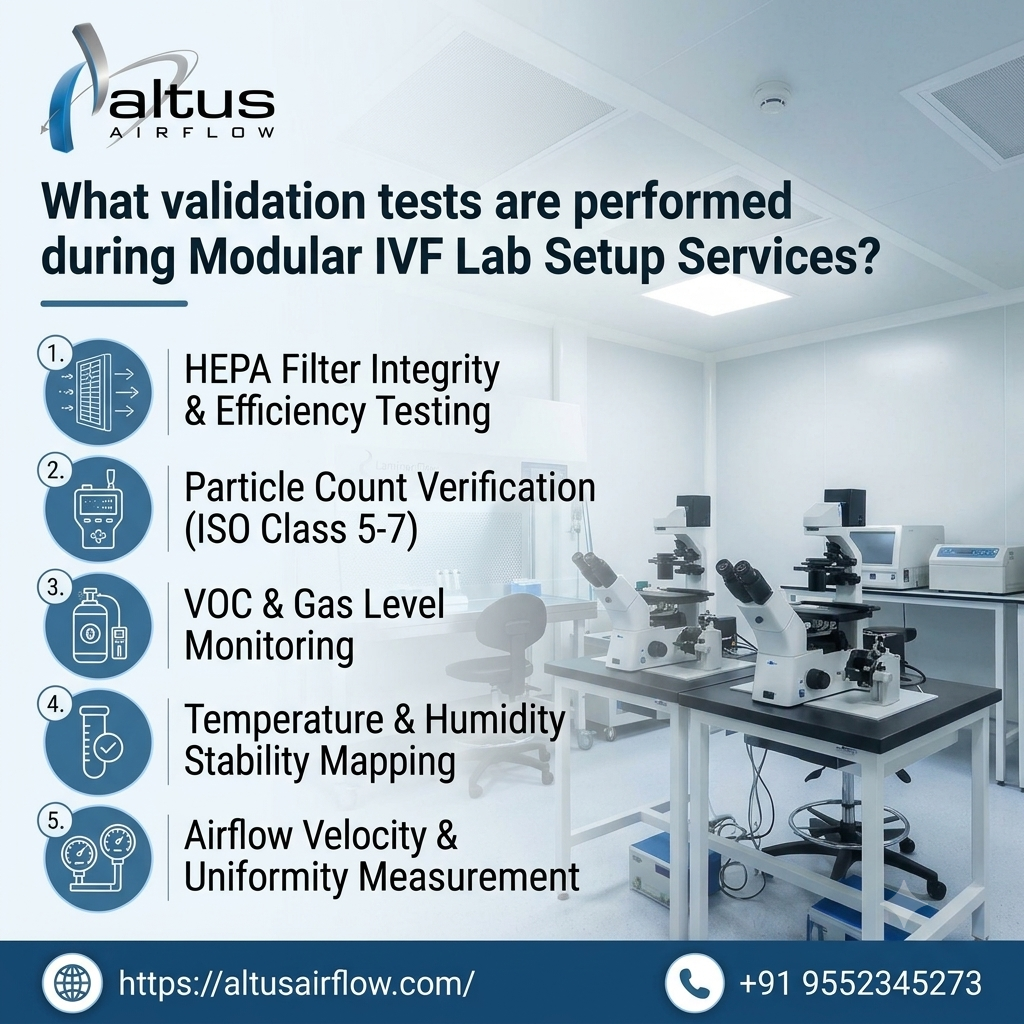
Introduction
Altus Airflow understands that an IVF laboratory requires carefully planned infrastructure, controlled environmental conditions, and reliable equipment to support sensitive embryology procedures. Modular IVF Lab Setup Services involve more than installing modular walls, ceilings, and laboratory workstations; they also require systematic testing to verify that the completed facility meets its approved engineering and operational specifications. Validation activities may cover HVAC performance, air quality, temperature, humidity, pressure differentials, electrical safety, lighting, equipment functionality, and monitoring systems. These checks help identify installation issues, confirm system performance, and prepare the laboratory for its intended use.
1. Understanding Validation Testing in an IVF Laboratory
Validation testing is a structured process used to establish whether laboratory infrastructure, equipment, and environmental control systems perform according to predefined requirements.
An IVF laboratory contains specialised areas for procedures such as oocyte handling, fertilisation, embryo culture, and cryopreservation. Each area may have different equipment and environmental requirements. Therefore, testing must be planned according to the laboratory layout, intended activities, equipment specifications, and applicable standards.
Validation and commissioning activities may include:
-
Reviewing approved engineering drawings.
-
Inspecting modular walls, ceilings, and flooring.
-
Testing HVAC and filtration systems.
-
Measuring temperature and humidity.
-
Checking room pressure relationships.
-
Verifying electrical safety.
-
Testing laboratory equipment.
-
Checking monitoring and alarm systems.
-
Preparing test reports and corrective-action records.
The exact tests depend on the project scope. Engineering commissioning, equipment qualification, and clinical laboratory process validation are related but distinct activities and may involve different specialists.
2. HVAC Performance and Airflow Testing
The HVAC system is one of the most important infrastructure components in an IVF laboratory. It is designed to maintain the environmental conditions specified for different laboratory areas.
HVAC validation checks whether the installed system operates according to the approved design. Common tests include:
Airflow measurement: Measures air movement at selected supply and return points to verify that the distribution matches the design.
Air balancing: Checks whether the airflow volume supplied to different rooms is appropriate for the specified system requirements.
Air changes assessment: Verifies the air-change performance where this parameter is included in the design criteria.
Ductwork inspection: Checks duct connections, insulation, leakage concerns, and installation quality.
Ventilation performance: Confirms that the system provides the intended ventilation under defined operating conditions.
These checks should be conducted using suitable calibrated instruments. The results are compared with project-specific acceptance criteria rather than applying one universal airflow requirement to every IVF laboratory.
3. HEPA Filtration and Air Quality Testing
Air filtration is an important consideration in IVF laboratory design because airborne particles and contaminants need to be managed according to the laboratory's environmental requirements.
Where HEPA filtration is specified, testing may include:
-
Verifying the installed filter type and specification.
-
Inspecting filter housing and sealing arrangements.
-
Checking for visible installation defects.
-
Performing filter integrity or leakage testing where required.
-
Reviewing differential pressure across filters.
-
Confirming that airflow is distributed as designed.
An appropriate aerosol-based integrity test may be used by qualified personnel to identify leakage through the filter media, seals, or housing. The testing method and acceptance criteria should follow the selected filter standard and project specifications.
Particle counting may also be performed at designated locations to assess airborne particle concentrations. Results should be interpreted against the laboratory's specified cleanliness classification and applicable requirements.
It is important to understand that HEPA filtration alone does not establish complete air quality. Other factors, including ventilation, cleaning practices, room materials, occupancy, and contaminant sources, also influence the laboratory environment.
4. Temperature Mapping and Stability Testing
Temperature control is particularly important in IVF laboratories because certain procedures and instruments require defined operating conditions.
Temperature validation helps establish whether the laboratory maintains the required range across different locations and operating conditions.
Testing may include:
Room temperature measurement: Records temperature at selected points throughout the laboratory.
Temperature mapping: Uses multiple calibrated sensors to identify variations between locations.
Stability assessment: Monitors temperature over a defined period to identify fluctuations.
Sensor verification: Compares installed sensor readings with suitable reference instruments.
Alarm testing: Checks whether monitoring systems generate alerts when configured limits are exceeded.
Separate checks may also be required for incubators, refrigerators, and other temperature-controlled equipment. Their operating requirements should be taken from manufacturer documentation and laboratory procedures.
5. Humidity and Moisture Control Testing
Humidity conditions can influence equipment operation, room comfort, and the performance of certain laboratory materials. Excessive moisture may also contribute to condensation or maintenance problems.
Humidity testing may include:
-
Measuring relative humidity at designated locations.
-
Comparing readings with approved operating limits.
-
Checking sensor accuracy.
-
Monitoring fluctuations over time.
-
Verifying alarm functionality.
-
Inspecting areas where condensation may occur.
The HVAC system should be evaluated under the operating conditions defined in the design. If humidity readings fall outside the specified range, possible causes such as cooling performance, outside-air conditions, infiltration, and sensor placement should be investigated.
6. Room Pressure Differential Testing
Some IVF laboratory layouts specify pressure relationships between different rooms to help manage airflow movement. These arrangements should be verified after the HVAC system is installed and balanced.
Pressure testing may involve:
-
Measuring differential pressure between designated rooms.
-
Checking pressure relationships with adjoining spaces.
-
Verifying airflow direction where specified.
-
Inspecting door seals and possible leakage paths.
-
Confirming monitoring and alarm settings where installed.
Testing should be performed with the doors and HVAC systems in defined operating conditions. Results must be compared with the approved pressure schedule.
Not every IVF laboratory requires the same pressure arrangement. The design should reflect the laboratory's intended use, risk assessment, and applicable technical requirements.
7. Volatile Organic Compound and Chemical Contaminant Assessment
IVF laboratories may need to consider volatile organic compounds (VOCs) and other chemical contaminants because certain substances can be relevant to sensitive laboratory procedures.
Potential sources include construction materials, adhesives, paints, cleaning products, furnishings, and equipment. The selection of low-emission materials and suitable ventilation arrangements can help manage these risks.
Where required, testing may include:
-
VOC sampling at selected locations.
-
Assessment of relevant chemical contaminants.
-
Review of material and product documentation.
-
Inspection of cleaning and storage practices.
-
Verification of ventilation performance.
The sampling method, timing, laboratory conditions, and acceptance criteria should be defined in advance. Specialist laboratories may be required to perform chemical analysis and interpret the results.
8. Electrical Safety and Power Supply Testing
IVF laboratories use incubators, microscopes, micromanipulation systems, refrigerators, freezers, computers, and other sensitive instruments. These devices require electrical infrastructure that meets their specifications.
Electrical validation may include:
-
Inspecting distribution boards and circuits.
-
Checking earthing arrangements.
-
Testing protective devices.
-
Verifying outlet locations and power capacity.
-
Checking dedicated circuits where required.
-
Testing backup power arrangements.
-
Reviewing emergency power provisions.
-
Inspecting cable management.
Critical equipment may require uninterrupted power arrangements based on its operational needs. Backup systems should be tested according to the approved design and relevant safety requirements.
All electrical testing should be performed by qualified professionals using suitable instruments and procedures.
9. Laboratory Equipment Installation and Qualification
Infrastructure testing must be supported by equipment installation checks. Each instrument should be installed in the correct location and operated according to manufacturer specifications.
Equipment qualification is commonly organised into three stages:
Installation Qualification (IQ): Confirms that equipment has been delivered, installed, connected, and documented according to the manufacturer's requirements.
Operational Qualification (OQ): Verifies that the equipment operates correctly across its specified functions.
Performance Qualification (PQ): Evaluates whether the equipment consistently performs as required under defined operating conditions and intended use.
Depending on the laboratory's equipment list, qualification activities may involve:
-
Incubators.
-
Microscopes.
-
Micromanipulation systems.
-
Cryopreservation equipment.
-
Refrigerators and freezers.
-
Centrifuges.
-
Laboratory monitoring devices.
For example, incubator qualification may involve temperature, gas concentration, alarm, and recovery checks according to the equipment specification. Cryogenic storage systems may require appropriate temperature monitoring and alarm verification.
10. Lighting and Laboratory Workstation Inspection
Lighting should support the laboratory's activities while meeting the requirements of the approved design. Inspection may include measuring illumination at workstations and checking the operation of installed lighting controls.
Other checks may include:
-
Confirming suitable task lighting.
-
Inspecting light fittings and their installation.
-
Checking emergency lighting where required.
-
Reviewing workstation dimensions.
-
Inspecting worktop finishes.
-
Confirming that equipment can be accessed safely.
-
Checking that surfaces are suitable for the specified cleaning procedures.
The inspection should also verify that workstations, equipment, and service connections match the approved laboratory layout.
11. Monitoring Systems and Alarm Validation
Environmental monitoring systems help laboratory personnel track conditions and identify deviations. Depending on the design, monitoring may cover temperature, humidity, pressure, equipment status, and other relevant parameters.
Validation checks may include:
Sensor accuracy: Comparing readings with calibrated reference devices.
Data logging: Confirming that measurements are recorded and can be retrieved.
Alarm functionality: Testing whether alerts activate at the configured limits.
Communication checks: Verifying data transmission between sensors and monitoring platforms.
Power failure response: Checking the behaviour of monitoring and alarm systems during a power interruption, where specified.
The laboratory should also establish procedures for responding to alarms, documenting deviations, and escalating technical problems.
12. Documentation and Final Validation Reports
Documentation is essential because it provides evidence that the planned tests have been performed and that the results have been reviewed.
Depending on the project scope, the final documentation package may contain:
-
Approved laboratory layout drawings.
-
HVAC testing and balancing reports.
-
HEPA filter integrity test reports, where applicable.
-
Particle count reports.
-
Temperature and humidity mapping records.
-
Pressure differential test results.
-
Electrical safety inspection reports.
-
Equipment IQ, OQ, and PQ documents, where applicable.
-
Calibration certificates.
-
Monitoring and alarm test records.
-
Inspection reports and corrective-action records.
-
Operation and maintenance manuals.
Each report should identify the test method, equipment used, acceptance criteria, measured results, date, and responsible personnel. Any failed result should be documented along with corrective actions and retesting evidence.
13. Planning Validation Before Laboratory Handover
Validation should be considered during the design and installation stages rather than treated as a last-minute activity. Early planning helps ensure that the required test points, access arrangements, sensors, and technical documentation are available.
A practical validation plan should:
-
Identify the laboratory's intended activities.
-
Define applicable technical and regulatory requirements.
-
Establish acceptance criteria for each system.
-
Assign testing responsibilities.
-
Confirm the availability of calibrated instruments.
-
Coordinate equipment suppliers and specialist contractors.
-
Schedule testing after installation and balancing.
-
Allow time for corrective actions and retesting.
-
Review and approve final documentation.
Modular IVF Lab Setup Services are more effective when testing requirements are integrated into the project schedule from the beginning. This reduces the risk of missing essential checks and helps make the handover process more organised.
Conclusion
Validation testing helps establish whether an IVF laboratory's infrastructure, environmental control systems, and equipment meet their approved specifications. Important checks may include HVAC performance, HEPA filter integrity, particle levels, temperature mapping, humidity, pressure differentials, VOC assessment, electrical safety, equipment qualification, and monitoring system functionality. The required tests depend on the facility's design, intended use, applicable standards, and agreed project scope.
Modular IVF Lab Setup Services can coordinate infrastructure installation and commissioning activities as part of a structured laboratory development process. Altus Airflow focuses on modular healthcare infrastructure and laboratory engineering, helping facilities plan technical requirements and essential testing activities. With clear acceptance criteria, qualified testing professionals, and complete documentation, Altus Airflow supports a systematic approach to IVF laboratory readiness.
Frequently Asked Questions (FAQs)
1. What validation tests are included in Modular IVF Lab Setup Services?
Modular IVF Lab Setup Services may include HVAC testing, HEPA filter integrity checks, particle counting, temperature mapping, humidity measurement, pressure testing, electrical checks, and equipment qualification, depending on the project scope.
2. Why is HEPA filter testing important in an IVF laboratory?
It helps verify that installed filters and their housings meet the specified filtration integrity requirements.
3. Is temperature mapping necessary for IVF laboratories?
Temperature mapping helps identify variations across the laboratory and verifies environmental stability against specified limits.
4. What is the purpose of pressure differential testing?
It verifies room pressure relationships and airflow direction where these are included in the laboratory design.
5. Are VOC tests performed during IVF laboratory setup?
VOC testing may be included when required by the laboratory's risk assessment, design specifications, or applicable guidelines.
Read Our Previous Blog --------------->How does a Modular IVF Lab Turnkey Project Company ensure timely project completion?

 English
 Arabic
 French
 Spanish
 Portuguese
 Deutsch
 Turkish
 Dutch
 Italiano
 Russian
 Romaian
 Portuguese (Brazil)
