


Microprinting Market to Reach USD 1.64 Billion by 2036 as European Authentication Requirements Support Demand
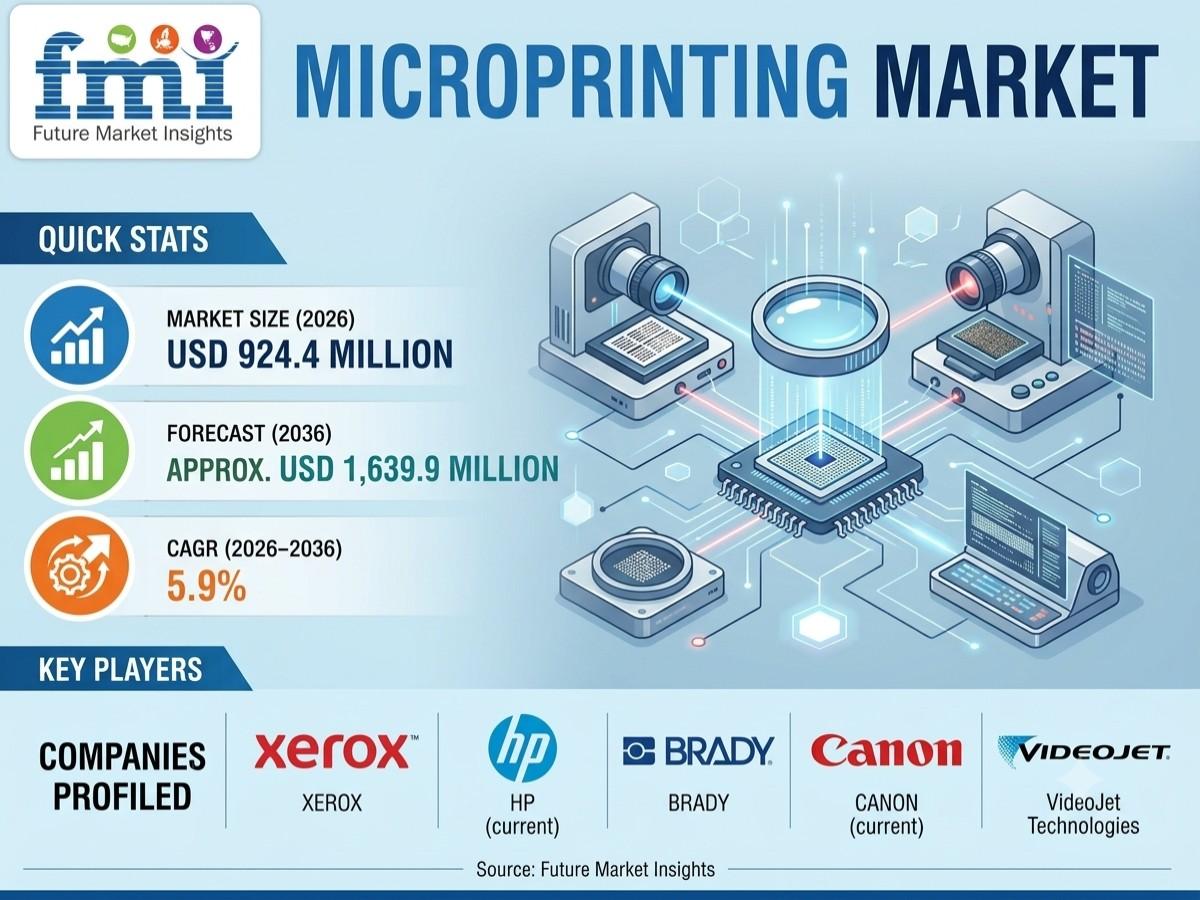
NEWARK, Del. — The global Microprinting Market is projected to increase from USD 924.4 million in 2026 to approximately USD 1,639.9 million by 2036, registering a compound annual growth rate (CAGR) of 5.9% during the forecast period, according to Future Market Insights (FMI). Microprinting involves reproducing very small text, lines, or other fine details within a printed design. These features can support product and document authentication when examined under suitable conditions.
Microprinting is used in applications such as currency, stamps, bank checks, labels, identity and payment cards, and other documents. Its effectiveness depends on the ability to reproduce fine details consistently on the selected material. As organizations seek reliable ways to identify and authenticate printed items, production quality and compatibility with other security features remain important considerations.
Access the Sample Report — Explore Key Insights Today!
https://www.futuremarketinsights.com/reports/sample/rep-gb-16608
Microprinting Market: Key Findings
- Market size in 2026: USD 924.4 million
- Projected market size by 2036: USD 1,639.9 million
- Forecast CAGR, 2026–2036: 5.9%
- Leading type segment: Monochrome, with a 54.0% share in 2026
- Leading print type: Single-sided, with a 57.0% share in 2026
- Companies profiled: Xerox, HP, Brady, Canon, and Videojet Technologies
Authentication Requirements Support Market Demand
Microprinting contributes to security designs by incorporating small printed details that can be examined more closely. Currency provides an established example. Official resources from the US Currency Education Program, European Central Bank, and Reserve Bank of India describe microprinting or micro-lettering as one feature used alongside other banknote security measures.
Its role extends beyond currency. Documents, identification cards, payment cards, labels, and bank checks may also require printed features that support identification or authentication. These applications have different substrates, production conditions, and inspection requirements.
The quality of reproduction is a key factor in purchasing decisions. If fine lines or letters become blurred during printing or handling, the feature may become harder to examine. Suppliers therefore need to consider artwork, printing methods, material behavior, and inspection conditions together.
Monochrome Leads the Type Segment
FMI estimates that the monochrome segment will account for 54.0% of the Microprinting Market by type in 2026. Monochrome output is relevant when a design relies on the clarity of fine lines and lettering rather than multiple colors.
Color printing continues to serve applications that require more complex visual designs. However, the selection of a printing type depends on the intended use of the finished item and the role assigned to the microprinted feature.
For buyers, the priority is to ensure that the chosen output can reproduce the required detail consistently on the relevant substrate. Microprinting is generally one element within a wider security design, rather than a standalone authentication system.
Single-Sided Printing Holds the Larger Print-Type Share
The single-sided segment is projected to represent 57.0% of print-type demand in 2026, compared with 43.0% for double-sided printing, according to FMI.
Single-sided production places the required fine detail on one face of the printed item. This can help align the artwork, printing process, and inspection method around a specific surface. Double-sided production remains relevant where the design requires printed information or security details on both faces.
The choice between these formats depends on document specifications, substrate handling, and the intended examination process. Consistent reproduction remains important regardless of the selected print type.
Regional Outlook: India and China Offer Growth Opportunities
FMI's country-level forecasts identify different growth rates across major markets for 2026–2036:
- India: Projected to grow at a 7.4% CAGR, the fastest among the five profiled countries.
- Germany: Expected to record a 6.8% CAGR.
- France: Forecast to expand at a 6.2% CAGR.
- United Kingdom: Projected to grow at a 5.6% CAGR.
- United States: Expected to register a 5.0% CAGR.
India's established use of micro-lettering in banknotes provides a documented example of fine-detail security printing. Germany and France operate within the euro banknote security framework, while the United States and United Kingdom also have official banknote examples of microprinting.
These examples demonstrate established applications; they should not be interpreted as evidence that currency is the only source of demand in these markets. Commercial documents, labels, and identification products also have distinct printing requirements.
Competitive Landscape: Top Companies in the Microprinting Market
FMI identifies Xerox, HP, Brady, Canon, and Videojet Technologies among the companies profiled in the Microprinting Market.
Xerox and HP are associated with digital and commercial printing systems. Brady focuses on industrial identification and labeling, while Canon supplies document and commercial printing technology. Videojet Technologies provides coding and marking systems used in production environments.
The competitive landscape spans different printing and identification requirements. Buyers may assess suppliers based on their ability to reproduce fine detail, support the intended substrate, and meet production and inspection specifications. These companies are presented as report-identified participants, not as a ranking by market share.
Outlook for the Microprinting Market
The Microprinting Market is expected to benefit from continued requirements for authentication across currency, documents, cards, and commercial labels. However, its effectiveness depends on more than the design of a fine printed feature. Production consistency, material selection, and practical inspection methods all influence the result.
Suppliers that can align printing capabilities with application-specific requirements may be better positioned to serve customers seeking dependable security and identification features. As buyers evaluate printed products, the ability to integrate microprinting with other authentication measures will remain an important consideration.
For detailed market forecasts, segment analysis, country-level insights, and competitive coverage, visit the Future Market Insights Microprinting Market report: https://www.futuremarketinsights.com/reports/microprinting-market
Explore More Related Reports -
Smart Mining Technologies Market - https://www.futuremarketinsights.com/reports/smart-mining-technologies-market
Master Recharge API Market - https://www.futuremarketinsights.com/reports/master-recharge-api-market
Community Engagement Platform Market - https://www.futuremarketinsights.com/reports/community-engagement-platform-market

 Arabic
 French
 Spanish
 Portuguese
 Deutsch
 Turkish
 Dutch
 Italiano
 Russian
 Romaian
 Portuguese (Brazil)
 Greek
