


Naphthenic Base Oil Market to Reach USD 4.37 Billion by 2036; France Posts 3.4% CAGR
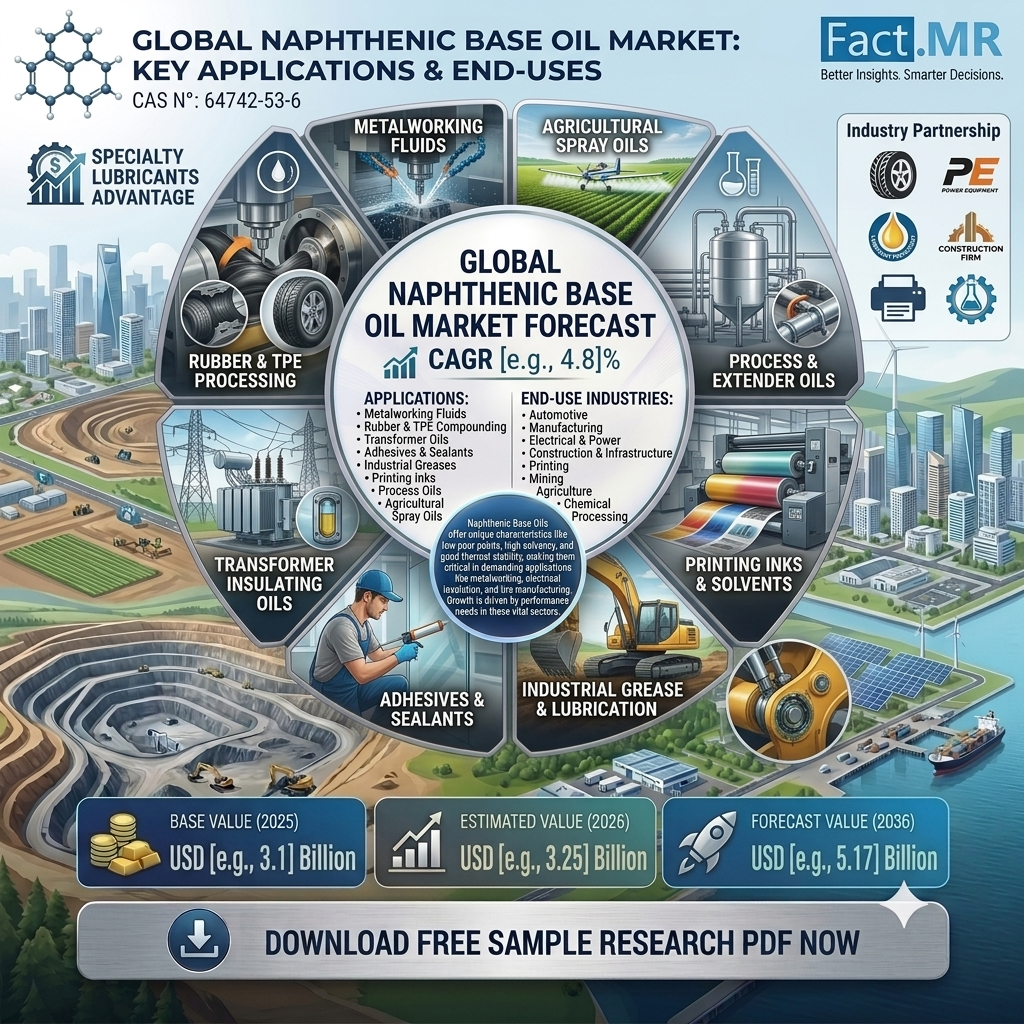
The naphthenic base oil market is forecast to expand from USD 2.98 billion in 2026 to USD 4.37 billion by 2036, registering a 3.9% CAGR over the forecast period. Fact.MR attributes this expansion to increasing demand for transformer insulating oils, growing consumption of process oils in tyre and rubber manufacturing, and the requirement for high-performance lubricants across industrial applications. The market was valued at USD 2.87 billion in 2025, with an absolute dollar opportunity of approximately USD 1.39 billion expected between 2026 and 2036.
Electrical grid modernization and industrial manufacturing are creating greater requirements for naphthenic base oils with strong solvency, low-temperature fluidity, and dependable thermal performance. Utilities are increasingly using specialized insulating fluids in transformer installations and refurbishment projects. Rubber manufacturers also depend on naphthenic process oils to improve compound processing while meeting restrictions on polycyclic aromatic hydrocarbons. However, limited availability of suitable naphthenic crude grades and refinery production constraints continue to influence procurement strategies and supply reliability.
Get detailed market forecasts, competitive benchmarking, and pricing trends:
https://www.factmr.com/connectus/sample?flag=S&rep_id=7321
Process Oils Maintain Leading Application Share
By application, process oils are expected to account for 46.0% of the naphthenic base oil market in 2026. Their leading position is supported by extensive use in tyre manufacturing, rubber compounding, and industrial processing applications. Naphthenic oils provide solvency and compatibility with additives, making them suitable for formulations that require consistent processing characteristics and material performance.
The 80–130 SUS viscosity category is projected to capture 27.0% of market demand in 2026. Its position reflects the requirement for specialized base oil grades across industrial applications. Meanwhile, the 400–800 SUS category is expected to expand at a 3.8% CAGR through 2036, supported by demand for heavy-duty lubricants, industrial greases, and process oils used in demanding operating environments.
Electrical oils represent another important application, projected to grow at a 3.7% CAGR during the forecast period. These oils are used in transformers, circuit breakers, and related electrical equipment because of their dielectric properties, thermal stability, and low pour points. Increasing investment in electricity transmission infrastructure and renewable energy integration is supporting demand for insulating fluids capable of maintaining performance under varying temperatures and operating conditions.
China, Germany, and France Show Growth Opportunities
China is expected to record a 4.5% CAGR from 2026 to 2036, the highest rate among the countries listed in Fact.MR's summary comparison. The country's large automotive manufacturing base, industrial expansion, and infrastructure development are supporting demand for electrical oils, metalworking fluids, and process oils. Investments in refining technology and domestic production capacity are also aimed at improving supply availability and reducing import dependence.
Germany is projected to advance at a 4.0% CAGR during the same period, making it the fastest-growing European country in the report's listed country comparison. Its established automotive manufacturing industry, precision engineering capabilities, and industrial equipment production support demand for high-quality naphthenic oils. Electrical grid modernization and investment in industrial automation are also increasing requirements for insulating oils and specialized lubricants.
France is expected to register a 3.4% CAGR through 2036. Demand is supported by automotive, aerospace, and metalworking industries that require process oils and industrial lubricants. Modernization of electricity transmission and distribution networks is creating additional opportunities for electrical insulating oils. Environmental regulations and sustainability objectives are also encouraging development of cleaner and more efficient oil formulations.
The broader market includes South Korea, which is forecast to expand at a 4.2% CAGR, supported by automotive production, electronics manufacturing, and electrical equipment demand. The United States is expected to grow at 3.5%, while the United Kingdom is projected to register a 3.2% CAGR during the forecast period.
Competitive Landscape
Competition in the naphthenic base oil market includes established refining companies and specialty oil manufacturers with differentiated product portfolios and international distribution capabilities. Key companies profiled by Fact.MR include Calumet Specialty Products Partners L.P., Petrobras, Apar Industries Ltd., Ergon International Inc., and Shell Plc.
Fact.MR estimates Calumet Specialty Products Partners L.P. holds a 15–18% market share, followed by Shell Plc at 12–15%, Petrobras at 10–12%, Ergon International Inc. at 8–10%, and Apar Industries Ltd. at 7–9%. Competition is influenced by refining capacity, crude feedstock access, product purity, technical specifications, and supply reliability.
Industrial buyers increasingly evaluate suppliers based on consistent product quality, regulatory compliance, and long-term availability. Manufacturers with diversified crude sourcing arrangements, advanced refining capabilities, and established customer relationships are better positioned to address procurement requirements across transformer oil, rubber processing, and industrial lubricant applications.
Refining Technology and Regulatory Developments Shape the Market
The market is undergoing changes in refining technology and environmental compliance requirements. Fact.MR highlights growing investment in hydrotreating capabilities, higher-purity base oils, and low-aromatic formulations that meet increasingly demanding industrial specifications. Refiners are also working to improve feedstock flexibility as suitable naphthenic crude grades become less widely available.
Regulatory requirements surrounding polycyclic aromatic hydrocarbons and industrial oil performance are influencing formulation decisions. Manufacturers must balance product effectiveness with compliance requirements, particularly in rubber processing and specialty lubricant applications.
Supply continuity remains a significant consideration. Limited refinery capacity and changing crude quality can create allocation risks for manufacturers dependent on individual suppliers. Diversifying procurement across qualified refineries and maintaining appropriate inventory levels can help reduce production interruptions.
As electrical infrastructure investment and industrial demand continue through 2036, the naphthenic base oil market is expected to remain focused on product quality, refining efficiency, and dependable supply. Manufacturers capable of meeting specialized performance requirements while managing feedstock constraints will remain important participants in the global market.
Top Reports:
https://adamaamresearch.blogspot.com/2026/11/aircraft-weapons-market-targets-usd-305.html
https://net-pals.com/blogs/63442/Global-Aircraft-Weapons-Market-to-Achieve-USD-30-5-Billion
https://acmingle.com/blogs/34654/Aircraft-Weapons-Market-Expected-to-Hit-USD-30-5-Billion
https://ikofficial.com/blogs/62726/Aircraft-Weapons-Market-Expected-to-Reach-USD-30-5-Billion
About Fact.MR
Fact.MR is a market research and consulting company providing market intelligence, competitive analysis, and forecasting across global industries. Its research supports businesses with data-driven insights into emerging markets, technology trends, competitive dynamics, regional opportunities, and changing demand patterns.

 English
 Arabic
 Spanish
 Portuguese
 Deutsch
 Turkish
 Dutch
 Italiano
 Russian
 Romaian
 Portuguese (Brazil)
 Greek
