


Inside the USD 2.1 Billion Automated Breast Ultrasound System Market Opportunity
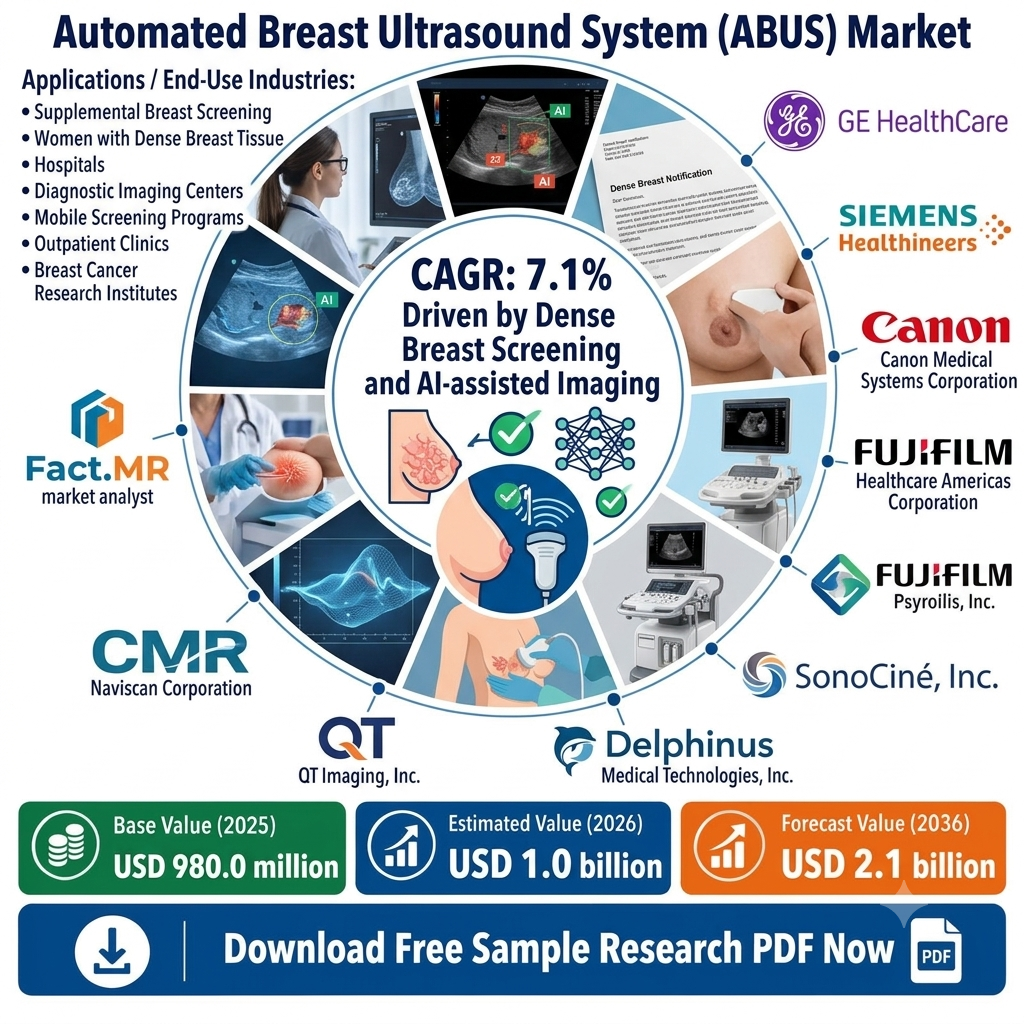
Global automated breast ultrasound system market is projected to grow at 7.1% CAGR through 2036, driven by dense breast screening requirements and AI-assisted imaging.
November 3, 2026 The global automated breast ultrasound system (ABUS) market is projected to reach USD 2.1 billion by 2036, increasing from USD 980.0 million in 2025 at a compound annual growth rate (CAGR) of 7.1%, according to Fact.MR. The market is estimated to reach USD 1.0 billion in 2026, creating an absolute dollar opportunity of approximately USD 1.0 billion between 2026 and 2036. Growing demand for supplemental breast cancer screening, particularly among women with dense breast tissue, is supporting procurement across hospitals and diagnostic imaging centers.
Automated breast ultrasound systems produce standardized, reproducible three-dimensional volumetric images of breast tissue for screening and diagnostic assessment. Unlike conventional handheld ultrasound, ABUS platforms automate probe positioning and scanning protocols, reducing operator dependency and improving examination consistency. Expanding dense breast notification requirements across multiple U.S. states and increasing clinical interest in supplemental ultrasound are creating new opportunities for equipment manufacturers.
Get detailed market forecasts, competitive benchmarking, and pricing trends: https://www.factmr.com/connectus/sample?flag=S&rep_id=585
Dense Breast Screening Requirements Support Automated Breast Ultrasound System Market Growth
Mammography remains an established breast cancer screening method. However, its sensitivity can be reduced in women with dense breast tissue, creating demand for complementary imaging technologies. Automated breast ultrasound systems address this requirement by providing additional breast tissue visualization alongside mammography.
Legislative developments are supporting adoption in the United States. Dense breast notification legislation across more than 35 states is encouraging discussions about supplemental screening options. FDA approval of ABUS for use as an adjunct to mammography also provides a regulatory foundation for clinical adoption.
Emerging markets are contributing to demand. Rising participation in breast cancer screening programs is increasing the need for standardized imaging equipment, particularly in healthcare facilities seeking consistent examination protocols.
AI integration is changing the interpretation workflow. Deep learning-based computer-aided detection algorithms can identify regions of interest within three-dimensional ABUS datasets and highlight suspicious areas for radiologist review. According to the Fact.MR analysis, this technology can reduce interpretation time from several minutes to under one minute for normal studies.
Automated Breast Ultrasound Systems Account for 42.1% of Product Share
Automated Breast Ultrasound Systems are expected to account for 42.1% of the product segment in 2026. Their established installed base and continued procurement across hospitals and diagnostic imaging centers support this position. The category includes 3D automated systems, portable automated systems, and stationary automated systems.
Hardware is projected to represent 37.5% of the component segment in 2026. Ultrasound scanners, transducers, probes, displays, and workstations form the primary hardware categories. Software demand is also developing around image processing and AI-assisted diagnosis applications.
Within the technology segment, 3D ultrasound imaging is expected to hold a 39.8% share in 2026. Volumetric imaging systems and real-time 3D reconstruction support standardized image acquisition, allowing imaging professionals to compare examinations across screening visits.
United States and Mexico Lead Country-Level Growth Outlook
The United States is projected to register a CAGR of 7.8% through 2036, making it the fastest-growing country market covered in the Fact.MR forecast. Dense breast notification legislation, supplemental screening demand, and established reimbursement pathways support market development.
Mexico follows with a projected CAGR of 7.4%. Expansion of breast cancer screening infrastructure, awareness programs, and private imaging center adoption are contributing to demand.
Germany is forecast to expand at 7.0% CAGR, supported by organized mammography screening programs and institutional procurement. France is expected to grow at 6.9%, while South Korea and the United Kingdom are each projected to record 6.7% CAGR. Japan is forecast to expand at 6.5% through 2036.
AI Integration and System Costs Shape Competitive Strategies
Despite growing demand, higher equipment costs and longer examination times compared with handheld ultrasound remain purchasing considerations for high-volume screening facilities. Radiologist training requirements also affect adoption in institutions without dedicated breast imaging specialists. Inconsistent reimbursement coverage across countries and healthcare payers creates another financial consideration.
Manufacturers are responding through product development and workflow improvements. The competitive landscape includes GE HealthCare, Siemens Healthineers AG, Canon Medical Systems Corporation, FUJIFILM Healthcare Americas Corporation, and SonoCiné, Inc. Other participants include Delphinus Medical Technologies, Inc., QT Imaging, Inc., and CMR Naviscan Corporation.
Recent developments reflect the direction of product innovation. In January 2026, GE HealthCare received FDA clearance for an AI-powered computer-aided detection module for its automated breast ultrasound system. Siemens Healthineers AG introduced a compact portable ABUS platform in 2025, targeting mobile screening programs and smaller imaging centers.
Canon Medical Systems Corporation also launched a cloud-based ABUS image management and AI-assisted triage platform in 2025. In February 2026, FUJIFILM Healthcare Americas Corporation partnered with a national breast cancer screening organization to deploy ABUS systems in underserved communities.
Shambhu Nath Jha, Principal Consultant at Fact.MR, said, "The automated breast ultrasound system market is at an inflection point driven by dense breast screening legislation, AI integration, and growing clinical evidence. ABUS has historically been limited by interpretation time and radiologist training requirements, but AI-assisted detection is resolving the workflow constraint that held back adoption."
Jha added that established companies such as GE HealthCare and Siemens Healthineers AG benefit from their installed bases and hospital relationships, while specialized manufacturers compete through AI capabilities and clinical evidence.
View Related Reports :
https://social.mytamam.com/blogs/1073/Capillary-Blood-Collection-Devices-Market-to-Reach-USD-4-18
https://ayushjadhavblogs.blogspot.com/2026/11/global-lecithin-market-set-for-strong.html
https://www.panchit.com/blogs/132828/China-and-USA-Emerge-as-Key-Growth-Markets-for-Rheumatoid
Fact.MR Research Methodology and Market Coverage
The Fact.MR assessment combines secondary research, primary interviews, and forecast modelling to evaluate global and regional demand. The research draws on more than 120 secondary sources and benchmarks over 65 company product portfolios.
The methodology covers more than 30 countries and includes over 25 primary interviews with manufacturers, distributors, buyers, and institutional users. Forecast validation incorporates shipment data, pricing trends, channel mix, product launches, and regional procurement patterns.
Fact.MR is a market research and consulting company that provides industry analysis, market forecasts, and strategic insights across global markets.
The full report examines product, component, technology, application, end-use, and regional segments, providing market estimates and competitive assessments for the 2026–2036 forecast period.

 English
 Arabic
 French
 Spanish
 Portuguese
 Deutsch
 Turkish
 Italiano
 Russian
 Romaian
 Portuguese (Brazil)
 Greek
