


Automotive Diff Ring Gear Market Growth, Revenue Analysis Industry Outlook, Forecast Analysis By Fact.MR
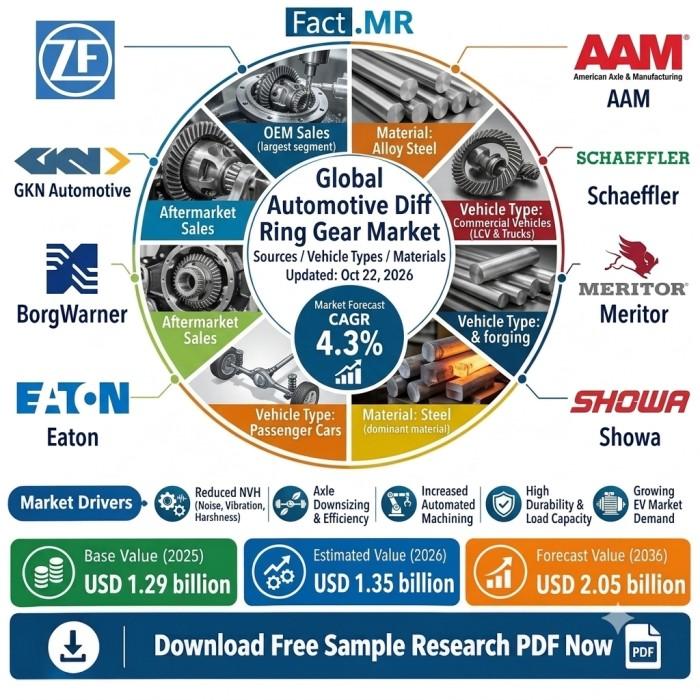
Rockville, Maryland, 2 November 2026 – The global automotive diff ring gear market is estimated at USD 1.35 billion in 2026 and is projected to reach USD 2.05 billion by 2036, expanding at a CAGR of 4.3% during the forecast period, according to Fact.MR.
The market generated USD 1.29 billion in 2025. Forecast growth reflects demand from passenger vehicle production, commercial axle replacements, drivetrain engineering and maintenance requirements across the global vehicle fleet. Original equipment manufacturer (OEM) sales account for 58.7% of market revenue, making production consistency, gear qualification and vehicle-platform supply agreements important commercial priorities.
Manufacturers and procurement teams can examine the latest market forecasts, segment shares and country-level opportunities in Fact.MR's research. Get a Sample of the Detailed Market Study:
The short version
- The automotive diff ring gear market is forecast to increase from USD 1.35 billion in 2026 to USD 2.05 billion by 2036, creating an incremental market opportunity of approximately USD 700 million.
- Steel dominates material demand with a 62.5% share, while passenger cars account for 45.4% of vehicle-type revenue.
- Brazil leads the five-country growth forecast at 5.3% CAGR. The United Kingdom follows at 4.6%, while Japan is projected to grow at 4.2%.
Three numbers that matter
USD 2.05 billion: Projected global market value by 2036.
58.7%: Share of 2026 market revenue attributed to original equipment manufacturer sales.
62.5%: Revenue share of steel-based automotive differential ring gears in 2026.
These figures point towards a market where gear material strength, tooth geometry, machining accuracy and reliable manufacturing schedules influence supplier selection.
Where growth is strongest
Fact.MR identifies five country markets in its forecast. Brazil records the highest projected growth, while the United Kingdom and Japan offer opportunities linked to vehicle servicing, engineering standards and replacement requirements.
- Brazil: CAGR (2026–2036) of 5.3% — Growth opportunity: Local vehicle production, commercial axle servicing and replacement-parts distribution.
- United Kingdom: CAGR (2026–2036) of 4.6% — Growth opportunity: Established vehicle fleets, specialist axle servicing and aftermarket demand.
- Japan: CAGR (2026–2036) of 4.2% — Growth opportunity: Vehicle engineering standards, consistent gear finishing and replacement requirements.
- Germany: CAGR (2026–2036) of 3.9% — Growth opportunity: Automotive assembly programmes, drivetrain engineering and precision gear manufacturing.
- United States: CAGR (2026–2036) of 3.0% — Growth opportunity: Vehicle assembly activity, axle repair and replacement requirements.
Why these markets matter
- Brazil: Local vehicle production and the availability of replacement differential components support market expansion. Commercial fleet operators require matched ring-and-pinion sets to maintain axle performance. Forecast CAGR is 5.3%.
- United Kingdom: An established vehicle fleet creates demand for differential components used in specialist axle repairs. Accurate gear identification and replacement-part availability remain important for workshops. Forecast CAGR is 4.6%.
- Japan: Vehicle manufacturers place emphasis on differential gear noise, tooth contact and consistent finishing. These engineering requirements support demand for precision-manufactured drivetrain components. Forecast CAGR is 4.2%.
- Germany: Automotive manufacturers require repeatable component quality across vehicle production programmes. Controlled surface hardening and accurate gear finishing remain important purchasing considerations. Forecast CAGR is 3.9%.
- United States: Vehicle assembly and in-service fleet maintenance support demand for differential ring gears. Repair businesses require correct ring-and-pinion matching for light trucks and other vehicles with driven axles. Forecast CAGR is 3.0%.
Who is moving: industry developments and key players
The competitive landscape includes established drivetrain manufacturers, powertrain suppliers and specialist gearing companies. Their opportunities differ according to manufacturing capabilities, engineering expertise, vehicle-platform relationships and aftermarket distribution networks.
Industry developments highlighted in the report:
- 2025 – Germany: Destatis reported that Germany exported approximately 1.5 million new passenger cars during the first five months of 2025. Vehicle export programmes require consistent axle-component quality across planned production schedules.
- 2025 – Japan: International passenger-car production data recorded approximately 7.139 million passenger cars manufactured in Japan during 2024, reflecting the country's substantial automotive engineering and manufacturing base.
- April 2026 – United Kingdom: The Department for Transport reported that 2.617 million vehicles received their first UK registration during 2025. This expands the range of vehicle models requiring servicing and replacement-component support.
- October 2026 – United States: Federal Reserve data recorded a seasonally adjusted annual vehicle assembly rate of 10.2061 million units in September 2026. Vehicle assembly activity provides important manufacturing context for automotive component suppliers.
Key players profiled by Fact.MR:
- Dana Incorporated
• ZF Friedrichshafen AG
• Dauch Corporation
• Eaton Corporation
• BorgWarner Inc.
• Auburn Gear LLC
• Motive Gear
• JTEKT Corporation
• Cummins-Meritor
Dana Incorporated and Dauch Corporation have established driveline activities connected with axle assembly requirements. ZF Friedrichshafen operates across transmission and chassis systems, while Eaton Corporation and BorgWarner supply technologies used in vehicle powertrains.
Auburn Gear and Motive Gear have closer associations with specialist gearing and replacement applications. JTEKT brings bearing and driveline-related engineering capabilities to the competitive landscape.
The competitive opportunity is not simply about supplying ring gears. Manufacturers must demonstrate that finished components meet vehicle-specific requirements for torque transmission, tooth geometry, material strength and operating durability.
Where to act
Strengthen steel gear manufacturing capabilities: Steel accounts for 62.5% of market revenue. Manufacturers can prioritise controlled heat treatment, tooth-surface quality and dimensional consistency to meet axle application requirements.
Build relationships with automotive OEMs: OEM sales represent 58.7% of market revenue. Suppliers should work with vehicle manufacturers and axle system providers during component development and qualification programmes.
Expand passenger-car applications: Passenger cars account for 45.4% of vehicle-type demand. Manufacturers can focus on repeatable production quality and gear-noise control for passenger vehicle differential systems.
Develop aftermarket distribution: Replacement demand creates opportunities for distributors serving commercial fleets and independent repair workshops. Accurate gear-ratio identification, vehicle fitment information and matched ring-and-pinion availability can reduce incorrect orders.
Prioritise application testing: Testing should cover representative torque loads, tooth contact patterns, surface hardness and operating noise. Consistent inspection procedures can help manufacturers meet customer qualification requirements.
Where to be careful
- Machining and heat-treatment costs: Precision manufacturing and controlled surface treatment increase production costs and can restrict supplier competitiveness.
- Gear set qualification: Changing an approved gear supplier or specification can require additional engineering validation, particularly in markets with demanding vehicle engineering requirements.
- Price pressure in repair channels: Aftermarket distributors face pricing competition while maintaining accurate fitment information and replacement availability.
- Alternative driveline designs: Changes in vehicle drivetrain architecture can influence long-term demand for conventional differential components.
- Manufacturing consistency: Variations in tooth geometry, surface finishing and hardness can affect gear contact, noise and operating performance.
- Customer concentration: Suppliers dependent on a limited number of vehicle platforms or OEM contracts may face procurement risks when production schedules change.
The commercial priority should be to balance recurring OEM contracts with aftermarket distribution while maintaining manufacturing consistency, competitive pricing and application-specific quality standards.
Analyst quote
Shambhu Nath Jha, Principal Consultant at Fact.MR, explains:
"Ring gear sales depend on the pairing of material strength and accurately cut tooth surfaces. A gearmaker serving passenger cars needs steady machining quality across long production batches."
His assessment highlights why manufacturers must combine material selection with precision machining and consistent inspection. Automotive suppliers need to understand axle requirements and production tolerances before approving differential ring gear components for vehicle platforms.
Unlock Actionable Insights from the Complete Report:
Questions for your next planning meeting
- Which automotive OEMs and axle assembly manufacturers should we approach for long-term differential ring gear supply agreements?
- Can our existing manufacturing capabilities meet the requirements for steel-based ring gears, controlled heat treatment and precision tooth finishing?
- How can we expand aftermarket distribution while improving vehicle-specific gear identification and replacement availability?
- Which country markets offer the strongest opportunities for our manufacturing and distribution capabilities through 2036?
Explore More Related Studies Published by Fact.MR Research
Automotive Air Conditioner Temperature Sensor Market-
Automotive Biometric Identification Market-
Automotive Airbag Parts Market-
About Fact.MR
Fact.MR is a market research and consulting firm providing market intelligence, industry analysis and strategic insights to businesses across multiple sectors.
Its research covers market sizing, forecasts, competitive landscapes, segment analysis, country-level opportunities and industry developments. Fact.MR supports manufacturers, investors, procurement teams and business leaders with information for strategic planning and commercial decision-making.
Media Contact
Fact.MR
Email: sales@factmr.com
Website: https://www.factmr.com

 English
 Arabic
 French
 Spanish
 Portuguese
 Deutsch
 Turkish
 Dutch
 Italiano
 Russian
 Romaian
 Portuguese (Brazil)