


Cloud Management for the OpenStack Market Growth, Revenue Analysis Industry Outlook, Forecast Analysis By Fact.MR
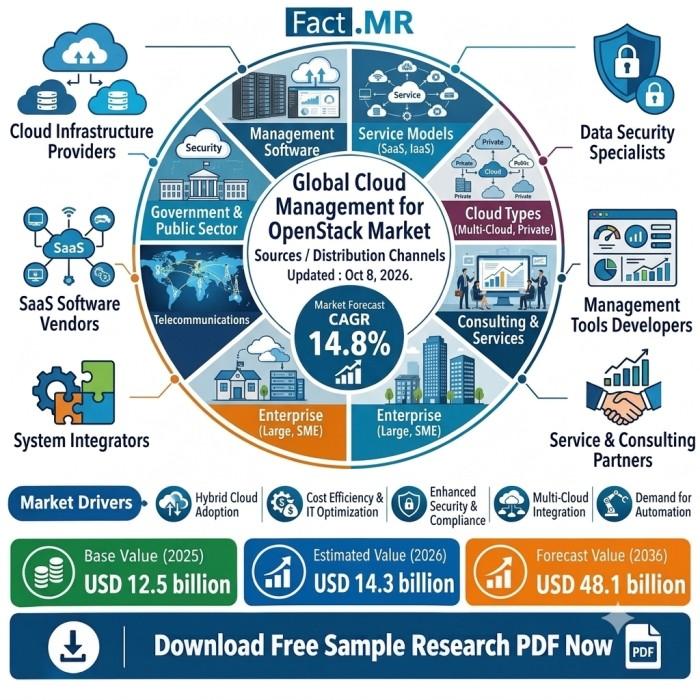
Rockville, Maryland, 2 November 2026 – The global cloud management for the OpenStack market is estimated at USD 2.11 billion in 2026 and is projected to reach USD 12.3 billion by 2036, expanding at a CAGR of 19.3% during the forecast period, according to Fact.MR. The market was valued at USD 1.77 billion in 2025.
Forecast growth reflects increasing enterprise demand for open-source cloud infrastructure, migration away from proprietary virtualization platforms, data sovereignty requirements and investments in private AI infrastructure. Software accounts for 62.3% of component revenue, while private cloud represents 43.7% of deployment demand. Large enterprises dominate the market with a 71.4% share, highlighting the importance of enterprise-scale cloud management solutions.
Technology companies, cloud infrastructure providers and enterprise procurement teams can examine the latest market forecasts, segment shares and country-level opportunities in Fact.MR's research. Get a Sample of the Detailed Market Study:
The short version
- The global cloud management for the OpenStack market is forecast to increase from USD 2.11 billion in 2026 to USD 12.3 billion by 2036, creating an incremental revenue opportunity of approximately USD 10.19 billion.
- Software leads the component segment with a 62.3% share, while private cloud accounts for 43.7% of deployment revenue.
- Germany leads the five-country growth forecast at 22.1% CAGR, followed by the United Kingdom at 15.8%, Japan at 15.2% and the United States at 14.9%.
Three numbers that matter
USD 12.3 billion: Projected global market value by 2036.
71.4%: Share of 2026 market revenue attributed to large enterprises.
62.3%: Revenue share of software within the component segment in 2026.
These figures indicate a market where software subscriptions, infrastructure control, migration capabilities and enterprise-grade operational support influence purchasing decisions.
Where growth is strongest
Fact.MR identifies five country markets in its forecast. Germany records the highest projected growth, supported by demand for locally hosted infrastructure and data control. The United Kingdom, Japan and the United States also offer opportunities as businesses strengthen cloud infrastructure and security requirements.
- Germany: CAGR (2026–2036) of 22.1% — Growth opportunity: Sovereign cloud infrastructure, enterprise private clouds and locally hosted computing environments.
- United Kingdom: CAGR (2026–2036) of 15.8% — Growth opportunity: Cybersecurity priorities, private cloud adoption and enterprise infrastructure control.
- Japan: CAGR (2026–2036) of 15.2% — Growth opportunity: Corporate cloud adoption, telecommunications infrastructure and network virtualization.
- United States: CAGR (2026–2036) of 14.9% — Growth opportunity: Enterprise cloud migration, private AI infrastructure and a strong cloud engineering workforce.
- Brazil: CAGR (2026–2036) of 13.6% — Growth opportunity: Expanding internet connectivity, regional cloud providers and locally hosted digital services.
Why these markets matter:
- Germany: Data sovereignty requirements and increasing enterprise cloud adoption support demand for infrastructure that organizations can host and manage locally. Fact.MR projects the country to expand at a 22.1% CAGR.
- United Kingdom: Security concerns are encouraging organizations to strengthen infrastructure control. Private OpenStack environments offer businesses greater flexibility over data access and operational policies. Forecast CAGR stands at 15.8%.
- Japan: More than 80% of Japanese companies were using cloud services, according to the Ministry of Internal Affairs and Communications' May 2025 survey. Telecommunications operators also support demand through large-scale network virtualization projects. Forecast CAGR is 15.2%.
- United States: A strong technology workforce and demand from hosting companies and research institutions support enterprise adoption. Fact.MR projects a 14.9% CAGR.
- Brazil: Increasing household internet access is expanding the potential customer base for regional hosting and cloud infrastructure services. The market is forecast to grow at a 13.6% CAGR.
Who is moving: dated developments and key players
The competitive landscape includes software distribution companies, cloud management specialists and managed infrastructure providers. Their commercial opportunities depend on migration capabilities, supported software distributions, upgrade reliability, Kubernetes integration and enterprise support services.
Developments highlighted in the report:
- October 2025 – Canonical: Canonical marked 15 years of OpenStack and reported that more than 500 clouds were running its distribution in production under Ubuntu Pro.
- January 2025 – Mirantis: Mirantis launched Rockoon, an open-source controller designed to streamline OpenStack management on Kubernetes. The development supports its Mirantis OpenStack for Kubernetes offering.
- March 2025 – Platform9: Platform9 released a free Community Edition of Private Cloud Director, allowing virtualization practitioners to experience its private cloud management platform.
- July 2025 – Rackspace Technology: The company launched OpenStack Business, a fully managed and dedicated private cloud service designed to provide enterprises with greater privacy, security and infrastructure control.
These developments demonstrate how vendors are positioning OpenStack around simplified operations, managed services and migration from traditional virtualization environments.
Key players profiled by Fact.MR:
- Red Hat, Inc.
• Canonical Ltd.
• Mirantis, Inc.
• Platform9 Systems, Inc.
• Rackspace Technology, Inc.
• OVHcloud
Red Hat offers Red Hat OpenStack Services on OpenShift, combining OpenStack infrastructure management with a containerized control plane.
Canonical supports enterprise OpenStack deployments through its Ubuntu-based distribution and long-term support capabilities.
Mirantis is developing Kubernetes-based OpenStack management capabilities, while Platform9 targets organizations seeking private cloud management solutions.
Rackspace Technology focuses on managed OpenStack infrastructure, and OVHcloud provides public cloud services built around open standards and OpenStack APIs.
The competitive opportunity is not limited to selling cloud management software. Providers must demonstrate reliable upgrades, predictable migration processes, workload compatibility and ongoing technical support to secure enterprise contracts.
Where to act
Expand enterprise software capabilities: Software accounts for 62.3% of component revenue. Vendors should prioritize supported distributions, lifecycle management, security updates and automated upgrade capabilities. Annual subscription and support requirements can support recurring revenue opportunities.
Develop private cloud management solutions: Private cloud represents 43.7% of deployment revenue. Providers can target regulated enterprises, financial institutions, healthcare organizations and government departments requiring greater control over data location and infrastructure access.
Target large enterprise customers: Large enterprises account for 71.4% of market demand. Suppliers should develop solutions capable of managing multi-site environments, large virtual machine estates and complex infrastructure requirements.
Strengthen telecommunications partnerships: IT and telecommunications account for 27.8% of end-user revenue. Technology providers can develop OpenStack platforms that support network function virtualization, 5G infrastructure and distributed computing environments.
Build managed service offerings: Managed private cloud services can address the requirements of mid-sized organizations that need infrastructure control but lack dedicated teams for continuous OpenStack operations.
Prepare infrastructure for AI workloads: Private AI and GPU cluster investments create opportunities for vendors offering scheduling, multi-tenant management and certified hardware integrations.
Where to be careful
- Shortage of skilled engineers: OpenStack operations require specialized technical expertise. Limited access to experienced engineers can increase deployment costs and affect service reliability.
- Migration complexity: Moving large virtual machine estates away from proprietary hypervisors requires application testing, workload compatibility assessments and carefully managed transitions.
- Upgrade management: Multi-site OpenStack deployments can create operational challenges when software upgrades affect networks, storage and computing environments.
- Competition from hyperscale cloud providers: Established public cloud platforms remain strong alternatives for organizations prioritizing managed infrastructure and simplified deployment.
- Enterprise implementation costs: Private cloud deployments require investment in software, integration, technical support and operational resources.
The commercial priority should be to simplify enterprise migration while offering predictable upgrade schedules, transparent support agreements and reliable infrastructure management.
Analyst quote
Shambhu Nath Jha, Principal Consultant at Fact.MR, explains:
"OpenStack is no longer a science project for most buyers, it is the fallback when they want control over cost, data location and hardware choice. The vendors that win will be the ones that make upgrades boring and migrations predictable. Managed service offers will gain most with firms that want the control of a private cloud without hiring a large operations team."
His assessment highlights how enterprise purchasing priorities are shifting towards infrastructure control and operational reliability. Vendors that reduce migration complexity and simplify ongoing cloud management can strengthen their position in enterprise procurement programmes.
Unlock Actionable Insights from the Complete Report:
Questions for your next planning meeting
- Which enterprise customers and telecommunications operators should we approach for OpenStack infrastructure and cloud management contracts?
- Can our existing software portfolio support enterprise migration from proprietary hypervisors to OpenStack-based environments?
- How can we develop managed private cloud offerings for organizations with limited in-house infrastructure teams?
- Are our cloud management solutions prepared to support private AI infrastructure, GPU clusters and containerized workloads?
- Which country markets should receive priority investment based on their projected growth rates through 2036?
Explore More Related Studies Published by Fact.MR Research
Airport Runway Safety Systems Market
Blockchain for Supply Chain Market
Commercial Aircraft LED Lighting System Market
About Fact.MR
Fact.MR is a market research and consulting firm providing market intelligence, industry analysis and strategic insights to businesses across multiple sectors.
Its research covers market sizing, forecasts, competitive landscapes, segment analysis, country-level opportunities and industry developments. Fact.MR supports manufacturers, investors, procurement teams and business leaders with information for strategic planning and commercial decision-making.
Media Contact
Fact.MR
Email: sales@factmr.com
Website: https://www.factmr.com

 English
 Arabic
 French
 Spanish
 Portuguese
 Deutsch
 Turkish
 Dutch
 Italiano
 Romaian
 Portuguese (Brazil)
 Greek