


Photonics Market to Reach USD 1,838.3 Billion by 2036; China Leads Among Profiled Countries at 7.0% CAGR
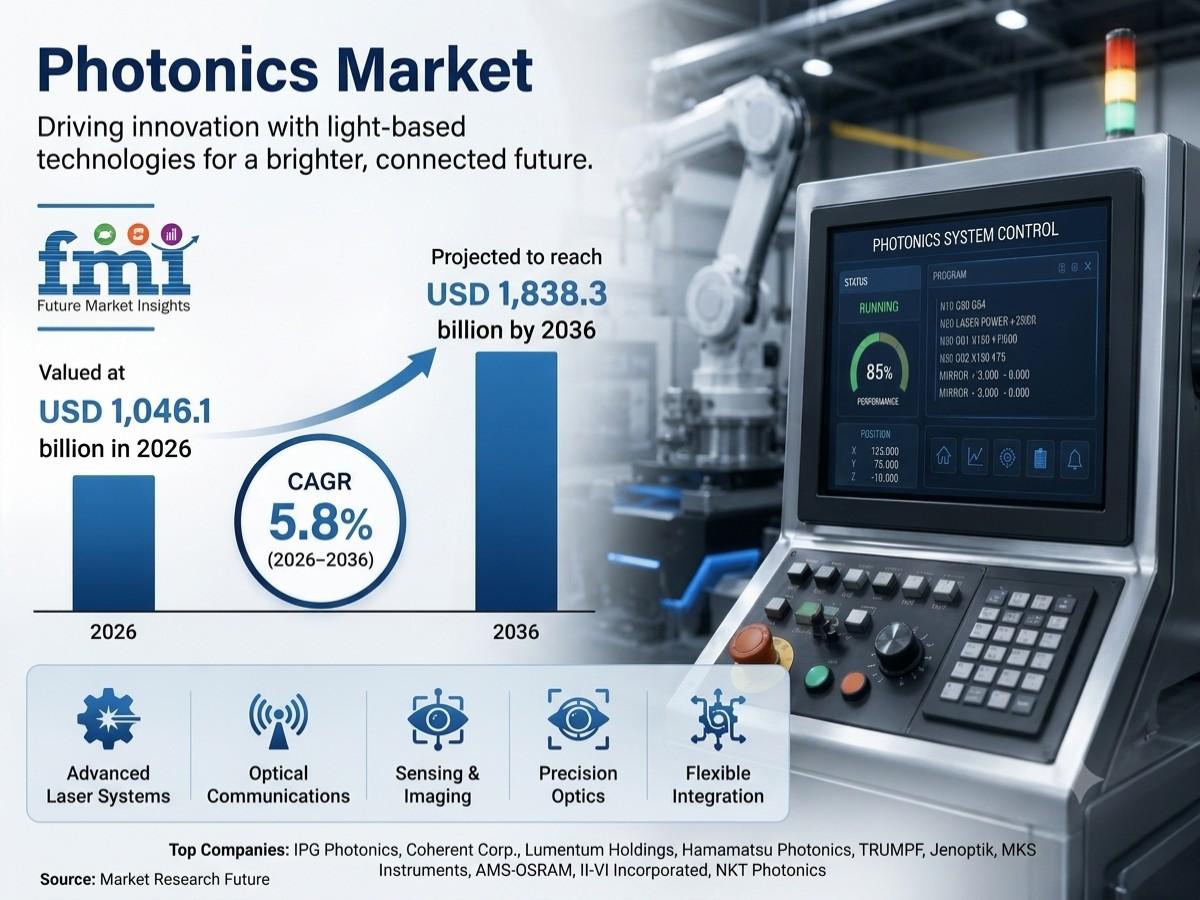
NEWARK, Del. — The global Photonics Market is projected to increase from USD 1,046.1 billion in 2026 to USD 1,838.3 billion by 2036, registering a compound annual growth rate (CAGR) of 5.8% during the forecast period, according to Future Market Insights (FMI). The market was valued at USD 988.7 billion in 2025. Growth is supported by rising demand for optical communication systems, industrial lasers, photonic sensors, and advanced imaging technologies.
Photonics involves the generation, detection, and manipulation of light for practical applications. Its technologies support fiber-optic networks, data center connections, medical diagnostics, precision manufacturing, and aerospace and defense systems. As industries seek faster data transmission, improved measurement accuracy, and more efficient production processes, photonic components are becoming increasingly important to modern infrastructure.
Access the Sample Report — Explore Key Insights Today!
https://www.futuremarketinsights.com/reports/sample/rep-gb-16732
Photonics Market: Key Findings
- Market size in 2026: USD 1,046.1 billion
- Projected market size by 2036: USD 1,838.3 billion
- Forecast CAGR, 2026–2036: 5.8%
- Leading product type: Sensors & Detectors, with a 32.5% share in 2026
- Leading material: Silicon, with a 39.4% share in 2026
- Leading component type: Active Components, accounting for 44.2% in 2026
- Leading industry segment: Telecommunication and IT, with a 34.7% share in 2026
Fiber-Optic Infrastructure and Data Center Demand Support Growth
The expansion of fiber-optic networks is a major source of demand for photonic technologies. Telecommunications providers require optical transceivers, lasers, amplifiers, and related components to support network capacity and data transmission. The rollout of 5G infrastructure and the expansion of data centers are increasing the need for optical connections that can handle growing volumes of information.
Industrial automation is another important growth area. Manufacturers use fiber lasers for cutting, welding, and other precision processes. Optical sensors and machine vision systems help production teams inspect products, guide automated equipment, and monitor manufacturing conditions.
Healthcare and life sciences applications also contribute to demand. Photonic technologies are used in diagnostic imaging, surgical lasers, optical coherence tomography, and other medical systems. These applications require reliable optical performance and components that meet the relevant technical and regulatory requirements.
Sensors and Detectors Lead the Product Type Segment
FMI reports that Sensors & Detectors account for 32.5% of the product type segment in 2026. These products support applications such as industrial monitoring, automotive sensing, environmental measurement, and medical diagnostics. Their ability to detect light and convert optical signals into usable information makes them important across a wide range of systems.
The material segment is led by Silicon, which accounts for 39.4% in 2026. Silicon is used in photonic devices and integrated optical technologies, including applications that benefit from established semiconductor manufacturing processes.
Active Components represent 44.2% of the component type segment. This category includes products such as laser diodes, optical amplifiers, and modulators that generate, amplify, or control light. Meanwhile, Telecommunication and IT accounts for 34.7% of industry demand, reflecting the importance of optical communication infrastructure.
Regional Outlook: China Leads Country Growth
FMI’s country-level forecasts show different growth opportunities across major photonics markets for 2026–2036.
China is projected to record the fastest growth, at a 7.0% CAGR. Telecommunications infrastructure investment, domestic photonics manufacturing, and industrial laser adoption are supporting demand.
The United States is forecast to grow at a 6.3% CAGR. Demand is supported by defense applications, data center optical interconnects, and established photonics research and commercialization capabilities.
The United Kingdom is projected to expand at a 5.4% CAGR, with photonics manufacturing and research supporting applications in telecommunications, defense, and healthcare.
South Korea is expected to register a 5.8% CAGR, supported by demand from electronics manufacturing, telecommunications, and smart factory applications.
In Japan, the market is forecast to grow at a 5.2% CAGR. Its established optical component manufacturing base supports applications in sensing, fiber-optic communications, and medical photonics.
Germany is projected to grow at 5.0%, France at 4.8%, Italy at 4.6%, Australia at 4.5%, and New Zealand at 4.2%. These forecasts highlight the broad geographic reach of photonics demand, with growth rates reflecting different industrial and technology priorities.
Competitive Landscape: Top Companies in the Photonics Market
FMI identifies IPG Photonics, Coherent Corp., Lumentum Holdings, Hamamatsu Photonics, TRUMPF, Jenoptik, MKS Instruments, AMS-OSRAM, II-VI Incorporated, and NKT Photonics among the companies profiled in the market.
IPG Photonics is associated with fiber lasers and industrial laser systems. Coherent Corp. supplies lasers, optical components, and materials, while Lumentum Holdings focuses on optical communications and laser technologies. Hamamatsu Photonics is known for optical sensors and detectors, and TRUMPF serves industrial laser applications.
Jenoptik and MKS Instruments participate in specialized photonics and industrial technology markets. AMS-OSRAM, II-VI Incorporated, and NKT Photonics add capabilities across optical components, materials, and specialized photonic applications.
Competition is shaped by technical performance, manufacturing scale, product reliability, and the ability to meet application-specific requirements. Customers in telecommunications, healthcare, manufacturing, and defense often require components that integrate with existing systems and deliver consistent performance. The companies listed are drawn from FMI’s report and are not presented as a ranked market-share list.
Outlook for the Photonics Market
The Photonics Market is expected to benefit from continued investment in optical communication networks, data center infrastructure, industrial automation, and medical technologies. Demand for sensors, lasers, optical components, and integrated photonic systems is likely to remain connected to the performance requirements of these end-use industries.
Manufacturers must also address challenges involving specialized fabrication, component availability, production costs, and supply chain capacity. Companies that can deliver reliable products and support integration across different applications will be positioned to serve the market’s evolving requirements.
For detailed market forecasts, segment analysis, country-level insights, and competitive intelligence, visit the Future Market Insights Photonics Market report: https://www.futuremarketinsights.com/reports/photonics-market
Explore More Related Reports -
Microsoft Dynamics Market - https://www.futuremarketinsights.com/reports/microsoft-dynamics-market
Mobile Notary Public Market - https://www.futuremarketinsights.com/reports/mobile-notary-public-market
Microprinting Market - https://www.futuremarketinsights.com/reports/microprinting-market

 English
 French
 Spanish
 Portuguese
 Deutsch
 Turkish
 Dutch
 Italiano
 Russian
 Romaian
 Portuguese (Brazil)
 Greek
