


Edutainment Market to Reach USD 15.44 Billion by 2036; China Leads Among Profiled Countries at 19.5% CAGR
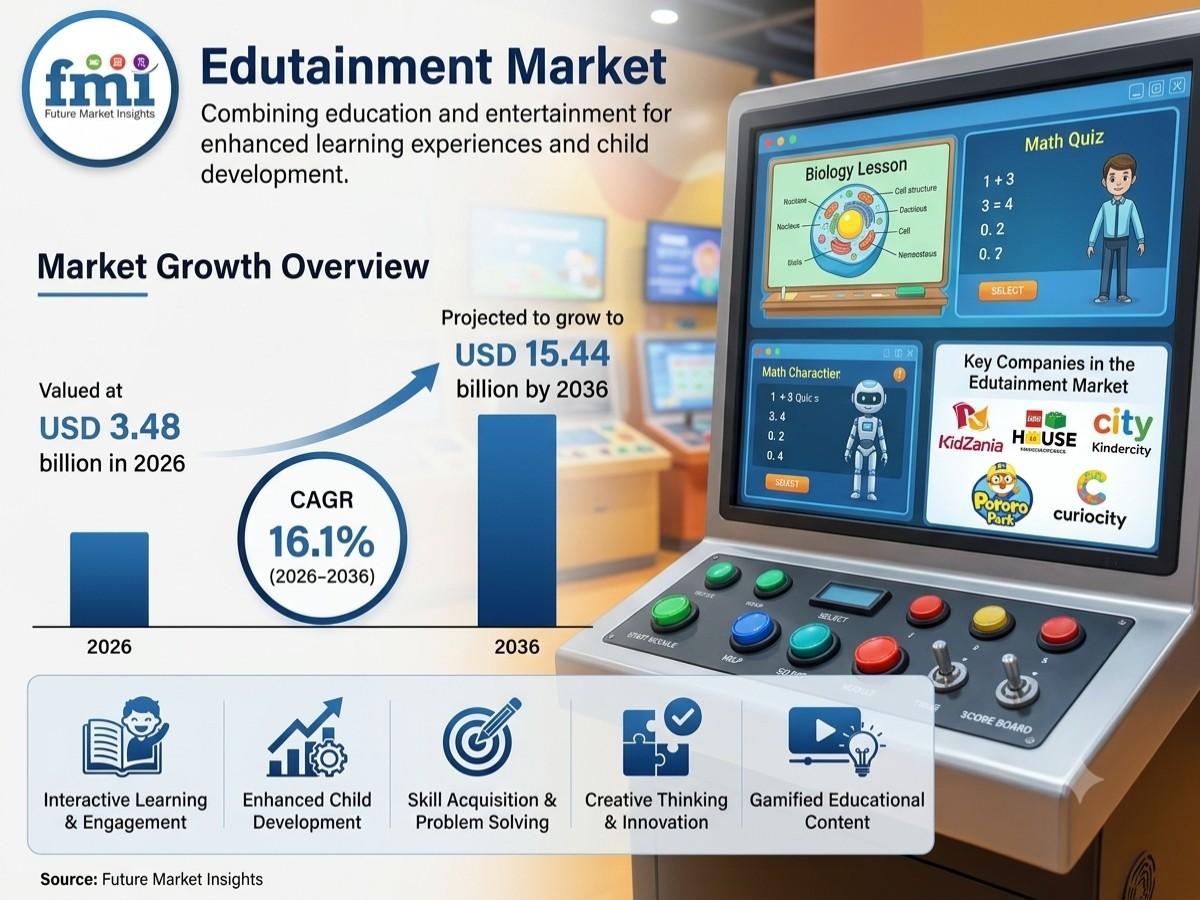
NEWARK, Del. — The global Edutainment Market is projected to grow from USD 3.48 billion in 2026 to USD 15.44 billion by 2036, registering a compound annual growth rate (CAGR) of 16.1% over the forecast period, according to Future Market Insights (FMI). The market was valued at USD 3.0 billion in 2025. Growth is being supported by demand for experiences that combine entertainment with structured learning, encouraging operators to develop interactive activities for children, families, and school groups.
Edutainment brings educational objectives into recreational settings through interactive gaming, role-based activities, guided experiences, and digital content. The model gives visitors opportunities to participate, explore, and practice skills rather than simply consume information. Operators are increasingly focused on creating experiences that offer a clear learning purpose while remaining enjoyable and accessible.
Access the Sample Report — Explore Key Insights Today!
https://www.futuremarketinsights.com/reports/sample/rep-gb-7563
Edutainment Market: Key Findings
- Market size in 2026: USD 3.48 billion
- Projected market size by 2036: USD 15.44 billion
- Forecast CAGR, 2026–2036: 16.1%
- Leading gaming type: Interactive gaming, with a 47.7% share in 2026
- Leading facility size: 20,001 to 40,000 sq. ft., with a 32.7% share in 2026
- Key companies: KidZania, LEGO House, Kindercity, Pororo Park, and Curiocity
Interactive Learning Experiences Support Market Expansion
The demand for edutainment is closely connected to the growing preference for learning formats that encourage participation. Families and schools are looking for activities that combine recreation with opportunities to develop creativity, problem-solving abilities, and practical knowledge.
Interactive exhibits, guided role-play, educational games, and hands-on activities can make complex subjects easier to explore. These formats also give operators opportunities to serve different visitor groups through age-appropriate activities and structured programs.
Technology is adding new possibilities to the experience. Augmented reality (AR), virtual reality (VR), interactive media, and digital learning tools can support immersive activities when they are selected to suit the intended learning objective. However, technology alone does not establish educational value. Clear instructions, suitable content, and staff guidance remain important to the visitor experience.
Interactive Gaming Leads the Gaming Type Segment
FMI reports that the interactive gaming segment accounts for 47.7% of gaming type demand in 2026. Interactive formats encourage visitors to take an active role through games, simulations, and hands-on activities. This approach allows participants to learn by exploring tasks and responding to challenges.
Operators can strengthen these experiences by combining suitable content with clear instructions and opportunities for progression. Activities that accommodate different ages and abilities can help venues serve family groups and school visits.
The report segments gaming types into interactive, non-interactive, explorative, and hybrid combination formats. Each format offers a different way to connect entertainment with learning, allowing operators to develop experiences suited to their target audiences.
Mid-Sized Facilities Hold a Significant Position
The 20,001 to 40,000 sq. ft. facility size segment accounts for 32.7% of facility-size demand in 2026, according to FMI. Facilities within this range can accommodate multiple activity areas while giving operators scope to manage visitor movement, staffing, and maintenance requirements.
Space planning is important to the commercial performance of an edutainment venue. Operators need to balance the number of attractions with visitor flow, staff supervision, and the time required to complete each activity. A well-organized facility can make the experience easier to navigate for families and school groups.
FMI also identifies entry fees and tickets, food and beverages, merchandising, advertising, and other sources as revenue categories within the market. Admission-based revenue remains an important part of the operating model, while additional offerings can complement the visitor experience.
Regional Outlook: China and India Offer Strong Growth Potential
FMI’s country forecasts indicate notable expansion across several markets between 2026 and 2036.
- China: Projected to record a 19.5% CAGR. Digital engagement through platforms such as WeChat and Xiaohongshu can help operators attract visitors, while the quality of on-site activities remains central to repeat participation.
- Japan: Expected to grow at an 18.4% CAGR. Familiar characters and technology-related activities offer opportunities to create engaging experiences for families and younger visitors.
- India: Forecast to expand at a 17.6% CAGR. Local-language content, hands-on learning activities, and suitable guidance can help operators reach a wider audience.
- Germany: Projected to register a 15.5% CAGR. Lifelong learning and digital learning formats provide opportunities for edutainment providers serving different age groups.
- United States: Expected to grow at a 13.9% CAGR. Operators can connect leisure activities with learning objectives through interactive programs and guided experiences.
These forecasts reflect the country-level growth rates published in the FMI report for 2026–2036.
Competitive Landscape: Key Companies in the Edutainment Market
FMI identifies KidZania, LEGO House, Kindercity, Pororo Park, and Curiocity as representative participants in the Edutainment Market.
KidZania offers role-based experiences that combine entertainment with learning. LEGO House uses play-based activities and guided school programs to support learning through participation. Kindercity participates in experience-based edutainment, while Pororo Park offers family-oriented, character-linked activities. Curiocity is positioned within the learning and activity experience landscape.
Competition is shaped by the quality and organization of the visitor experience. Operators need to consider age suitability, activity design, staff guidance, admission value, and content renewal. Partnerships with schools and the ability to offer repeatable experiences can also influence how venues attract and retain visitors.
Outlook for the Edutainment Market
The Edutainment Market is expected to benefit from continued interest in experience-based learning and interactive recreation. Operators that connect activities with clear educational purposes can appeal to families and schools seeking alternatives to passive entertainment.
The market also faces operational considerations. Facility costs, staffing, maintenance, and content development can affect profitability, particularly when venues depend on repeat attendance. Providers must ensure that technology and attractions remain relevant to visitors while delivering a safe, accessible, and well-organized experience.
For detailed market forecasts, segment analysis, regional insights, and competitive coverage, visit the Future Market Insights Edutainment Market report: https://www.futuremarketinsights.com/reports/edutainment-market
Explore More Related Reports -
Event Apps Market - https://www.futuremarketinsights.com/reports/event-apps-market
Structural Health Monitoring Market - https://www.futuremarketinsights.com/reports/structural-health-monitoring-market
Employee Recognition Software Market - https://www.futuremarketinsights.com/reports/employee-recognition-software-market

 Arabic
 French
 Spanish
 Portuguese
 Deutsch
 Turkish
 Dutch
 Italiano
 Russian
 Romaian
 Portuguese (Brazil)
 Greek
