


Additive Manufacturing Market Set to Hit USD 53.31 Billion by 2036; India Records 13.5% CAGR, China 12.0%, Germany 8.5%
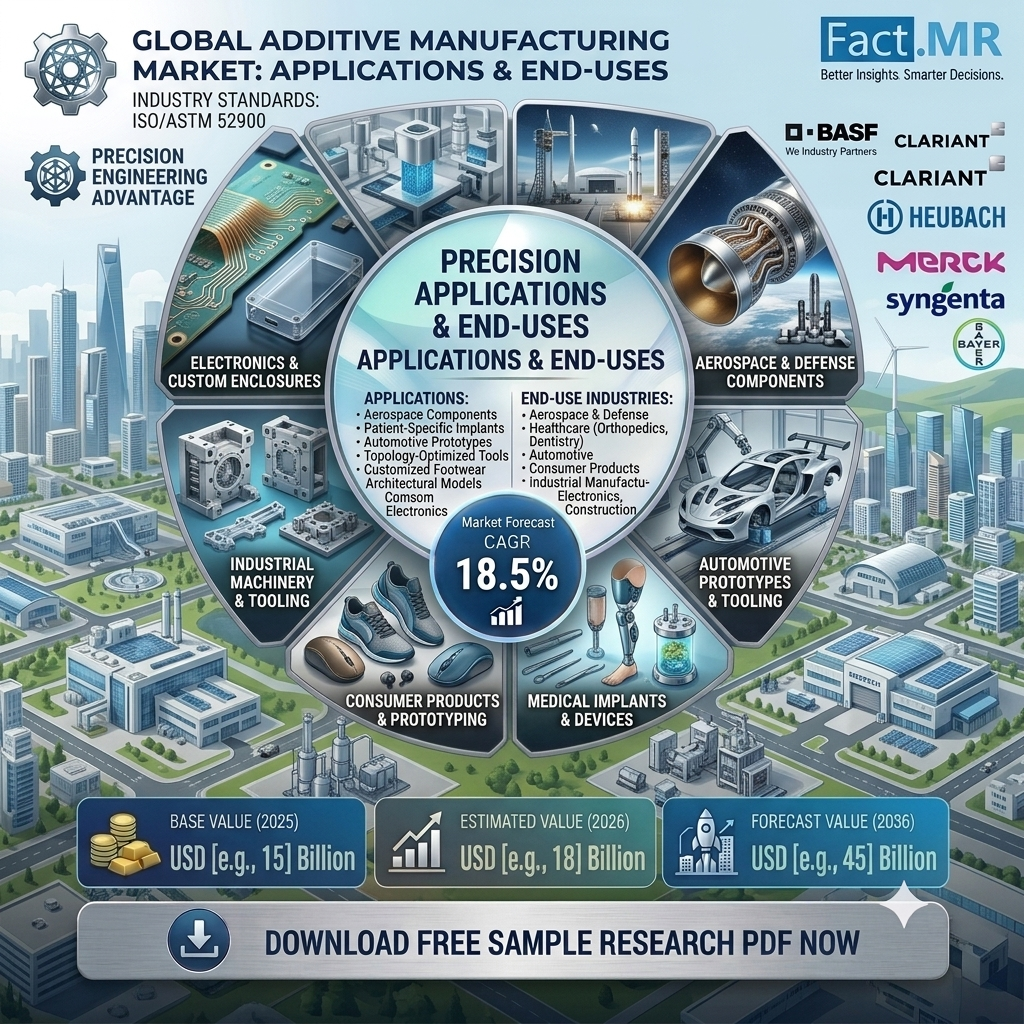
The global additive manufacturing market is forecast to expand from USD 20.37 billion in 2026 to USD 53.31 billion by 2036, registering a 10.1% CAGR over the forecast period. Fact.MR attributes this expansion to the growing adoption of 3D printing technologies across aerospace, automotive, healthcare, and industrial manufacturing. The market was valued at USD 18.50 billion in 2025 and is expected to generate an absolute dollar opportunity of approximately USD 32.94 billion between 2026 and 2036.
Industrial manufacturers are increasingly adopting additive manufacturing to produce complex components, reduce material waste, and improve production flexibility. The transition from rapid prototyping toward commercial-scale production is strengthening demand for advanced polymer and metal printing systems. Aerospace component certification, personalized medical devices, and automotive lightweighting are creating additional opportunities for manufacturers seeking greater design freedom and lower tooling requirements.
Get detailed market forecasts, competitive benchmarking, and pricing trends:
https://www.factmr.com/connectus/sample?flag=S&rep_id=9254
Polymer Technology Retains Dominant Market Position
By technology, polymer additive manufacturing is expected to account for 50.0% of the global market in 2026. Its leading position is supported by the accessibility of thermoplastic and photopolymer materials, established printing technologies, and the ability to manufacture customized components without extensive tooling investment.
Metal additive manufacturing represents another major technology category, accounting for approximately 35.0% of market demand. Its adoption is supported by aerospace manufacturing, medical implants, and industrial applications requiring high-strength components. Ceramic and other additive manufacturing technologies account for the remaining 15.0%, serving specialized applications requiring advanced material properties.
Aerospace represents the largest application segment, accounting for approximately 30.0% of the market. Aircraft manufacturers are increasingly using additive technologies to produce lightweight components with complex geometries. Fact.MR highlights that consolidating multiple conventionally manufactured parts into a single printed component can reduce component weight by 20% to 40% in qualifying aerospace applications.
Automotive applications account for approximately 25.0% of demand, supported by prototyping, tooling, customization, and production of lightweight components. Healthcare represents 20.0%, reflecting growing adoption of patient-specific surgical guides, orthopedic implants, and dental products.
By component, equipment holds the leading position with approximately 45.0% market share. Materials account for 35.0%, while services represent 20.0%, reflecting demand for specialized printing materials, maintenance, technical support, and manufacturing expertise.
India, China, and Germany Show Strong Growth Potential
India is expected to record the fastest growth among countries assessed in the report, with additive manufacturing demand rising at a 13.5% CAGR from 2026 to 2036. Expanding industrial production, government-backed digitalization initiatives, and increasing investment in advanced manufacturing technologies are supporting the country's growth. Manufacturing centers including Bengaluru, Pune, Chennai, and Delhi are adopting additive solutions for product development and specialized industrial applications.
China follows with a projected 12.0% CAGR through 2036. Industrial modernization, advanced manufacturing policies, and increasing adoption of intelligent production systems are contributing to market expansion. Manufacturing facilities in Shanghai, Shenzhen, Beijing, and Guangzhou are integrating additive technologies to improve production capabilities and support aerospace and other high-value industrial applications.
Germany is projected to advance at an 8.5% CAGR during the same period. Its established manufacturing infrastructure, industrial automation expertise, and adoption of Industry 4.0 technologies are strengthening demand for advanced printing systems. Industrial regions including Bavaria, Baden-Württemberg, and North Rhine-Westphalia are supporting technology deployment across specialized manufacturing applications.
The broader market is also influenced by developments in the United States, Mexico, and South Korea. The United States is projected to grow at 9.0%, supported by aerospace manufacturing and defense applications. Mexico is expected to register a 9.5% CAGR, while South Korea advances at 8.0% as industrial automation and advanced manufacturing adoption increase.
Competitive Landscape
Competition in the additive manufacturing market includes established technology providers offering industrial printing systems, advanced materials, and manufacturing services. Key companies identified by Fact.MR include Stratasys, 3D Systems, EOS, HP, GE Additive, SLM Solutions, Desktop Metal, and Renishaw. Other companies covered include Nikon SLM, Markforged, ExOne, Trumpf, Siemens, Farsoon, and Prodways.
Market competition is increasingly influenced by printing precision, material compatibility, equipment reliability, and production scalability. Manufacturers are investing in advanced printing platforms and integrated software to support industrial applications. Strategic partnerships with aerospace, automotive, and healthcare companies are also helping technology providers expand their production capabilities and market presence.
Technology and Industrial Developments Shape the Market
Additive manufacturing is entering a period of technological advancement as manufacturers move beyond prototyping toward direct production of functional components. Fact.MR identifies developments in multi-laser metal printing, expanded material libraries, and industrial polymer printing systems as important factors improving production economics.
The report highlights the growing availability of industrial polymer systems priced below USD 100,000 and multi-laser metal printing technologies capable of build rates exceeding 100 cubic centimeters per hour. These improvements are supporting broader adoption among manufacturers evaluating additive production for specialized and lower-volume applications.
Material qualification remains an important consideration. Aerospace and medical applications require extensive testing, consistent mechanical properties, and compliance with industry-specific requirements. High equipment costs, technical expertise requirements, and certification procedures may continue to influence adoption among smaller manufacturers.
As printing technologies become more capable and industrial applications expand, additive manufacturing is expected to gain a larger role in production planning and component development. Continued investment in materials, process monitoring, and manufacturing automation will support the market's expansion through 2036.
Top Reports:
https://adamaamresearch.blogspot.com/2026/10/tea-bags-market-projected-at-usd-155.html
https://net-pals.com/blogs/62812/Tea-Bags-Market-to-Hit-USD-15-5-Billion-by
https://acmingle.com/blogs/34402/Tea-Bags-Market-to-Reach-USD-15-5-Billion-by
About Fact.MR
Fact.MR is a market research and consulting company providing market intelligence, competitive analysis, and forecasting across global industries. Its research supports businesses with data-driven insights into emerging markets, technology trends, competitive dynamics, regional opportunities, and changing demand patterns.

 English
 Arabic
 French
 Spanish
 Portuguese
 Deutsch
 Turkish
 Dutch
 Italiano
 Russian
 Romaian
 Greek
