


Sunflower Lecithin Gains Ground as Food Manufacturers Seek Non-GMO Alternatives
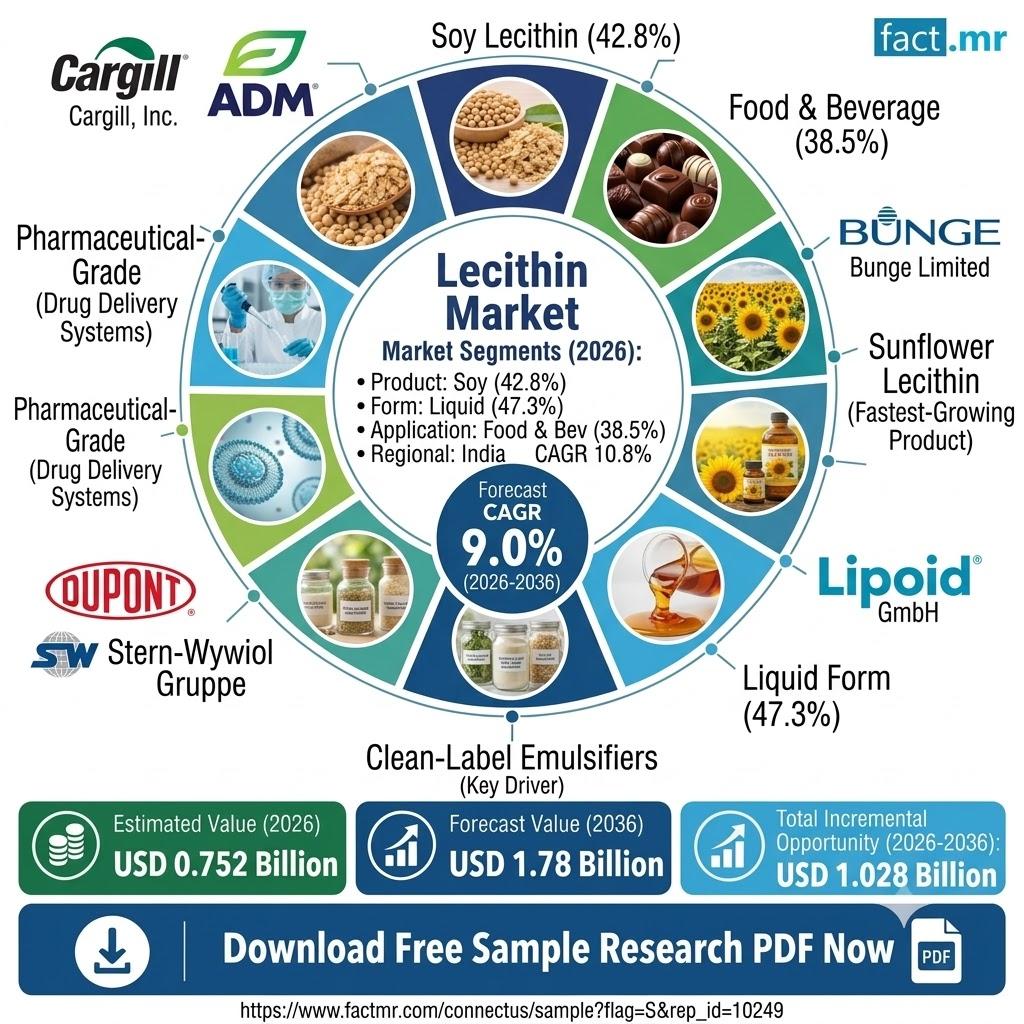
November 2, 2026 — The global lecithin market is projected to reach USD 1.78 billion by 2036, increasing from USD 0.69 billion in 2025, according to Fact.MR. The market is expected to reach USD 0.752 billion in 2026, expanding at a compound annual growth rate (CAGR) of 9.0% through the forecast period. Rising demand for natural emulsifiers, growing preference for non-GMO ingredients, and expanding pharmaceutical applications are supporting this growth.
The market is expected to generate an incremental opportunity of USD 1.028 billion between 2026 and 2036. Soy lecithin will remain the leading product category, accounting for 42.8% of product demand. Liquid lecithin is also expected to maintain its position as the leading form, representing 47.3% of market demand. Food and beverage applications will account for approximately 38.5% of total application demand.
Get detailed market forecasts, competitive benchmarking, and pricing trends: https://www.factmr.com/connectus/sample?flag=S&rep_id=10249
Clean-Label Reformulation Supports Growing Lecithin Demand
The shift toward clean-label food products remains a major demand driver. Food manufacturers are increasingly replacing synthetic emulsifiers, including mono- and diglycerides, polysorbates, and PGPR, with naturally derived alternatives. Lecithin offers emulsification and stabilisation properties while supporting ingredient transparency.
Sunflower lecithin is gaining attention as manufacturers look for non-GMO and soy-allergen-free alternatives. Its demand is growing at an estimated 15% to 20% annually as food producers respond to changing ingredient preferences and labelling requirements. It also provides emulsification performance comparable to soy lecithin across many food applications.
Pharmaceutical applications are creating another source of demand. Liposomal drug delivery systems use phosphatidylcholine-enriched lecithin fractions to form phospholipid vesicles. These formulations are used in vaccine development, cancer therapeutics, and nutraceutical products designed to improve ingredient bioavailability.
Animal feed applications are also expanding. Lecithin functions as a fat dispersant, palatability enhancer, and energy source in poultry, swine, and aquaculture feed. Its ability to support fat utilisation and feed conversion efficiency is encouraging adoption among feed manufacturers.
Soy Lecithin Accounts for 42.8% of Product Demand
Soy lecithin is expected to hold 42.8% of the product segment. Its leading position reflects its established production infrastructure and cost advantages. Lecithin is obtained during soybean oil degumming, allowing processors to utilise an existing by-product stream.
Sunflower lecithin holds the second-largest product share and represents the fastest-growing product category. Its non-GMO positioning and absence of soy allergens make it attractive to food manufacturers targeting specific consumer preferences.
Rapeseed lecithin serves markets where rapeseed processing is well established, particularly in Europe. Egg yolk lecithin is used in specialised pharmaceutical applications requiring high phosphatidylcholine purity, while marine lecithin serves niche nutraceutical applications.
Liquid lecithin accounts for 47.3% of form demand. Its cost-effectiveness, ease of dosing, and compatibility with standard food manufacturing equipment support its widespread use. Powder lecithin serves applications such as bakery premixes, infant formula, and dietary supplements. Granular and modified lecithin products address more specialised formulation requirements.
Food and Beverage Remains the Leading Application
Food and beverage applications are projected to account for 38.5% of total lecithin demand. Chocolate and confectionery manufacturing represents an important consumption area, as lecithin helps reduce viscosity and improve processing efficiency.
In chocolate production, lecithin can reduce viscosity by 30% to 50%, allowing manufacturers to achieve the required consistency while optimising cocoa butter usage. Bakery products, margarine, instant beverages, and dairy products also contribute to segment demand.
Animal feed represents the second-largest application segment. Lecithin is used in poultry, swine, and aquaculture feed to improve fat dispersion and support energy utilisation.
Pharmaceuticals represent the fastest-growing application area. Increasing interest in liposomal formulations is creating demand for high-purity lecithin with standardised phospholipid compositions. Pharmaceutical-grade products containing more than 90% phosphatidylcholine can command significantly higher prices than conventional food-grade lecithin.
Direct sales account for 61.8% of distribution channel demand, reflecting the business-to-business nature of lecithin ingredient procurement.
India and China Lead Country-Level Growth
South Asia and Pacific is projected to remain the fastest-growing regional market, supported by expanding food processing activities and rising demand for functional food ingredients.
India is expected to register the highest country-level CAGR of 10.8% between 2026 and 2036. China follows at 10.4%, supported by its large food manufacturing industry, pharmaceutical expansion, and animal feed production.
Brazil is projected to expand at 9.8% CAGR, while Germany is expected to record 9.1% growth. The United States market is forecast to grow at 8.6%, followed by the United Kingdom at 8.3% and Japan at 7.9%.
North America remains a significant market by revenue, with the United States generating approximately USD 0.265 billion in 2025. Japan contributed USD 0.037 billion, while South Korea accounted for USD 0.021 billion during the same year.
India's growth is supported by rising packaged food manufacturing and domestic soybean processing. China benefits from its large-scale oilseed processing infrastructure and expanding demand from food and pharmaceutical manufacturers. Germany maintains an important position through sunflower lecithin production and demand for pharmaceutical-grade ingredients.
Competitive Landscape and Industry Positioning
The competitive landscape is led by Cargill, Inc., which holds approximately 17.0% of global market share. Its position is supported by integrated soybean processing operations, established lecithin production capabilities, and a broad distribution network.
Other key participants include Archer Daniels Midland (ADM), Bunge Limited, Lipoid GmbH, DuPont de Nemours, Inc., and American Lecithin Company. Stern-Wywiol Gruppe GmbH & Co. KG, NOW Foods, Global River Food Ingredients, and Haneil Soyatech Pvt. Ltd. also participate in the market.
Competition varies across product grades. Commodity food-grade lecithin suppliers compete on production scale, pricing, and supply reliability. Sunflower lecithin producers focus on non-GMO certification and allergen-free positioning, while pharmaceutical-grade manufacturers compete through phospholipid purity and specialised processing capabilities.
Recent industry developments reflect this shift toward specialised ingredients. Cargill expanded its sunflower lecithin portfolio in 2025 with de-oiled powder and granular formats. Lipoid GmbH increased pharmaceutical-grade production capacity, while ADM developed an organic soy lecithin supply chain in 2026.
Manufacturers investing in high-purity phospholipid fractions, organic sourcing, and modified lecithin formulations are positioned to address growing demand from specialised applications. These developments are gradually shifting the market beyond conventional soybean-derived ingredients toward higher-value functional products.
View Related Reports:
https://social.mytamam.com/blogs/841/Mining-Lubricants-Market-to-Reach-USD-5-45-Billion-by
https://ayushjadhavblogs.blogspot.com/2026/10/global-chemical-depolymerization-market.html
https://uddokta64.com/blogs/14962/Digital-PID-Control-and-Automation-Shape-the-Future-of-the
https://gulfsena.com/blogs/112090/Passenger-Cars-to-Account-for-60-of-Global-Automotive-Actuator
About Fact.MR
Fact.MR is a market research and consulting firm providing market intelligence, industry analysis, and strategic insights across multiple sectors. Its research combines primary interviews, secondary sources, and proprietary forecasting models to evaluate market size, growth patterns, competitive positioning, and emerging opportunities.

 English
 Arabic
 French
 Spanish
 Portuguese
 Deutsch
 Turkish
 Dutch
 Italiano
 Romaian
 Portuguese (Brazil)
 Greek
