


Safety Lancets Expected to Hold 48% Share of Product Segment in 2026
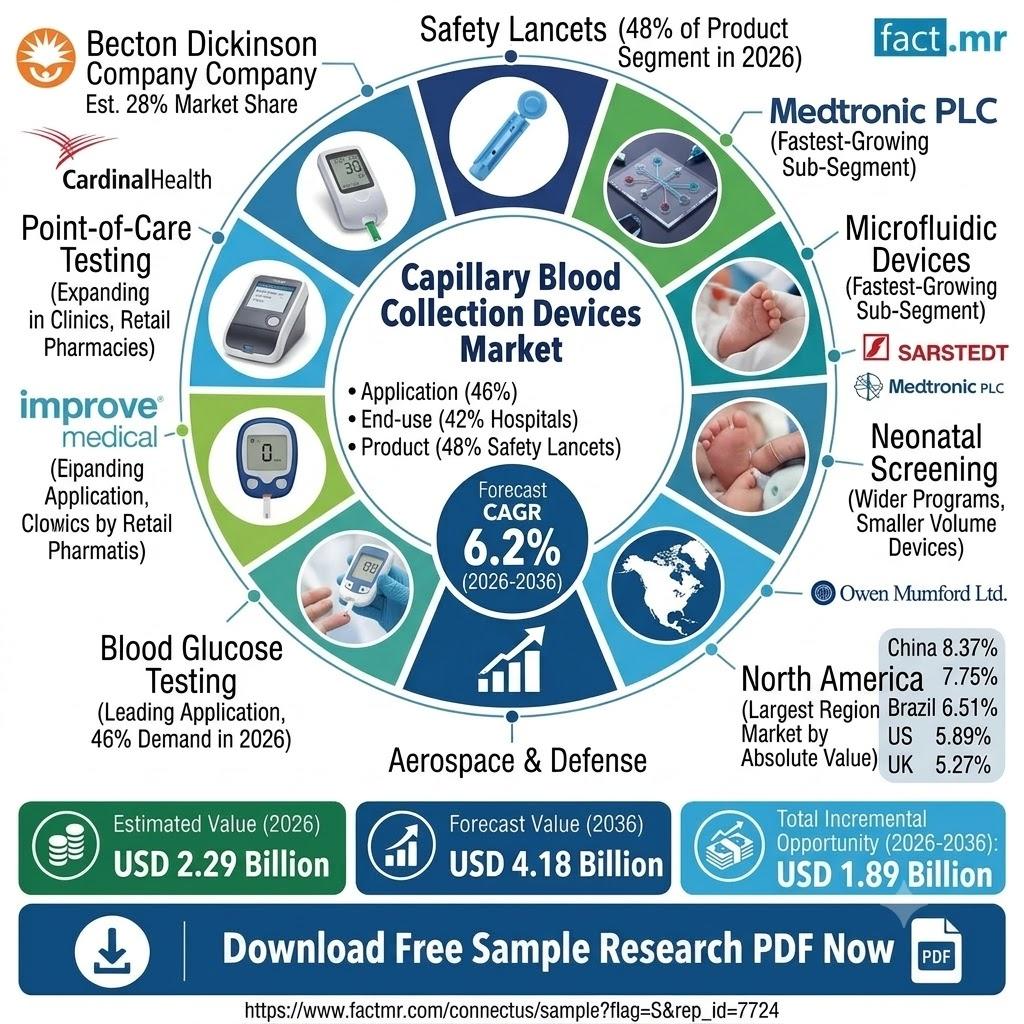
November 2, 2026 — The global capillary blood collection devices market is projected to reach USD 4.18 billion by 2036, increasing from USD 2.16 billion in 2025, according to Fact.MR. The market is expected to reach USD 2.29 billion in 2026, expanding at a compound annual growth rate (CAGR) of 6.2% through the forecast period. Rising demand for blood glucose monitoring, expanding point-of-care testing, and wider neonatal screening programs are shaping this growth.
The market is expected to generate an incremental opportunity of USD 1.89 billion between 2026 and 2036. Safety lancets will remain the leading product category, accounting for 48% of the product segment in 2026. Blood glucose testing is also expected to maintain its position as the leading application, representing approximately 46% of market demand.
Get detailed market forecasts, competitive benchmarking, and pricing trends: https://www.factmr.com/connectus/sample?flag=S&rep_id=7724
Rising Diabetes Cases Support Recurring Device Demand
The growing global diabetic population remains a central demand driver. Patients managing diabetes, particularly those receiving insulin therapy, require regular blood glucose monitoring. This creates recurring demand for lancets and capillary blood collection supplies across hospitals, pharmacies, and home healthcare settings.
Home-based testing continues to support product consumption. Although continuous glucose monitoring (CGM) systems are gaining adoption, capillary blood testing remains an established monitoring method for many diabetic patients.
Point-of-care testing is creating another source of demand. Primary care clinics, urgent care centers, retail pharmacy clinics, and occupational health providers increasingly use capillary samples for rapid diagnostic procedures. These applications include HbA1c testing, hemoglobin testing, lipid panels, and infectious disease screening.
Neonatal screening programs are expanding the market's reach. Developed markets screen newborns for 30 to 60 conditions using heel-stick blood samples. Emerging markets are also progressively extending screening coverage, supporting demand for devices that collect smaller blood volumes with less patient discomfort.
Safety Lancets Account for 48% of Product Demand
Safety lancets are expected to hold 48% of the product segment in 2026. Their position reflects recurring consumption in diabetes care and growing emphasis on preventing needlestick injuries in healthcare environments.
Push-button safety lancets are widely used in home testing, while pressure-activated products and reusable lancet pens serve specific clinical and patient preferences. Healthcare safety requirements also support adoption of engineered lancets across hospitals and clinical settings.
Microfluidic collection devices represent the fastest-growing premium sub-segment. These products offer controlled sample collection and compatibility with integrated diagnostic platforms. Their adoption is supported by decentralized testing and direct-to-consumer specimen collection models.
Companies such as Tasso Inc. and YourBio Health are developing solutions for self-collection applications. These workflows support demand for microfluidic devices compatible with at-home specimen collection and postal-return testing.
Blood Glucose Testing Remains the Leading Application
Blood glucose testing is projected to account for approximately 46% of application demand in 2026. The segment benefits from recurring monitoring requirements among diabetic patients and established distribution through pharmacies and healthcare providers.
Hospitals represent 42% of end-use demand. Home healthcare, clinical laboratories, and neonatal care units contribute additional consumption.
The broader adoption of capillary blood collection devices across ambulatory care and point-of-care settings is also creating opportunities beyond traditional diabetes monitoring. Manufacturers offering products compatible with different diagnostic platforms may benefit as testing moves closer to patients.
China and India Lead Country-Level Growth
Asia Pacific is projected to remain the fastest-growing regional market, supported by expanding diabetic care infrastructure, increasing home testing adoption, and domestic manufacturing activity.
China is expected to register the highest country-level CAGR of 8.37% between 2026 and 2036. India follows at 7.75%, supported by its growing diabetic population, wider pharmacy retail penetration, and increasing point-of-care testing adoption.
Germany is projected to expand at 7.13% CAGR, while Brazil is expected to record 6.51% growth. The United States market is forecast to grow at 5.89%, and the United Kingdom at 5.27%.
North America will continue to represent the largest regional market by absolute value. Its position is supported by high diabetic population counts, established home healthcare penetration, and active retail clinic networks.
Competitive Landscape and Industry Positioning
The competitive landscape is led by Becton Dickinson and Company, which holds an estimated 28% market share. Its position is supported by a broad portfolio of safety lancets and capillary collection products, alongside established clinical distribution relationships.
Other key participants include Improve Medical, Cardinal Health, Medtronic PLC, SARSTEDT AG & Co. KG, and Owen Mumford Ltd. Specialty competitors include Terumo Corporation, Abbott Laboratories, B. Braun Melsungen AG, and Danaher Corporation.
Product innovation and distribution capabilities will remain important competitive factors. Manufacturers are focusing on microfluidic collection systems, self-collection platforms, and expanded product compatibility with point-of-care testing equipment.
Price competition remains a concern for basic lancet products. Asian manufacturers and private-label suppliers are creating additional pressure in commodity segments, making premium product development and multi-channel distribution important commercial priorities.
View Related Reports :
https://social.mytamam.com/blogs/841/Mining-Lubricants-Market-to-Reach-USD-5-45-Billion-by
https://ayushjadhavblogs.blogspot.com/2026/10/global-chemical-depolymerization-market.html
https://uddokta64.com/blogs/14962/Digital-PID-Control-and-Automation-Shape-the-Future-of-the
https://gulfsena.com/blogs/112090/Passenger-Cars-to-Account-for-60-of-Global-Automotive-Actuator
About Fact.MR
Fact.MR is a market research and consulting firm providing market intelligence, industry analysis, and strategic insights across multiple sectors. Its research combines primary interviews, secondary sources, and proprietary forecasting models to evaluate market size, growth patterns, competitive positioning, and emerging opportunities.

 English
 Arabic
 French
 Spanish
 Portuguese
 Deutsch
 Turkish
 Dutch
 Russian
 Romaian
 Portuguese (Brazil)
 Greek
