


The Global Visible Light Communication Market Transformation for 2035
Transmitting Data on Beams of Light
Imagine a world where every light bulb is also a wireless router, delivering ultra-fast, secure internet connectivity. This is the revolutionary promise of Visible Light Communication (VLC), a technology that uses the visible light spectrum—the same light we use for illumination—to transmit data. The Visible Light Communication Market is the global industry dedicated to developing and deploying these innovative systems. By modulating the intensity of LED lights at speeds imperceptible to the human eye, VLC can transmit data at incredible rates. A photodetector on a receiving device then decodes these minute flickers back into a digital signal. This elegant concept, often popularly referred to as Li-Fi (Light Fidelity), leverages the ubiquitous LED lighting infrastructure to create a communication network that is not only incredibly fast but also inherently more secure and free from radio frequency interference, positioning it as a transformative technology for the future of wireless connectivity.
How VLC Overcomes the RF Spectrum Crunch
The modern world is facing a digital traffic jam. The radio frequency (RF) spectrum, which powers everything from Wi-Fi and Bluetooth to cellular networks, is becoming increasingly congested. This "spectrum crunch" threatens to limit the speed and reliability of our wireless connections, especially in densely populated areas. Visible Light Communication offers a powerful solution to this problem by opening up a completely new and vast highway for data. The visible light spectrum is approximately 10,000 times larger than the entire radio frequency spectrum combined, offering a virtually unlimited and unlicensed resource for communication. By offloading data traffic from congested Wi-Fi networks onto the lighting infrastructure, VLC can significantly increase the overall network capacity of a space, ensuring that users in a crowded office, conference hall, or airport terminal can all enjoy high-speed, reliable connectivity without competing for the same limited RF bandwidth.
The Core Components of a Li-Fi System
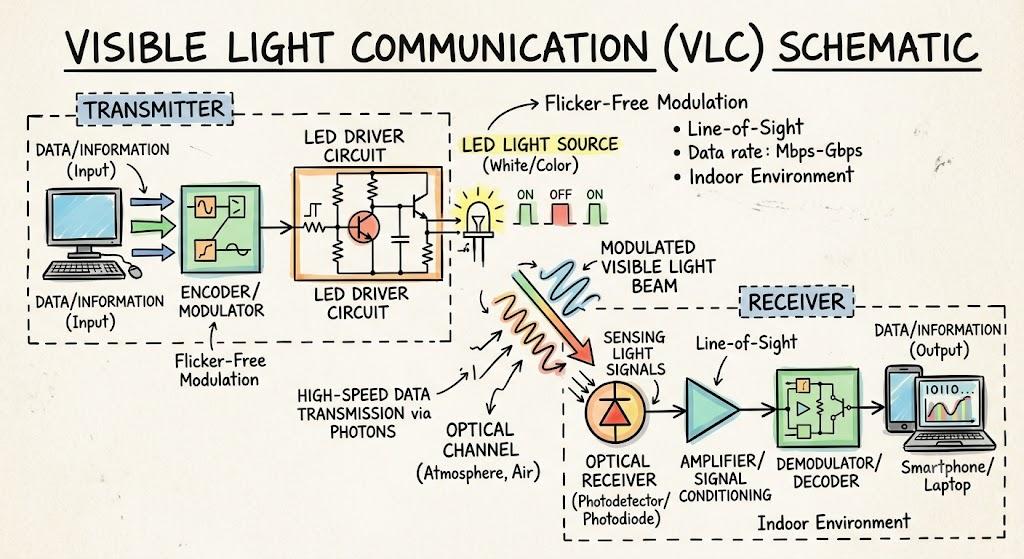
A Visible Light Communication system is composed of a few key components that work together to turn light into data. The transmitter side is integrated into an LED light fixture. It consists of an LED bulb and a driver that includes a modulation integrated circuit (IC). This IC takes the digital data stream and modulates the current flowing to the LED, causing it to flicker on and off at millions or even billions of times per second. The receiver side, which can be a USB dongle or integrated into a device, contains a photodiode. This highly sensitive light detector captures the flickering light and converts the variations in intensity back into an electrical signal. A trans-impedance amplifier (TIA) then strengthens this signal, and a demodulation circuit decodes it back into the original digital data. This elegant interplay between transmitter and receiver is what enables the dual functionality of simultaneous illumination and high-speed data transmission.
Inherent Security: A Key Differentiator
One of the most significant advantages of Visible Light Communication is its inherent physical security. Unlike radio waves from Wi-Fi, which easily penetrate walls and can be intercepted by someone outside a building, light is contained by opaque physical barriers. For a device to connect to a Li-Fi network, it must be within the line of sight of the light source in that specific room. This means that data cannot be "sniffed" or eavesdropped upon from an adjacent room, a hallway, or a car in the parking lot. This physical containment makes VLC an ideal solution for environments where data security is paramount, such as government and military facilities, corporate boardrooms, and research and development labs. By creating a well-defined and physically contained network perimeter, VLC offers a layer of security that radio frequency technologies simply cannot match by their very nature.
Future Vision: A Fully Integrated and Luminous Network
Looking toward 2035, the vision for VLC is a world where high-speed connectivity is as ubiquitous and simple as turning on a light. The technology will move beyond niche applications and become a standard feature in commercial and residential lighting fixtures. Future smartphones, laptops, and IoT devices will have VLC receivers integrated directly into them, eliminating the need for dongles and enabling seamless connectivity. We will see the rise of hybrid networks where a device can intelligently switch between Li-Fi and Wi-Fi for optimal performance, using Li-Fi for high-speed, secure downloads and Wi-Fi for the return data path. This vision of a fully integrated, luminous network promises to solve the challenges of RF congestion and security, paving the way for a faster, safer, and more connected digital future powered by the very lights that illuminate our world.
➤ In-Depth Market Studies by Market Research Future:

 English
 Arabic
 French
 Spanish
 Portuguese
 Deutsch
 Turkish
 Dutch
 Italiano
 Romaian
 Portuguese (Brazil)
 Greek
