


Water Soluble Packaging Market Forecast to Reach USD 6.69 Billion by 2036, with Kuraray, Mondi Group and SEKISUI Chemical Leading the Competitive Landscape
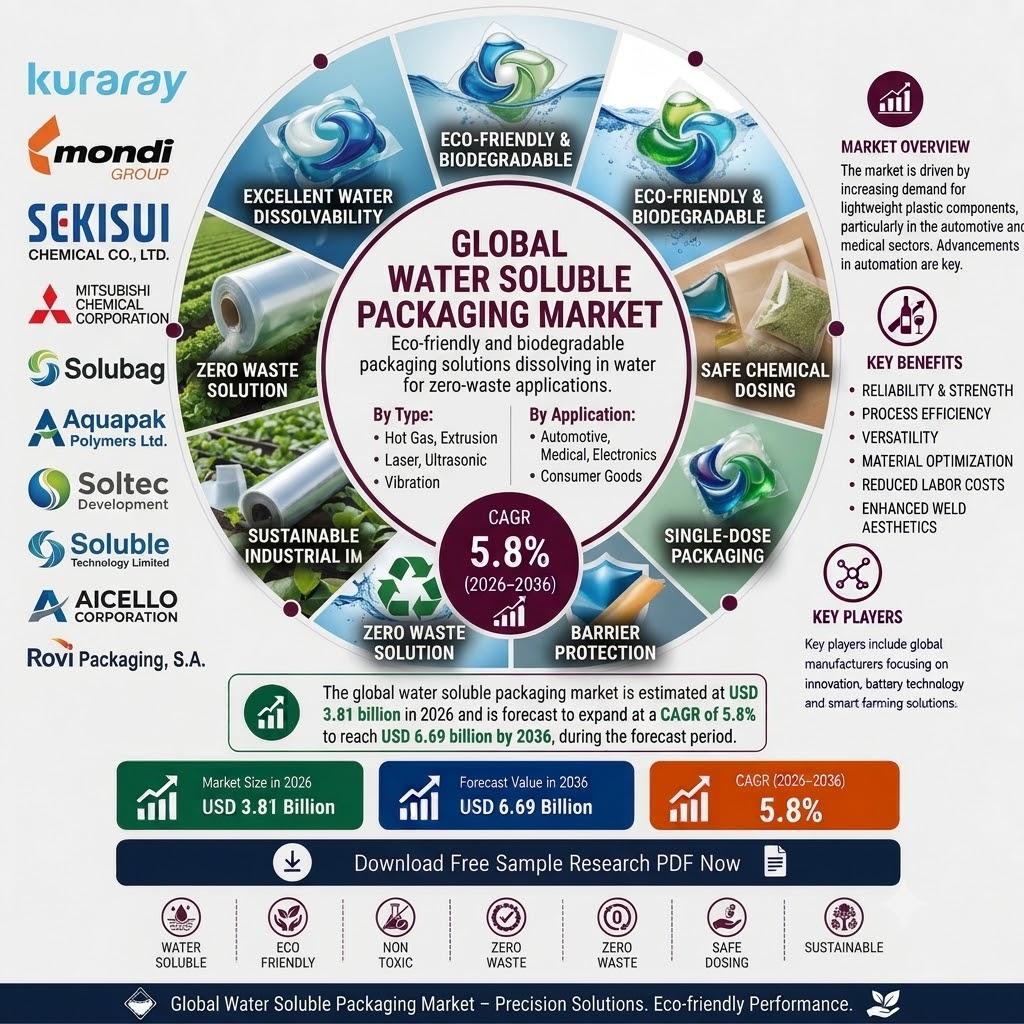
The global water soluble packaging market is estimated at USD 3.81 billion in 2026 and is projected to reach USD 6.69 billion by 2036, expanding at a compound annual growth rate (CAGR) of 5.8% during the forecast period, according to Fact.MR. Demand is increasing as manufacturers across household care, agriculture, and healthcare adopt dissolvable packaging formats that support precise product dosing and reduce dependence on conventional single-use packaging.
Water soluble packaging includes films, bags, pouches, capsules, and pods made primarily from polyvinyl alcohol (PVA/PVOH) and blended polymers. These materials dissolve upon contact with water, making them suitable for applications where controlled product release, convenient handling, and measured quantities are important.
Get detailed market forecasts, competitive benchmarking, and pricing trends: https://www.factmr.com/connectus/sample?flag=S&rep_id=12172
Market Drivers and Emerging Trends
The growing popularity of laundry detergent pods and dishwasher capsules is a major demand driver. These formats offer consumers pre-measured doses and convenient handling. Their adoption is increasing demand for cold-water-soluble films that dissolve during standard washing cycles.
Agriculture is creating another important opportunity. Water-soluble pesticide and fertilizer sachets help workers handle concentrated chemicals with less direct contact. They also support accurate dosing, reducing the risk of handling errors during application. As agricultural safety requirements receive greater attention, dissolvable packaging is gaining relevance across crop protection supply chains.
Pharmaceutical applications are broadening the market's potential. Oral dissolving films, single-dose sachets, and specialized unit-dose formats offer opportunities for manufacturers developing higher-value packaging materials. Innovation in multilayer PVA films is also improving barrier properties, mechanical strength, and dissolution control, allowing suppliers to address more demanding applications.
Segmental Analysis
PVA/PVOH accounts for 65% of the material type segment in 2026. Its established film-forming properties, water solubility, and commercial use across detergent, agrochemical, and pharmaceutical packaging support its leading position. Blended polymers, starch-based materials, and cellulose-based films are emerging as alternatives for specialized applications.
Films hold 45% of the product type segment, supported by their use in detergent pods, pouches, and sachets. Cold-water-soluble formulations account for 60% of the solubility type segment, reflecting the requirements of household laundry and dishwashing products.
Detergents represent 40% of the application segment in 2026. Household care accounts for 35% of the end-use industry segment, supported by growing use of pre-measured cleaning products. Healthcare and pharmaceutical packaging is emerging as a high-value growth area.
Regional Growth Outlook
India is projected to register the fastest country-level growth, with a CAGR of 6.4% through 2036. Expanding household care consumption, agrochemical safety requirements, and emerging domestic PVA production capacity are supporting demand.
China follows with an anticipated CAGR of 6.1%, driven by household pod adoption, agricultural packaging needs, and domestic film production. The United States is expected to grow at 5.8%, supported by established detergent pod consumption and expanding pharmaceutical unit-dose applications.
Germany is projected to record a CAGR of 4.9%, while the United Kingdom and Japan are expected to expand at 4.6% and 4.3%, respectively. Regulatory attention to plastic packaging waste and established household care markets will continue to influence demand across these countries.
Analyst Perspective
Shambhu Nath Jha, Principal Consultant at Fact.MR, says, “Water soluble packaging is evolving from a niche format for detergent pods into a platform technology serving multiple industries.”
He identifies consumer demand for pre-measured convenience, regulatory pressure to reduce plastic waste, and worker safety requirements in chemical handling as structural growth drivers. He also notes that innovation in blended polymers, starch-based films, and cellulose alternatives is creating competition for conventional PVA materials.
Companies with vertically integrated PVA production and broad application expertise are positioned to strengthen their market presence. Material performance, customization, and production economics will remain important competitive factors as adoption expands.
Competitive Landscape
The water soluble packaging market is moderately consolidated, with the top five manufacturers accounting for over 25% of market share. Kuraray holds approximately 15% through its MonoSol subsidiary, supported by dedicated water-soluble film production capacity and a broad portfolio of PVOH-based materials.
Key players profiled by Fact.MR include Kuraray, Mondi Group, SEKISUI Chemical Co. Ltd., Mitsubishi Chemical Corporation, Solubag, Aquapak Polymers Ltd., Soltec Development, Soluble Technology Limited, AICELLO Corporation, and Rovi Packaging S.A.
Recent developments highlight the importance of material innovation and intellectual property. Kuraray showcased an expanded portfolio of PVOH-based sustainable packaging materials at K 2025, including biocircular grades produced at its Antwerp facility. In November 2025, SEKISUI Chemical enforced a patent injunction against Kuraray Europe concerning certain PVB interlayer products in Germany, reflecting the growing importance of proprietary material technologies.
Market Snapshot
- Market value (2026): USD 3.81 billion
- Forecast value (2036): USD 6.69 billion
- CAGR (2026–2036): 5.8%
- Leading material type: PVA/PVOH (65%)
- Leading product type: Films (45%)
- Leading solubility type: Cold-water-soluble formulations (60%)
- Leading application: Detergents (40%)
- Fastest-growing country: India (6.4% CAGR)
To View Related reports
https://afgbfh.blogspot.com/2026/10/bioceramics-market-to-record-usd-413.html
https://sportgalax.com/read-blog/26717
About Fact.MR
Fact.MR is a market research and competitive intelligence provider delivering market intelligence, competitive analysis, and forecasting across global industries. Its research helps businesses evaluate market demand, understand competitive developments, and identify growth opportunities.

 English
 Arabic
 French
 Portuguese
 Deutsch
 Turkish
 Dutch
 Italiano
 Russian
 Romaian
 Portuguese (Brazil)
 Greek
