


Graphic Design Market Outlook 2036: USD 110.5 Billion Forecast, China 9.7%, UK 7.0%, Germany 6.5%
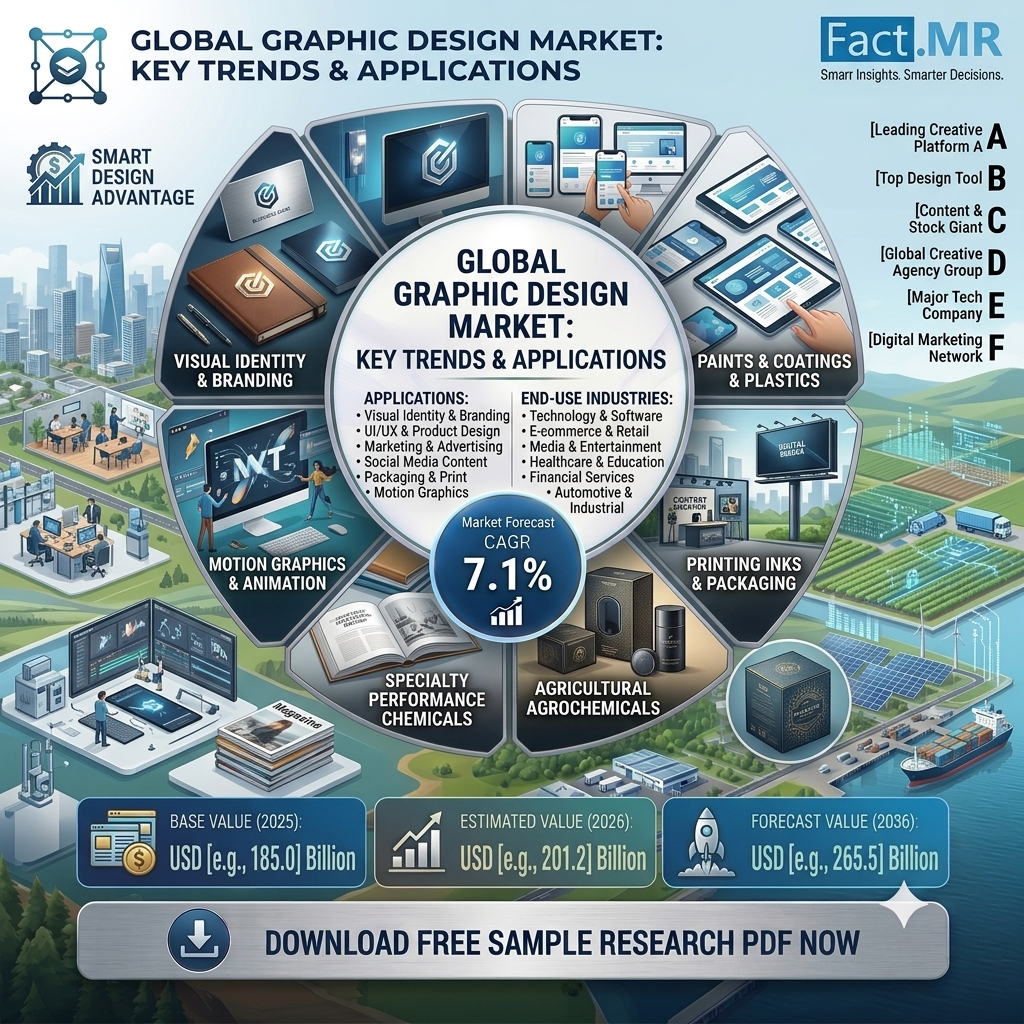
The global graphic design market is forecast to expand from USD 63.2 billion in 2026 to USD 110.5 billion by 2036, registering a 5.8% CAGR over the forecast period. Fact.MR attributes this expansion to increasing enterprise investment in digital marketing, growing demand for brand identity services, and the rising volume of visual content required across websites, mobile applications, and social media platforms. The market was valued at USD 59.7 billion in 2025 and is expected to generate an absolute dollar opportunity of USD 47.3 billion between 2026 and 2036.
Digital transformation is creating sustained demand for professional design services across industries. Businesses increasingly require consistent visual identities, localized marketing materials, and digital assets to communicate with customers across multiple platforms. The expansion of e-commerce, mobile-first advertising, and startup ecosystems is also supporting demand for branding and user-interface design. Meanwhile, AI-assisted design tools are changing production workflows by reducing the time required for routine creative tasks while increasing the volume of content businesses can produce.
Get detailed market forecasts, competitive benchmarking, and pricing trends:
https://www.factmr.com/connectus/sample?flag=S&rep_id=7742
Logo Design and Branding Retain Leading Position
By service type, logo design and branding are expected to account for approximately 32% of the graphic design market in 2026. Their leading position reflects the importance of visual identity for startups, established enterprises, and businesses entering new geographic markets. Companies continue investing in brand architecture, typography, and visual communication systems to maintain recognition across physical and digital channels.
Enterprises represent another major segment, accounting for approximately 58% of demand in 2026. Large organizations require recurring design support for advertising campaigns, product launches, corporate communications, and digital platforms. Their need for consistent branding across business units and regional markets supports continued engagement with professional agencies and design service providers.
Digital design is projected to capture approximately 78% of the market by delivery mode in 2026. The expansion of social media marketing, website development, mobile applications, and digital advertising is supporting this segment. Retail and consumer goods lead end-use demand with approximately 30% share, while project-based pricing accounts for around 55% of the market as businesses continue commissioning defined creative assignments.
China, United Kingdom, and Germany Show Strong Growth Potential
China is projected to record the fastest growth among the countries covered in the report, with graphic design demand advancing at a 9.7% CAGR from 2026 to 2036. The expansion of e-commerce, live-streaming commerce, and short-video marketing is creating continuous demand for localized visual content. According to the country's Ministry of Commerce, e-commerce transaction value exceeded RMB 46.8 trillion in 2024. Platforms such as Douyin and Taobao Live are supporting demand for mobile-first design assets among brands and online sellers.
The United Kingdom is expected to register a 7.0% CAGR through 2036. Its established advertising, publishing, and media industries provide a substantial base for professional design services. The UK's Creative Industries Council reported that the creative sector contributed GBP 124.8 billion to the national economy in 2023. Continued investment in digital branding, corporate identity, and multimedia content is supporting demand across the country's creative agency ecosystem.
Germany is forecast to expand at a 6.5% CAGR during the same period. Its established manufacturing sector and export-oriented businesses generate demand for product catalogues, trade fair materials, technical communication, and corporate identity services. The Bundesverband Digitale Wirtschaft reported that German digital advertising expenditure reached EUR 13.3 billion in 2024, supporting additional demand for digital campaign design and marketing assets.
India and the United States also represent important growth opportunities. India is projected to advance at a 9.2% CAGR, supported by startup formation and digital infrastructure development. The United States is expected to grow at an 8.4% CAGR, reflecting substantial enterprise advertising expenditure and recurring brand development requirements.
Competitive Landscape
Competition in the graphic design market includes global brand consultancies, specialized creative agencies, and independent design professionals. Key companies profiled by Fact.MR include AKQA, Landor & Fitch, Pentagram, Frog Design, MetaDesign, Leo Burnett, Studio Dumbar, SuperUnion, Metalab, and Sagmeister & Walsh.
The market remains highly fragmented, with companies competing through creative expertise, industry specialization, client relationships, and service delivery capabilities. Large enterprises increasingly prefer long-term agency partnerships and approved vendor arrangements to maintain brand consistency and manage design expenditure. Freelance platforms such as Fiverr and Upwork are also influencing competition by providing businesses with access to flexible design resources.
Artificial Intelligence and Digital Marketing Shape the Market
The graphic design industry is undergoing a technological transition as AI-assisted creative tools become more widely adopted. Platforms such as Adobe Firefly, Canva, and Midjourney are enabling faster production of visual assets and reducing the time required for repetitive design activities. Fact.MR notes that Adobe Firefly generated more than 9 billion images between its launch in 2023 and mid-2025, demonstrating the growing use of generative AI in creative workflows.
Digital advertising expenditure is another important growth driver. The Interactive Advertising Bureau reported that U.S. digital advertising revenue reached USD 258.6 billion in 2024, representing a 15.6% increase from the previous year. Higher spending on digital campaigns is supporting demand for advertising creatives, social media graphics, and visual content adapted to different platforms.
However, AI adoption is also placing pressure on pricing for standardized design services. Agencies are responding by emphasizing strategic branding, creative direction, and integrated design solutions that extend beyond routine asset production. Subscription-based service models are gaining relevance as enterprises seek predictable access to ongoing design support.
As businesses increase their reliance on digital communication and brand differentiation, demand for professional graphic design services is expected to remain steady through 2036. Companies combining creative expertise with AI-supported workflows and long-term client relationships are positioned to address changing procurement requirements across global markets.
Top Reports:
https://adamaamresearch.blogspot.com/2026/10/herbal-supplement-market-to-reach-usd.html
https://net-pals.com/blogs/61035/Herbal-Supplement-Market-2036-Forecast-USD-116-6-Billion-India
https://acmingle.com/blogs/33554/Herbal-Supplement-Market-2036-Outlook-India-11-1-UK-8
https://ikofficial.com/blogs/61676/Herbal-Supplement-Market-Expansion-to-USD-116-6-Billion-by
About Fact.MR
Fact.MR is a market research and consulting company providing market intelligence, competitive analysis, and forecasting across global industries. Its research supports businesses with data-driven insights into emerging markets, technology trends, competitive dynamics, regional opportunities, and changing demand patterns.

 English
 Arabic
 French
 Spanish
 Portuguese
 Deutsch
 Dutch
 Italiano
 Russian
 Romaian
 Portuguese (Brazil)
 Greek
