


Plastic Welding Equipment Market Forecast to Reach USD 3.16 Billion by 2036, with Leister, Dukane and Emerson Leading the Competitive Landscape
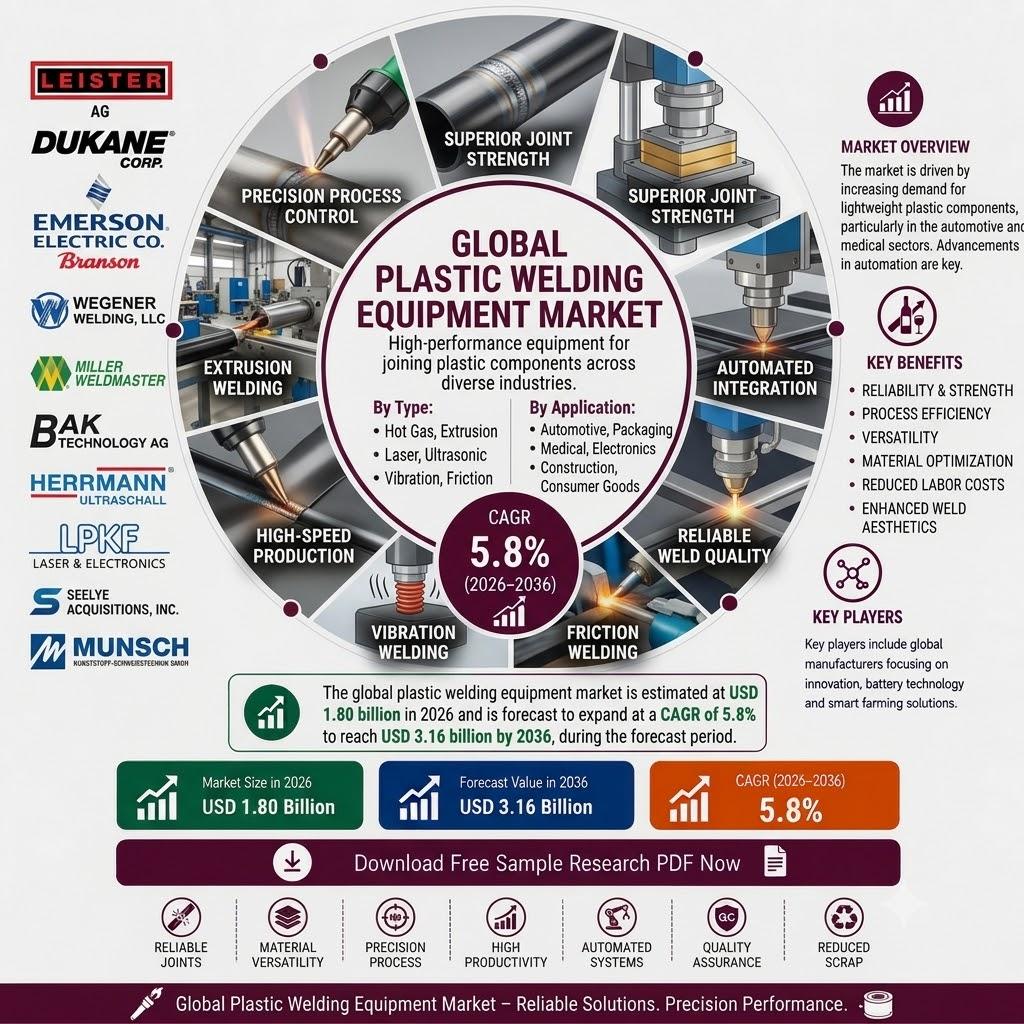
The global plastic welding equipment market is estimated at USD 1.80 billion in 2026 and is projected to reach USD 3.16 billion by 2036, expanding at a compound annual growth rate (CAGR) of 5.8% during the forecast period, according to Fact.MR. Growing use of thermoplastic components across automotive, electronics, healthcare, and industrial manufacturing is creating demand for equipment that delivers precise, repeatable, and reliable joints.
Plastic welding systems use technologies such as ultrasonic, hot plate, laser, vibration, and spin welding to join thermoplastic components without relying on adhesives or mechanical fasteners. Manufacturers are investing in these systems to improve production efficiency, maintain consistent product quality, and support increasingly automated assembly operations.
Get detailed market forecasts, competitive benchmarking, and pricing trends: https://www.factmr.com/connectus/sample?flag=S&rep_id=12347
Market Drivers and Emerging Trends
Automotive manufacturing is a major source of demand. Increasing plastic content in vehicle dashboards, door panels, fluid reservoirs, air intake systems, and electric vehicle battery enclosures is expanding the need for automated welding equipment. Lightweight plastic components help manufacturers address vehicle weight and design requirements while maintaining structural performance.
Medical device production is another important growth driver. Disposable products such as syringes, IV components, and diagnostic cartridges require clean, reliable joints. Ultrasonic and laser welding systems support precision assembly while limiting particulates and avoiding adhesives in applications where product quality and cleanliness are critical.
Electronics manufacturers are also adopting precision welding systems for casings, connectors, sensors, and control unit housings. At the same time, Industry 4.0 integration is changing equipment specifications. Robotic welding cells, inline quality monitoring, and process data logging are becoming important features in high-volume production environments.
Laser plastic welding is emerging as the fastest-growing technology. Its ability to produce clean, aesthetically consistent joints makes it suitable for medical devices, consumer electronics, and visible automotive components. The technology also supports applications involving transparent and multi-colour plastic assemblies.
Segmental Analysis
Ultrasonic welders account for 30% of the product type segment in 2026. Their fast cycle times, clean weld joints, and compatibility with different thermoplastics support demand across automotive, medical device, and electronics manufacturing.
Automotive represents 30% of the application segment in 2026. Demand is supported by the expanding use of plastic components in vehicle interiors, under-the-hood assemblies, and electric vehicle systems.
Fully automated equipment holds 45% of the automation level segment. Robotic welding cells and integrated production lines are gaining traction among manufacturers seeking repeatability, higher throughput, and improved process control. Thermoplastics account for 85% of material compatibility demand, reflecting the widespread use of polypropylene, polyethylene, ABS, and polycarbonate in manufactured components.
Regional Growth Outlook
India is projected to record the fastest growth, with a CAGR of 7.1% through 2036. Expanding automotive production, electronics manufacturing, medical device investment, and factory automation are supporting equipment demand.
China follows with an anticipated CAGR of 6.8%, driven by its large manufacturing base and increasing adoption of automated welding systems. Saudi Arabia is forecast to grow at 6.3%, supported by industrial diversification and expansion in packaging and petrochemical fabrication.
Brazil is projected to register 5.6% growth, while Japan and Germany are expected to expand at 5.1% and 4.9%, respectively. The United States is forecast to record a CAGR of 4.7%, supported by automotive lightweighting, medical device production, and electric vehicle component manufacturing.
Analyst Perspective
Shambhu Nath Jha, Principal Consultant at Fact.MR, identifies the convergence of automotive lightweighting, medical device production, and electronics assembly automation as a key force accelerating the market.
He also highlights the growing competitive distinction between full-solution providers and equipment-focused manufacturers. Application engineering, process validation, robotic integration, and aftermarket support are becoming important differentiators. Companies with broader technology portfolios and stronger engineering capabilities are positioned to address increasingly specialized manufacturing requirements.
Competitive Landscape
The plastic welding equipment market is moderately concentrated, with competition shaped by technology breadth, application engineering, automation integration, and service capabilities. Leister AG holds approximately 19% market share, supported by its portfolio spanning hot air, laser, and ultrasonic platforms.
Key players profiled by Fact.MR include Leister AG, Dukane Corp., Emerson Electric Co., Herrmann Ultraschall, LPKF Laser & Electronics, WEGENER Welding, Miller Weldmaster, BAK Technology AG, Seelye Acquisitions, Inc., and MUNSCH Kunststoff-Schweisstechnik GmbH.
Recent industry developments reflect increasing investment in advanced welding platforms. Leister has expanded its integrated laser and ultrasonic welding capabilities, while LPKF has strengthened its precision laser welding portfolio for medical device applications. Herrmann Ultraschall has also expanded robotic integration within its ultrasonic welding systems to support automated production lines.
Market Snapshot
- Market value (2026): USD 1.80 billion
- Forecast value (2036): USD 3.16 billion
- CAGR (2026–2036): 5.8%
- Leading product type: Ultrasonic welders (30%)
- Leading application: Automotive (30%)
- Leading automation level: Fully automated equipment (45%)
- Material compatibility leader: Thermoplastics (85%)
- Fastest-growing country: India (7.1% CAGR)
To View Related Reports
https://afgbfh.blogspot.com/2026/10/utility-analytics-and-energy-analytics.html
https://sportgalax.com/read-blog/26711
About Fact.MR
Fact.MR is a market research and competitive intelligence provider delivering market intelligence, competitive analysis, and forecasting across global industries. Its research helps businesses evaluate market demand, understand competitive developments, and identify growth opportunities.

 English
 Arabic
 French
 Spanish
 Portuguese
 Deutsch
 Turkish
 Dutch
 Russian
 Romaian
 Portuguese (Brazil)
 Greek
