


Enteral Feeding Formulas Market Growth, Analysis Industry Outlook & Region Forecast Analysis By Fact.MR
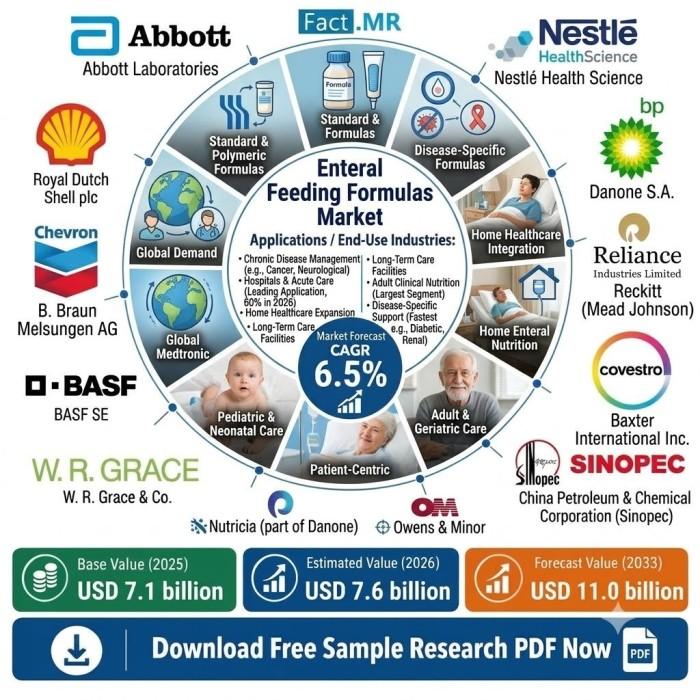
Rockville, Maryland, October 29, 2026 — The global enteral feeding formulas market is projected to reach USD 14.87 billion by 2036, increasing from an estimated USD 8.46 billion in 2026, according to Fact.MR. The market is forecast to expand at a compound annual growth rate (CAGR) of 5.8% over the 2026–2036 period, creating an absolute dollar opportunity of USD 6.41 billion.
The market outlook reflects rising demand for clinical nutrition in hospitals, intensive care units, long-term care facilities, and homecare settings. Growing adoption of disease-specific formulas is also creating opportunities for manufacturers that can align product development with patient requirements and evolving clinical nutrition practices.
Fact.MR identifies Abbott Laboratories, Danone S.A., Fresenius Kabi AG, Nestlé Health Science S.A., Victus, and Primus Pharmaceuticals, Inc. among the companies operating in the enteral feeding formulas market. Other companies identified in the report include Meiji Holdings Co., Ltd., Mead Johnson & Company, LLC, Alcresta Therapeutics, Inc., and Kate Farms, Inc.
Get detailed market forecasts, competitive benchmarking, and pricing trends:
Key Takeaways: Enteral Feeding Formulas Market
- 2026 market value: USD 8.46 billion.
- 2036 market forecast: USD 14.87 billion.
- Forecast CAGR: 5.8% between 2026 and 2036.
- Leading product segment: Standard formula, accounting for 54% of the product segment in 2026.
- Leading flow type: Intermittent feeding, representing 56% of the application segment in 2026.
- High-growth countries: India at 6.4% CAGR and China at 6.1% CAGR through 2036.
- Competitive focus: Specialized formulations, clinical evidence, product quality, pricing, and distribution capabilities.
Why Is the Enteral Feeding Formulas Market Growing?
Enteral feeding formulas provide nutritional support to patients who cannot meet their nutritional requirements through regular oral food intake alone. Demand is supported by expanding clinical nutrition programs and the need to manage nutritional requirements across critical care, chronic disease management, oncology, pediatric care, and long-term treatment settings.
The growing burden of chronic diseases, including cancer and neurological disorders, is expanding the population requiring tube-fed nutritional support. At the same time, investments in hospital and intensive care capacity are creating additional procurement opportunities, particularly in developing healthcare markets.
The expansion of homecare feeding programs is another important demand driver. Healthcare providers and caregivers increasingly require convenient nutritional products suitable for continued use outside traditional hospital settings. Manufacturers that can support homecare requirements through appropriate product formats and distribution networks may be better positioned to address this demand.
Disease-Specific Formulas Create Opportunities for Manufacturers
Standard formulas remain the leading product category, accounting for 54% of the enteral feeding formulas market's product segment in 2026, according to Fact.MR.
However, disease-specific formulations represent an important area of product development. Formulas designed for diabetes management, renal care, hepatic conditions, and pulmonary care address different nutritional requirements. Elemental and semi-elemental products also serve specialized patient populations.
This diversification creates opportunities for manufacturers to develop differentiated portfolios rather than compete exclusively on standard products and pricing. Companies can evaluate investment priorities across formulation research, clinical validation, product availability, and healthcare-provider engagement.
For procurement teams, the growing range of specialized products makes it important to assess suitability for clinical protocols, product consistency, supply reliability, and total purchasing costs. Commercial success will depend on matching formulation capabilities with the requirements of hospitals, long-term care providers, and homecare channels.
Top Companies in the Enteral Feeding Formulas Market
Fact.MR identifies the following 10 companies in its market analysis:
1. Abbott Laboratories
2. Danone S.A.
3. Fresenius Kabi AG
4. Nestlé Health Science S.A.
5. Victus
6. Primus Pharmaceuticals, Inc.
7. Meiji Holdings Co., Ltd.
8. Mead Johnson & Company, LLC
9. Alcresta Therapeutics, Inc.
10. Kate Farms, Inc.
This list reflects companies named in the Fact.MR report and is not a ranked assessment of market share, revenue, or competitive performance.
The competitive landscape is described as moderately fragmented, with established healthcare and nutrition companies competing alongside specialized manufacturers. Product quality, clinical evidence, pricing, service support, and distribution capabilities influence competitive positioning.
For market participants, potential strategic priorities include strengthening specialized product portfolios, improving access to hospitals and homecare providers, and developing distribution arrangements that support reliable product availability. Companies must also consider regulatory requirements and price sensitivity across different healthcare systems.
Which Regional Markets Offer the Strongest Growth Opportunities?
Asia-Pacific offers significant growth opportunities, with India and China recording the highest country-level growth rates among the markets highlighted in the Fact.MR report.
India: The enteral feeding formulas market is forecast to grow at a CAGR of 6.4% through 2036. Healthcare infrastructure expansion, institutional investment, and improving clinical adoption support the outlook. Manufacturers may evaluate distribution partnerships and product availability to strengthen their reach across healthcare facilities.
China: The market is projected to expand at a CAGR of 6.1% through 2036. Healthcare development and increasing clinical adoption support demand. Market entry and expansion strategies will need to account for local regulatory requirements, distribution capabilities, and purchasing conditions.
Japan: The market is forecast to grow at a CAGR of 5.7%. Established healthcare infrastructure and institutional demand provide a basis for evaluating specialized nutrition opportunities.
United States: The market is projected to grow at a CAGR of 4.9%. Established healthcare infrastructure and institutional procurement support demand, while competition and purchasing costs remain relevant commercial considerations.
Germany: The market is forecast to grow at a CAGR of 4.6%. Clinical nutrition standards, healthcare infrastructure, and an aging population contribute to the country's market outlook.
These country-level forecasts can help manufacturers prioritize market assessments, but investment decisions should also consider reimbursement conditions, regulatory requirements, competitive intensity, and channel economics.
What Challenges Could Affect Market Expansion?
Despite the positive outlook, manufacturers face several constraints. Cost sensitivity in price-conscious healthcare settings can limit adoption of premium formulations. Differences in clinical awareness may also affect demand for specialized products, while regulatory variations across countries add complexity to product development and commercialization.
Companies can respond by evaluating product affordability, strengthening clinical education, and adapting their market-entry strategies to local requirements. Supply reliability and the ability to demonstrate product suitability for intended patient populations will remain important considerations for institutional buyers.
Integrated care offerings and improved product usability may also create opportunities. However, their commercial potential depends on demonstrated customer requirements, procurement economics, and compliance with applicable regulations.
Business Outlook: What Should Market Participants Prioritize?
The projected increase in market value from USD 8.46 billion in 2026 to USD 14.87 billion in 2036 provides a basis for manufacturers, suppliers, distributors, and investors to evaluate long-term opportunities in clinical nutrition.
Three areas warrant attention: specialized formulation development, expansion of homecare distribution, and stronger access to hospital and long-term care procurement channels. Companies should compare these opportunities against their existing capabilities, target-market requirements, and cost structures before committing resources.
The outlook also reinforces the importance of balancing product differentiation with affordability. Manufacturers that can demonstrate product quality, maintain reliable supply, and meet the requirements of healthcare providers will be better equipped to compete as nutritional care expands across institutional and homecare settings.
About the Enteral Feeding Formulas Market Report
Fact.MR's Enteral Feeding Formulas Market report examines global and regional market trends, forecasts, competitive positioning, product categories, feeding flow types, end users, applications, and country-level growth opportunities. The forecast covers 2026 to 2036 and includes analysis of standard formulas, disease-specific formulas, and elemental formulas.
The report uses a combination of secondary research, primary interviews, demand-side market assessment, and forecast modeling to evaluate industry developments.
Frequently Asked Questions
1. What is the projected size of the enteral feeding formulas market by 2036?
Fact.MR projects the global market to reach USD 14.87 billion by 2036.
2. What is the expected CAGR of the enteral feeding formulas market?
The market is forecast to grow at a CAGR of 5.8% between 2026 and 2036.
3. Which companies are identified in the market report?
Key companies include Abbott Laboratories, Danone S.A., Fresenius Kabi AG, Nestlé Health Science S.A., Victus, Primus Pharmaceuticals, Inc., Meiji Holdings Co., Ltd., Mead Johnson & Company, LLC, Alcresta Therapeutics, Inc., and Kate Farms, Inc.
4. Which product segment leads the market?
Standard formula is expected to account for 54% of the product segment in 2026.
5. Which countries have the highest projected growth rates?
India leads the country forecasts highlighted in the report at 6.4% CAGR, followed by China at 6.1% through 2036.
6. What factors are driving demand for enteral feeding formulas?
Demand is supported by chronic disease prevalence, hospital and intensive care expansion, specialized nutritional requirements, and growing homecare feeding programs.
Unlock 360° insights for strategic decision making and investment planning / Read the full report:
Explore More Related Studies Published by Fact.MR Research
Pharmaceutical Manufacturing Fastener Market
Diphtheria, Tetanus, and Pertussis (DTaP) Vaccine Market
About Fact.MR
Fact.MR is a market research and consulting firm providing syndicated research, customized research, investment research, and market intelligence across a broad range of industries. Its research coverage includes food and beverage, healthcare, pharmaceuticals, biotechnology, consumer products, chemicals and materials, technology, industrial goods, and packaging.
Fact.MR provides market intelligence designed to help organizations understand market dynamics, emerging opportunities, competitive developments, and changing industry requirements.
Media Contact
Fact.MR
Email: sales@factmr.com
Phone: +1 (628) 251-1583
Website: www.factmr.com

 English
 Arabic
 French
 Spanish
 Portuguese
 Deutsch
 Turkish
 Dutch
 Russian
 Romaian
 Portuguese (Brazil)
 Greek
