


How does Modular IVF OT Design support contamination control and laboratory workflow?
Introduction
In an in vitro fertilisation (IVF) facility, maintaining a controlled environment is essential for laboratory operations involving oocytes, sperm, and embryos. Contamination risks, unstable environmental conditions, unnecessary movement, and poorly organised workstations can create challenges for embryologists and clinical teams. Therefore, an IVF operation theatre and its associated laboratory areas must be planned with careful attention to air quality, hygiene, equipment positioning, and the movement of personnel and materials.
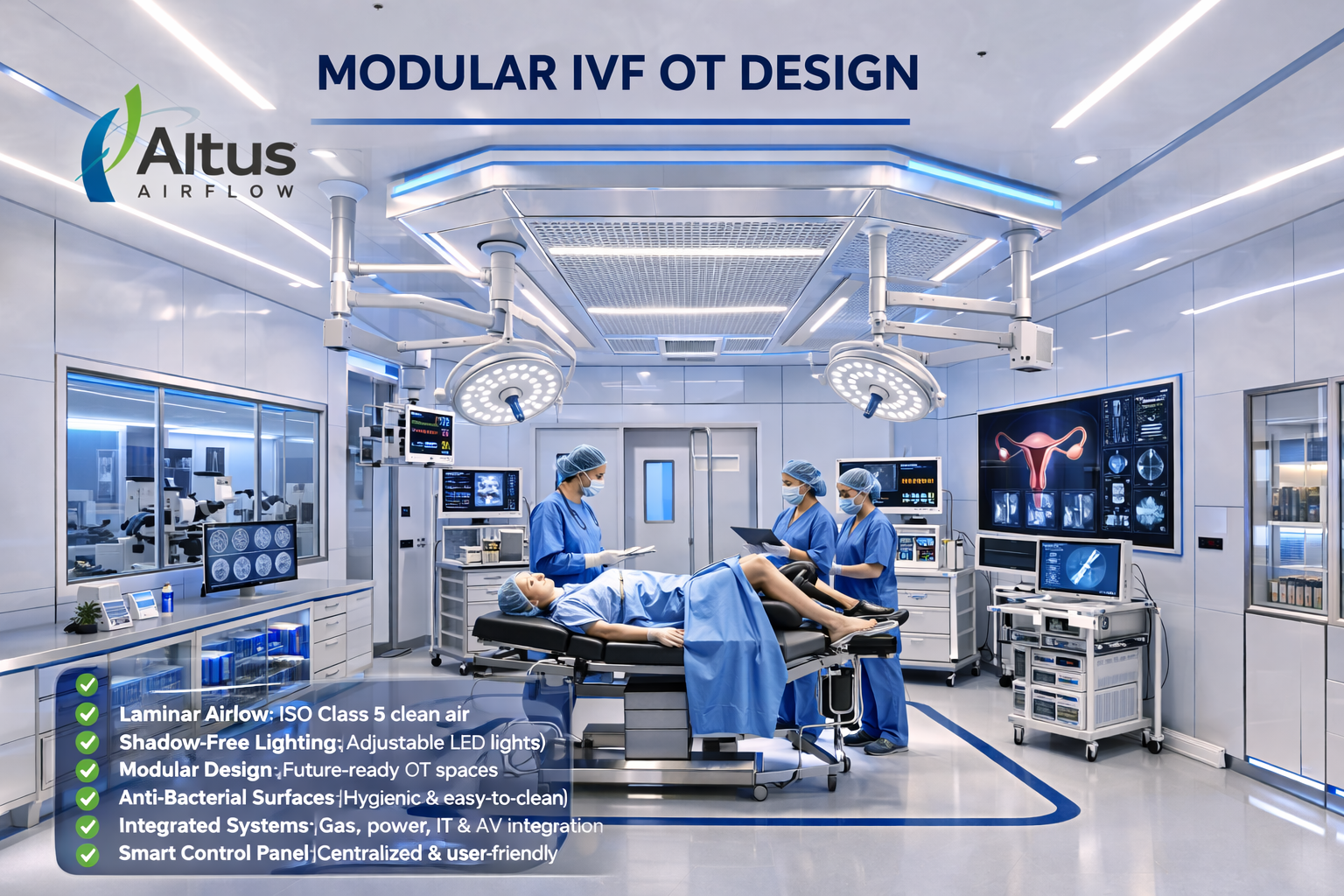
Modular IVF OT Design supports these requirements by integrating the physical layout, modular construction, ventilation systems, and technical infrastructure into a coordinated facility plan. Instead of treating the operating theatre and laboratory as isolated spaces, the design process considers how they function together throughout assisted reproductive procedures.
A well-planned facility can help reduce avoidable contamination pathways, support consistent laboratory practices, and improve staff workflow. However, modular construction alone cannot guarantee embryo safety or successful IVF outcomes. The design must work alongside validated equipment, environmental monitoring, documented procedures, and trained laboratory personnel.
The European Society of Human Reproduction and Embryology (ESHRE) published updated recommendations for good practice in IVF laboratories in 2026, covering laboratory design, air quality, equipment, safety, and quality management. These recommendations reinforce the importance of integrating environmental controls with daily laboratory operations.
1. Why Is Contamination Control Important in IVF Facilities?
IVF laboratories handle reproductive cells and embryos that require carefully controlled working conditions. Environmental contaminants, including airborne particles, volatile organic compounds (VOCs), and inappropriate handling practices, must be managed according to the facility's risk assessment and applicable technical requirements.
Contamination control is not limited to cleaning the room after installation. It begins during planning and continues through construction, commissioning, laboratory operation, and routine maintenance.
A suitable design considers the movement of people, the introduction of materials, cleaning procedures, equipment placement, and the environmental conditions surrounding sensitive laboratory activities.
Modular construction can support these objectives through smooth, cleanable surfaces, properly finished joints, compatible materials, and planned service access. When these elements are coordinated early, the laboratory team can maintain the environment more consistently and identify potential contamination risks before the facility becomes operational.
2. How Does Modular Construction Support a Cleaner Environment?
Traditional construction can leave difficult-to-clean junctions, exposed gaps, uneven finishes, and areas that collect dust. These details may complicate routine housekeeping and environmental maintenance.
Modular IVF facilities can incorporate purpose-selected wall panels, ceiling systems, flooring interfaces, and doors designed for cleanability and the intended laboratory environment. Sealed joints and suitable surface finishes can help minimise dust accumulation and simplify cleaning.
Material selection is particularly important in embryology laboratories. Construction products, coatings, adhesives, sealants, flooring, and furniture should be evaluated for their suitability and potential release of VOCs. Materials that are acceptable for a general hospital room may not automatically be appropriate for a sensitive IVF laboratory.
The construction and commissioning plan should also allow sufficient time for material off-gassing where required. Environmental conditions should be assessed before sensitive laboratory activities begin.
These measures help establish a facility that supports routine cleaning and controlled laboratory operations without relying on modular panels alone to prevent contamination.
3. How Does HVAC Design Help Control Airborne Contamination?
Heating, ventilation, and air conditioning (HVAC) systems play an important role in maintaining the environmental conditions required by an IVF facility. Their design should address particulate filtration, air distribution, temperature, humidity, pressure relationships, and control of relevant chemical contaminants.
High-efficiency particulate air (HEPA) filtration can remove airborne particles when correctly selected, installed, and maintained. However, HEPA filters do not independently remove all gaseous contaminants, including VOCs. Where risk assessment indicates a need, suitable gas-phase filtration and source control should also be considered.
Positive pressure may help reduce the entry of contaminated air from adjacent spaces when the room arrangement and ventilation strategy are designed appropriately. The pressure relationships between the IVF laboratory, procedure room, corridors, and supporting areas must be established according to the facility's requirements rather than assumed to be identical for every project.
Airflow design should account for room dimensions, equipment heat loads, ceiling services, access doors, and the positions of critical workstations. After installation, the HVAC system must be tested and commissioned against approved design criteria.
Regular monitoring and maintenance help identify changes in performance before they become significant operational problems.
4. How Does Modular IVF OT Design Improve Laboratory Workflow?
Laboratory workflow affects how efficiently embryologists and clinical teams perform their tasks. Poorly organised spaces can increase walking distances, create unnecessary movement, and extend the time reproductive cells spend outside controlled conditions during handling.
Modular IVF OT Design helps address these challenges by planning the relationship between the procedure room, embryology laboratory, equipment stations, staff access, and supporting spaces before construction begins.
Where practical and clinically appropriate, the embryology laboratory should be located close to the procedure room to support efficient movement of materials and personnel. Workstations should be arranged according to the sequence of laboratory activities, with adequate space for equipment operation and safe handling.
The design should also separate activities that do not belong in the main embryology workspace. Administrative tasks, general storage, cleaning and sterilisation, and work involving hazardous or volatile reagents may require dedicated areas based on the facility's operational needs.
A coordinated layout can reduce unnecessary crossings between clean and support activities while making it easier for staff to follow established standard operating procedures.
5. How Can Laboratory Zoning Reduce Contamination Risks?
Zoning divides the facility into areas with clearly defined functions and access requirements. In an IVF environment, this can help manage the movement of personnel, materials, waste, and equipment.
The precise zoning plan depends on the services offered, laboratory procedures, applicable regulations, and the facility's documented risk assessment.
A project may need to distinguish between:
- The IVF procedure or oocyte retrieval area.
- The embryology laboratory used for reproductive cell handling.
- Supporting areas for staff preparation and controlled entry.
- Equipment and consumables storage.
- Separate cleaning, sterilisation, and waste-handling areas.
- Cryopreservation facilities with appropriate safety provisions.
These areas should be connected through a practical circulation plan. Entry procedures, hand hygiene facilities, laboratory clothing arrangements, and material transfer routes should be established before the final layout is approved.
Restricted access helps prevent unnecessary traffic through sensitive areas. Where appropriate, controlled entry arrangements and pass-through systems can further support organised movement.
The objective is to make the correct workflow straightforward for staff while reducing opportunities for avoidable contamination.
6. How Does Equipment Placement Support Stable Laboratory Conditions?
IVF facilities depend on specialised equipment, including incubators, microscopes, workstations, temperature-controlled surfaces, and cryopreservation systems. Each item requires suitable positioning, utility access, and maintenance clearance.
Incorrect equipment placement can obstruct staff movement, interfere with ventilation distribution, or make routine servicing difficult. Equipment may also generate heat or require environmental conditions that must be considered during HVAC planning.
The engineering team should coordinate equipment schedules and layout drawings with the embryology team before installation. Important considerations include electrical connections, backup power for critical systems, gas supply arrangements where required, equipment clearances, and access for cleaning.
Incubators and other critical equipment should be selected, installed, and qualified for their intended use. Temperature, gas concentrations where applicable, alarms, and other operational parameters should be managed according to equipment specifications and laboratory procedures.
Cryopreservation equipment requires particular attention to storage location, monitoring, emergency response, and the safety arrangements appropriate to the system used.
By incorporating these requirements into the initial design, hospitals can reduce the need for disruptive modifications after the laboratory becomes operational.
7. How Can Temperature, Humidity, and Environmental Monitoring Be Managed?
Reproductive cells and embryos require carefully controlled handling conditions. Environmental stability is therefore an important part of IVF laboratory planning.
The facility design should establish suitable temperature and humidity control for the intended procedures and equipment. These parameters should be defined by the laboratory's validated processes, equipment specifications, and applicable guidance rather than applying a single target to every room or procedure.
Monitoring instruments should be appropriately calibrated, and records should be maintained according to the laboratory's quality management system. Where relevant, environmental monitoring may include airborne particles, microbial contamination, VOC trends, and pressure differentials.
The facility should also have a documented response process for measurements that fall outside approved limits. This process should identify who investigates the deviation, how corrective actions are recorded, and how the effectiveness of those actions is verified.
Environmental monitoring is most useful when it forms part of an ongoing quality programme rather than being performed only during initial commissioning.
8. How Can Staff Ergonomics and Operational Accuracy Improve?
Embryologists often perform detailed tasks that require concentration, precise movements, and sustained use of microscopes and other equipment. Poor ergonomics can contribute to fatigue, discomfort, and avoidable handling errors.
An effective design considers bench height, microscope viewing position, adjustable seating, lighting, work surface dimensions, and the amount of space available to each operator.
Frequently used tools and materials should be positioned logically without overcrowding the workspace. Equipment displays, controls, and connections should remain accessible, while cables and service routes should not interfere with movement or cleaning.
The layout should also support the laboratory's established procedures for patient identification, sample traceability, material transfer, and documentation. Physical design cannot replace staff training or procedural controls, but it can make correct practices easier to follow.
9. How Does Modular Design Support Installation and Commissioning?
The installation stage brings together architectural components, HVAC systems, electrical infrastructure, equipment supports, and other technical services. If these elements are planned independently, conflicts may arise between ceiling fixtures, ductwork, cable routes, and laboratory equipment.
A coordinated engineering process can help prevent these problems by reviewing drawings, verifying site measurements, confirming equipment requirements, and establishing installation sequences.
After construction, the facility should undergo appropriate commissioning and verification. This may include inspections of modular surfaces, checks of HVAC operation, verification of pressure relationships, review of filtration performance, and confirmation that critical equipment operates within its approved parameters.
Where applicable, the project team should also evaluate potential chemical contamination from new materials and confirm that the environment is suitable before reproductive cell handling begins.
The hospital should receive the required test reports, approved drawings, equipment documentation, maintenance schedules, and operating instructions. These records help laboratory staff maintain the intended conditions after handover.
10. What Should Hospitals Consider When Planning an IVF Facility?
Hospitals should involve embryologists, fertility specialists, biomedical engineers, HVAC professionals, infection-control personnel, and facility managers during the planning stage.
Their combined input helps ensure that the layout reflects actual clinical workflows instead of focusing only on room appearance or construction convenience.
Key considerations include laboratory adjacency to the procedure room, controlled personnel and material movement, low-emission construction materials, suitable air filtration, environmental monitoring, equipment integration, emergency power arrangements, and future maintenance access.
Hospitals should also establish clear acceptance criteria before commissioning begins. This helps determine whether the completed facility meets its intended environmental and operational requirements.
A modular approach can offer flexibility during construction and future modifications, but every change should be evaluated for its potential effect on airflow, room pressure, equipment performance, and laboratory procedures.
Conclusion
A properly planned IVF facility combines contamination-control measures with a practical laboratory workflow. Modular construction can support cleanable surfaces, organised zoning, coordinated ventilation, suitable equipment placement, and easier maintenance when these elements are designed around the laboratory's actual requirements.
Altus Airflow supports modular IVF operation theatre planning by focusing on coordinated layouts, airflow integration, technical infrastructure, and installation requirements. By combining engineering planning with appropriate commissioning, environmental monitoring, and laboratory procedures, healthcare facilities can establish an organised environment designed to support controlled IVF operations.
Frequently Asked Questions
1. How does Modular IVF OT Design support contamination control and laboratory workflow?
Modular IVF OT Design supports contamination control through cleanable modular surfaces, suitable construction materials, planned laboratory zoning, coordinated HVAC systems, and controlled personnel and material movement. It improves workflow by organising the procedure room, embryology laboratory, workstations, and equipment to minimise unnecessary movement and support efficient handling under controlled environmental conditions.
2. Why is HEPA filtration important in an IVF laboratory?
HEPA filtration helps remove airborne particles from supplied air when the system is correctly designed, installed, and maintained. Additional measures may be required to manage VOCs and other environmental risks.
3. Why should the IVF laboratory be close to the procedure room?
Locating the laboratory near the procedure room can reduce transfer distances and support efficient handling of reproductive cells. The final layout should also maintain appropriate separation between critical laboratory activities and unrelated support functions.
4. Which materials are suitable for modular IVF laboratory construction?
Materials should be cleanable, durable, compatible with approved cleaning agents, and suitable for the intended laboratory environment. Their potential release of VOCs should be considered because certain chemical contaminants may be harmful to sensitive reproductive cells and embryos.
5. What checks should be completed before an IVF laboratory becomes operational?
Checks should follow the approved commissioning plan and may include HVAC performance, pressure relationships, filtration, environmental conditions, surface cleanliness, equipment qualification, alarm systems, and backup power arrangements. Required results should be documented and reviewed before clinical operations begin.

 English
 Arabic
 French
 Spanish
 Deutsch
 Turkish
 Dutch
 Italiano
 Russian
 Romaian
 Portuguese (Brazil)
 Greek
