


Web3 Gaming Market to Grow at 18.5% CAGR Through 2036; UK Records 18.3% Growth Forecast
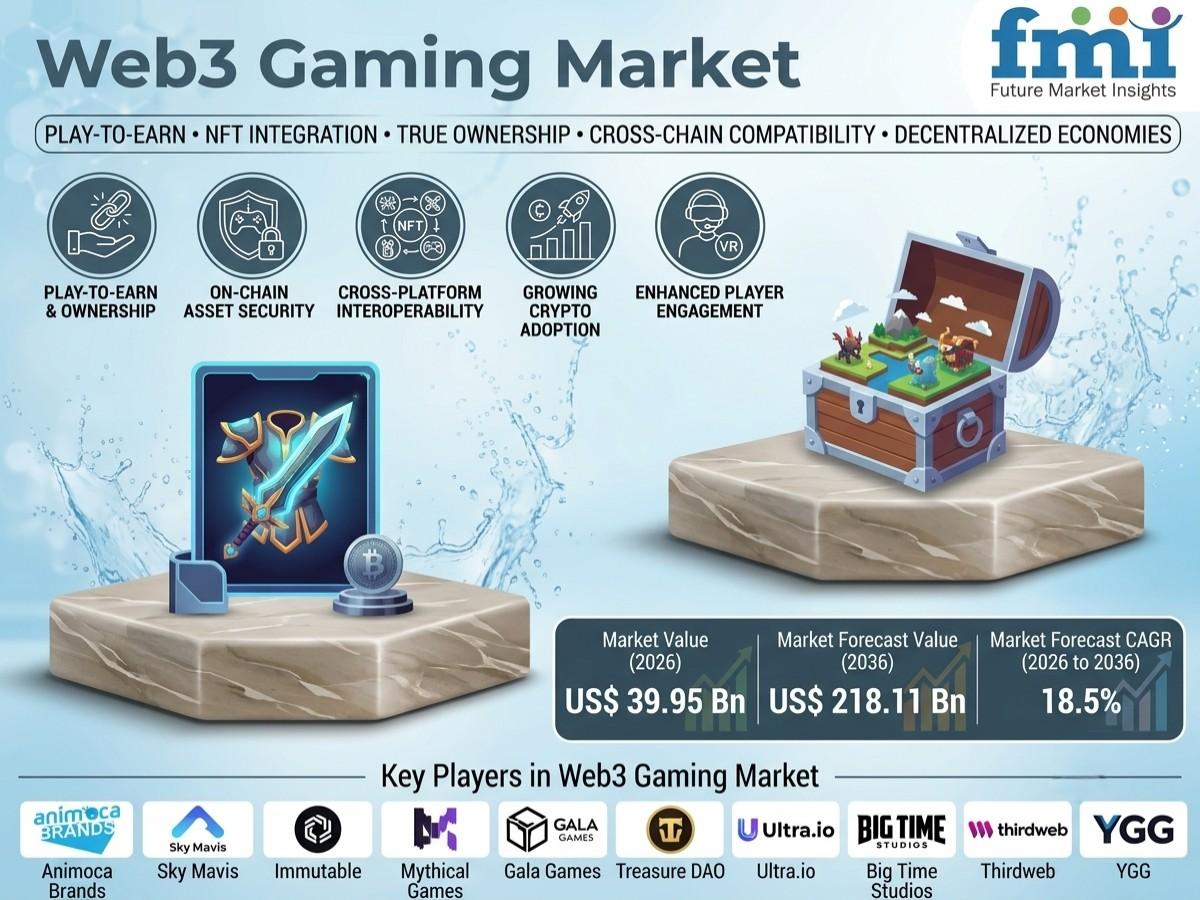
NEWARK, Del. — The global Web3 Gaming Market is projected to grow from US$39.95 billion in 2026 to US$218.11 billion by 2036, registering a compound annual growth rate (CAGR) of 18.5%, according to Future Market Insights (FMI). The market was valued at approximately US$33.71 billion in 2025, reflecting the growing commercial interest in blockchain-integrated gaming, digital asset ownership, and decentralized gaming ecosystems.
Web3 gaming integrates blockchain technology into video games, enabling features such as player-owned digital assets, token-based transactions, and NFT-supported game economies. As the market develops, gaming companies are evaluating how these capabilities can support player engagement without compromising gameplay quality or accessibility.
Access the Sample Report — Explore Key Insights Today!
https://www.futuremarketinsights.com/reports/sample/rep-gb-17570
Web3 Gaming Market Size and Forecast, 2026–2036
FMI estimates that the market will generate an incremental opportunity of approximately US$178.16 billion between 2026 and 2036. This outlook presents opportunities for game studios, blockchain infrastructure providers, digital asset platforms, and developers building tools for Web3 gaming ecosystems.
Market expansion will depend on the ability of companies to deliver engaging games while making blockchain features easier to use. Players must be able to access games, manage digital assets, and complete transactions without facing unnecessary technical complexity.
The commercial opportunity therefore extends beyond token rewards. Developers that balance entertainment value, accessible onboarding, and practical digital ownership features can address a broader audience than players already familiar with cryptocurrency.
Key Growth Drivers and Emerging Trends
Player ownership of digital assets: Blockchain-enabled games can allow players to own, trade, or transfer eligible in-game assets. These capabilities create alternative approaches to digital ownership and game economies.
Mobile-first gaming adoption: Smartphone accessibility and mobile-compatible blockchain wallets can reduce barriers to entry. Mobile platforms are particularly relevant for reaching players who prefer gaming through familiar handheld devices.
Improving blockchain infrastructure: Layer-2 scaling solutions and game-specific blockchain networks can help address transaction costs, speed, and scalability. These developments support efforts to integrate blockchain functionality into interactive gaming experiences.
A shift toward sustainable game economies: The market is moving beyond early play-to-earn approaches that emphasized token rewards. Developers are increasingly challenged to combine compelling gameplay with digital ownership and balanced in-game economies.
Mobile Gaming and Ethereum Shape Segment Demand
FMI projects that mobile will account for 62.9% of the end-user device segment in 2026, while Ethereum will represent 66.4% of in-game purchase currency demand.
Mobile's projected share reflects the importance of smartphone-based gaming and accessible digital wallets. For developers, mobile optimization and straightforward account onboarding can help reduce friction during player acquisition.
Ethereum's projected share highlights its position within NFT-based gaming transactions and the supporting developer ecosystem. However, companies evaluating blockchain deployment must also consider transaction costs, scalability, security, and the experience offered to players.
These segment estimates offer practical guidance for product planning. Gaming businesses should assess the needs of their target audience before selecting a device strategy, blockchain network, or in-game payment model.
Regional Opportunities in the Web3 Gaming Market
FMI identifies the following country and regional growth estimates for 2026–2036:
- South Korea: 18.8% CAGR
- United States: 18.7% CAGR
- Japan: 18.6% CAGR
- European Union: 18.5% CAGR
- United Kingdom: 18.3% CAGR
South Korea benefits from an established gaming culture and blockchain development activity. The United States offers opportunities supported by its gaming audience, developer ecosystem, and investment environment. Japan's established gaming industry provides a foundation for exploring blockchain-enabled entertainment.
Across the European Union and United Kingdom, developers and investors can evaluate opportunities as gaming businesses navigate evolving digital asset requirements. Companies entering these markets should consider regulatory obligations, consumer expectations, and the practical value of blockchain features alongside projected growth.
Top Companies in the Web3 Gaming Market
FMI identifies the following companies in its competitive analysis:
- Animoca Brands — Blockchain gaming and digital property ecosystem.
- Sky Mavis — Developer of Axie Infinity and the Ronin ecosystem.
- Immutable — Gaming infrastructure and player onboarding solutions.
- Mythical Games — Blockchain-integrated game development.
- Gala Games — Blockchain gaming platform and digital asset ecosystem.
- Treasure DAO — Decentralized gaming ecosystem.
- Ultra.io — Gaming distribution and blockchain-enabled platform.
- Big Time Studios — Web3 game development.
- Thirdweb — Tools and infrastructure for Web3 applications.
- YGG (Yield Guild Games) — Gaming-focused Web3 community and guild ecosystem.
These companies operate across game development, blockchain infrastructure, digital ownership, and player access. Their differing business models demonstrate that competition extends beyond the production of individual games.
For decision-makers, supplier and partnership evaluations should focus on technical capabilities, onboarding, ecosystem compatibility, user experience, and the ability to support sustainable game economies. The companies listed are identified market participants, not a ranked order of market leadership.
Business Outlook for the Web3 Gaming Market
The projected expansion of the Web3 Gaming Market creates opportunities for game developers, platform operators, blockchain infrastructure providers, and digital asset service companies.
Businesses seeking growth should prioritize gameplay quality, accessible onboarding, transparent asset ownership, and reliable transaction infrastructure. They should also evaluate how token-based features affect retention and long-term engagement rather than treating rewards as the primary reason to play.
Regional growth estimates can guide market prioritization, while segment forecasts can inform product development and deployment decisions. Ultimately, sustainable adoption will depend on whether blockchain features provide clear value to players and developers.
About the Web3 Gaming Market Report
Future Market Insights provides market sizing, forecasts, segment analysis, regional assessments, and competitive intelligence for the global Web3 Gaming Market.
Read the full report: https://www.futuremarketinsights.com/reports/web3-gaming-market
Explore More Related Reports -
Conversational AI Markethttps://www.futuremarketinsights.com/reports/conversational-ai-market
Digital Journal Apps Markethttps://www.futuremarketinsights.com/reports/digital-journal-apps-market
Robotics Markethttps://www.futuremarketinsights.com/reports/robotics-market

 English
 Arabic
 Spanish
 Portuguese
 Deutsch
 Turkish
 Dutch
 Italiano
 Russian
 Romaian
 Portuguese (Brazil)
 Greek
