


Traction Inverter Industry Forecast: Semiconductor Advances Support Market Growth
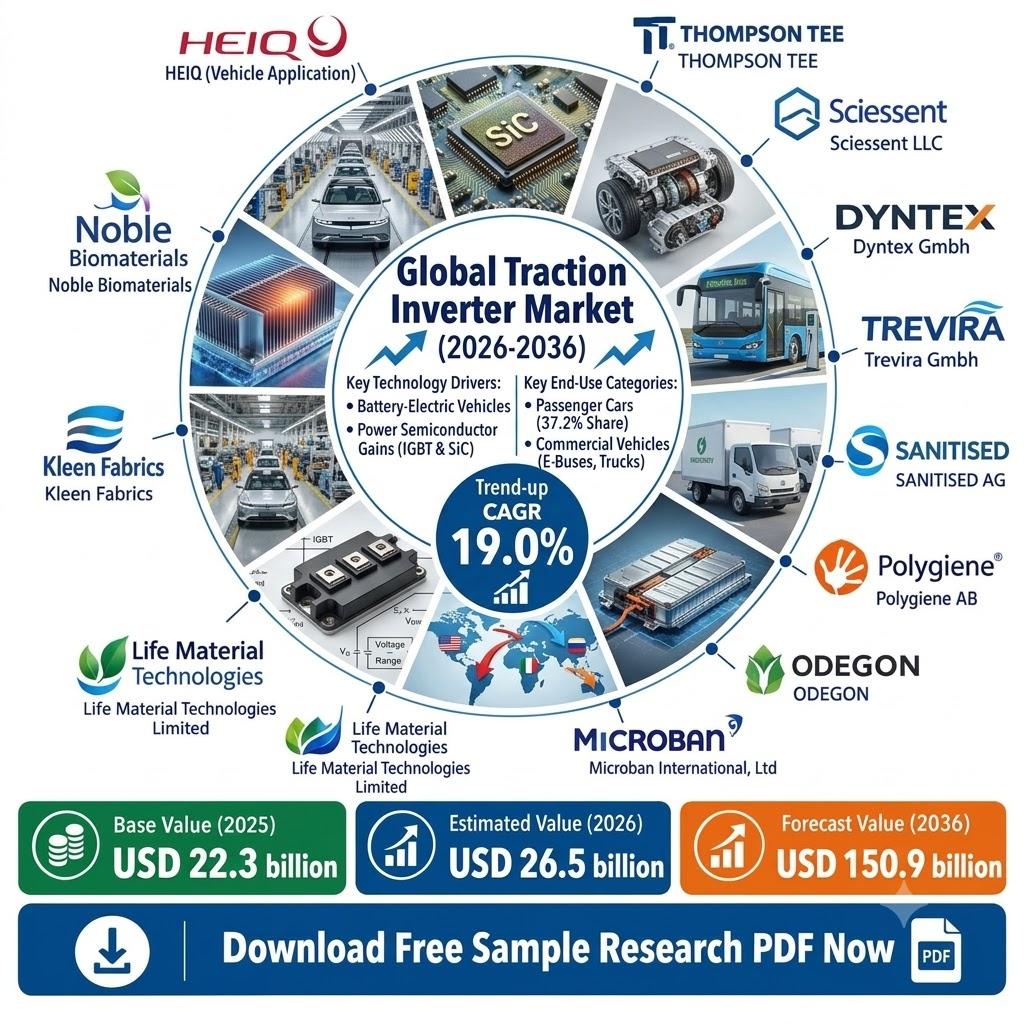
The traction inverter market is projected to grow at a 19.0% CAGR through 2036, supported by battery-electric vehicle production, power semiconductor efficiency gains, and integrated e-axle development.
October 29, 2026 — The global traction inverter market is projected to increase from USD 26.5 billion in 2026 to USD 150.9 billion by 2036, according to Fact.MR, representing a compound annual growth rate (CAGR) of 19.0% over the forecast period. The market crossed USD 22.3 billion in 2025, with the forecast indicating an absolute opportunity of USD 124.4 billion between 2026 and 2036.
Battery-electric vehicle production remains a central driver of this outlook. Automakers are expanding electric vehicle model portfolios and refining powertrain designs to improve energy efficiency, thermal performance, and packaging. Meanwhile, advances in insulated-gate bipolar transistor (IGBT) modules, silicon carbide semiconductors, and integrated e-axle systems are creating additional opportunities for automotive component suppliers.
Get detailed market forecasts, competitive benchmarking, and technology trends: https://www.factmr.com/connectus/sample?flag=S&rep_id=8041
Traction Inverter Market Forecast Reflects Expanding Vehicle Electrification
Fact.MR's analysis identifies battery-electric vehicles as a leading propulsion category, with a projected 22.5% share in 2026. IGBT technology is expected to account for 28.7% of the technology segment, while systems operating at up to 200V are projected to hold a 38.9% share in the voltage segment. Passenger cars lead end-use demand with an estimated 37.2% share in 2026.
A traction inverter converts direct current (DC) from a vehicle battery into controlled alternating current (AC) for the electric traction motor. Its switching performance influences power delivery, energy efficiency, and the thermal requirements of an electrified powertrain.
As automakers introduce more electric and hybrid models, inverter design is becoming a significant part of powertrain engineering. Suppliers must balance semiconductor costs with switching losses, cooling requirements, and vehicle-level reliability. These considerations influence product qualification and long-term sourcing decisions.
The International Energy Agency reported in May 2026 that global electric car sales exceeded 20 million in 2025. This expansion supports demand for traction inverters, as battery-electric vehicles require motor-control systems designed around electric propulsion.
Battery-Electric Vehicle Production Remains a Core Demand Driver
Battery-electric vehicles provide a direct source of traction inverter demand because each vehicle relies on controlled electrical power to operate its traction motor. Hybrid electric vehicles and plug-in hybrid electric vehicles also require inverter systems, although their configurations differ according to the relationship between the electric motor and combustion engine.
For automakers, compact packaging is becoming increasingly important. Integrating the inverter with the motor and gearbox can reduce space requirements and support more coordinated powertrain engineering. These designs also require careful electrical and thermal validation before production begins.
Fleet electrification is extending demand beyond passenger cars. Electric buses, delivery vehicles, and heavy commercial vehicles require inverter systems capable of operating under demanding duty cycles. The IEA reported in May 2026 that worldwide electric truck sales exceeded 400,000 units in 2025, accounting for 9% of total truck sales.
Shambhu Nath Jha, Senior Consultant at Fact.MR, highlights the changing priorities in supplier selection.
“Traction inverter sourcing is no longer a simple power-rating decision. Vehicle makers are expected to compare switching loss, cooling structure and calibration evidence before approval,” Jha states in the report.
For component manufacturers, this creates a need to coordinate semiconductor selection with battery voltage, motor characteristics, and thermal management requirements.
Semiconductor Technology and Voltage Requirements Shape Market Demand
IGBT technology retains an important position because silicon-based power modules are already qualified across many vehicle platforms. Their established manufacturing base and cost profile support continued adoption in mass-market applications.
Silicon carbide MOSFETs are gaining attention where improved switching efficiency and reduced power losses can justify higher component costs. Mitsubishi Electric announced in January 2026 that it would ship trench silicon carbide MOSFET bare-die samples for EV traction inverters. Such developments highlight ongoing efforts to improve inverter performance through semiconductor innovation.
Voltage architecture also influences purchasing decisions. Lower-voltage systems serve compact electric vehicles and light-duty platforms, while higher-voltage designs support applications requiring greater power output. Systems operating at 900V and above remain more selective because insulation, safety, and validation requirements add complexity.
For automotive suppliers, the priority is to demonstrate reliable operation under repeated acceleration, regenerative braking, and temperature changes. Gate-driver performance and cooling design must be validated alongside the power semiconductor itself.
Regional Growth: USA Leads the Traction Inverter Market Forecast
Fact.MR projects varying growth rates across the countries covered in its forecast. The United States leads with a 19.8% CAGR from 2026 to 2036, followed by Japan at 19.2% and the United Kingdom at 17.6%.
South Korea is projected to grow at 15.2%, while France records a forecast CAGR of 12.3%. Italy follows at 11.9%.
The United States benefits from electric vehicle manufacturing capacity and growing attention to localized power-electronics sourcing. Japan's established automotive engineering capabilities and hybrid vehicle development support continued inverter innovation. In the United Kingdom, zero-emission vehicle requirements and fleet replacement are expected to contribute to demand.
South Korea combines automotive manufacturing with battery and electronics capabilities. France and Italy are supported by European fleet electrification requirements, although adoption rates, charging access, and vehicle affordability differ across their markets.
These regional differences have implications for investment and procurement planning. Suppliers evaluating new manufacturing capacity must consider local vehicle production, customer qualification requirements, and access to semiconductor supply chains.
Competitive Landscape and Strategic Priorities
The competitive landscape includes BorgWarner Inc., Marelli, Mitsubishi Electric Mobility Corporation, DENSO Corporation, and Voith GmbH. Other relevant companies and technology providers include Infineon Technologies, Toshiba Electronic Devices & Storage Corporation, Hitachi, and Siemens.
BorgWarner has direct traction inverter exposure through dual-inverter programs. DENSO contributes inverter technology integrated with Toyota vehicle platforms, while Mitsubishi Electric and other semiconductor suppliers support power-device development for electrified drivetrains.
Competition increasingly depends on the ability to combine electrical performance with practical manufacturing and vehicle integration. Suppliers that can demonstrate reliable thermal management, efficient switching, and repeatable calibration are better positioned to compete for extended automotive programs.
Automakers should align inverter voltage requirements with battery platform plans before finalizing supplier contracts. Semiconductor teams need documented switching-loss and thermal-cycling performance to support automotive qualification. Meanwhile, tier-one suppliers can benefit from closer coordination between inverter, motor, and e-axle engineering.
For investors, distinguishing dedicated traction inverter exposure from broader automotive semiconductor and power-conversion businesses is important when assessing market opportunities.
View Related Reports:
https://ayushjadhavblogs.blogspot.com/2026/10/pleated-filter-market-to-reach-usd-4.html
https://sohomoy.com/blogs/73256/Digital-Signage-System-Market-to-Reach-USD-93-2-Billion
About Fact.MR
Fact.MR is a market research and consulting firm that provides industry analysis, market sizing, forecasts, and strategic insights to support business planning and commercial decision-making.
The traction inverter market report examines market size and forecasts, propulsion and technology segments, voltage categories, end-use applications, regional growth, competitive positioning, and factors influencing procurement and investment decisions from 2026 to 2036.

 English
 Arabic
 French
 Spanish
 Portuguese
 Deutsch
 Dutch
 Italiano
 Russian
 Romaian
 Portuguese (Brazil)
 Greek
