


Patient Blood Management Market Forecast to Reach USD 34.1 Billion by 2036, Led by Key Players Haemonetics, Terumo and Fresenius Kabi
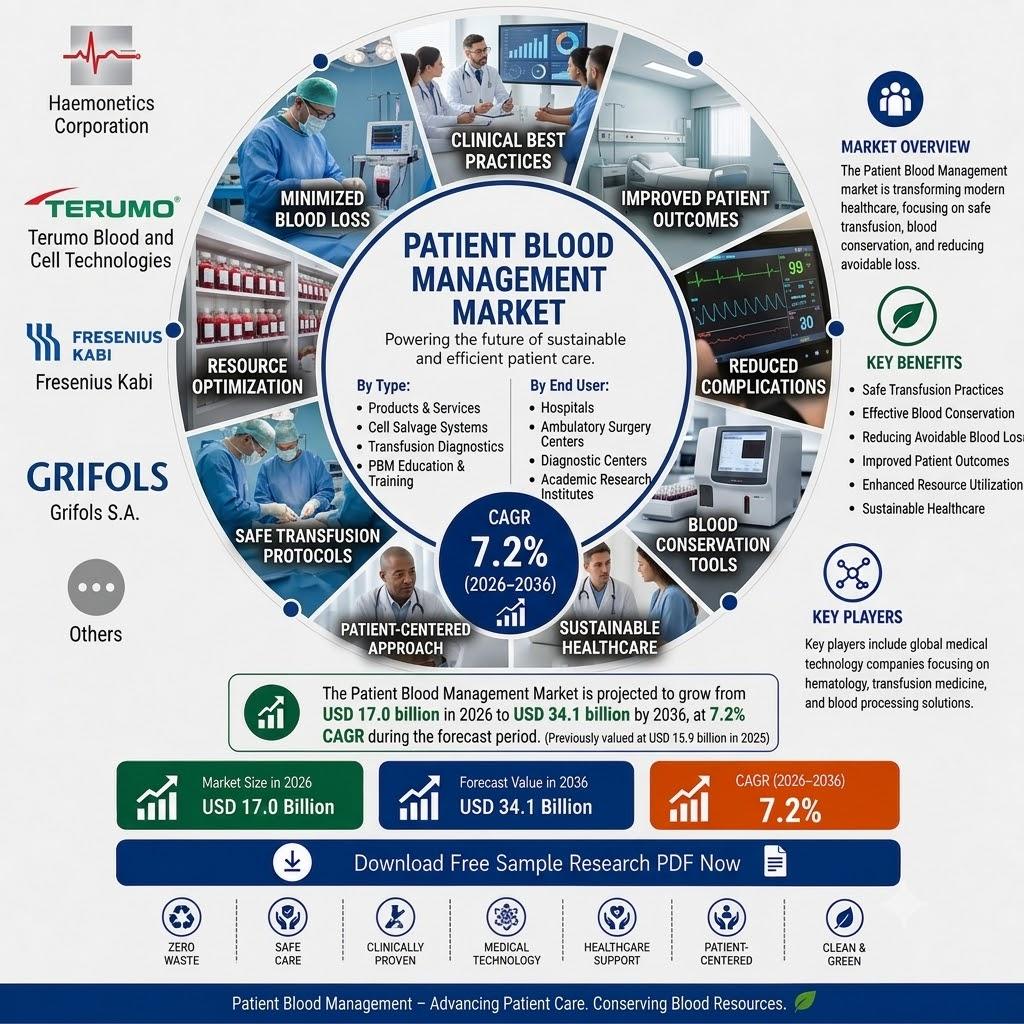
The global patient blood management market is projected to increase from USD 17.0 billion in 2026 to USD 34.1 billion by 2036, registering a compound annual growth rate (CAGR) of 7.2%, according to Fact.MR. The market was valued at USD 15.9 billion in 2025. Growing attention to safe transfusion practices, avoidable blood loss reduction, and effective blood-use decisions is encouraging hospitals to adopt patient blood management (PBM) systems and protocols.
Patient blood management combines clinical practices, instruments, software, and hospital workflows to optimize the use of a patient's own blood. Its scope includes anemia management, surgical blood conservation, transfusion decision support, cell salvage, and blood inventory control. Adoption requires coordination among surgeons, anesthesiologists, laboratory teams, nurses, and hospital blood banks.
Get detailed market forecasts, competitive benchmarking, and pricing trends: https://www.factmr.com/connectus/sample?flag=S&rep_id=7783
Instruments Lead Product-Type Demand
Instruments are projected to account for 41.0% of the patient blood management market in 2026, making them the leading product category. Hospitals use these systems for blood processing, cell salvage, and transfusion support across operating rooms, blood banks, and critical care settings. Accessories, reagents and kits, and software also contribute to the market, with digital solutions supporting inventory visibility and transfusion audits.
By management area, blood transfusion management is expected to hold a 38.0% share in 2026. This reflects hospitals' focus on appropriate blood-use decisions, patient safety, and clinical documentation.
Perioperative care is projected to represent 36.0% of the market by application, as surgical procedures create demand for anemia screening, blood conservation tools, and transfusion protocols. Hospitals are expected to remain the leading end-user segment with a 49.0% share, while direct institutional sales are forecast to account for 53.0% of the market.
Regional Outlook: India Leads Country Growth
India is projected to record the fastest growth among the countries covered, with a CAGR of 8.4% through 2036. Hospital expansion and rising surgical demand are supporting the adoption of blood conservation systems and transfusion decision support.
China follows with a projected CAGR of 8.1%, supported by healthcare infrastructure development and blood safety modernization. Canada is forecast to grow at 6.9%, while the United States is expected to register 6.8%. Germany and Japan are projected to expand at CAGRs of 6.2% and 5.8%, respectively. Brazil is forecast to record a CAGR of 5.6% over the assessment period.
Analyst Perspective
Shambhu Nath Jha, Senior Analyst at Fact.MR, notes, “Patient blood management is becoming a hospital quality program rather than a blood bank initiative alone. Hospitals will gain when anemia screening, cell salvage, transfusion decision support, and blood inventory control work as one clinical system. Suppliers that support workflow integration and clinical training will be better placed.”
The report identifies implementation complexity as a key market restraint. Successful PBM adoption requires coordination across clinical departments, staff training, and integration with hospital workflows. Suppliers offering implementation support, clinical education, and software capabilities can address these operational requirements.
Competitive Landscape
The patient blood management market includes medical technology companies, blood processing specialists, diagnostics providers, and software suppliers. Key companies profiled by Fact.MR include Haemonetics Corporation, Terumo Blood and Cell Technologies, Fresenius Kabi, Grifols S.A., Immucor, Inc., Macopharma, Werfen, Cerus Corporation, B. Braun Melsungen AG, Bio-Rad Laboratories, Inc., Roche Diagnostics, Quotient Limited, Medtronic plc, and Stryker Corporation.
Competition is shaped by instrument reliability, transfusion traceability, software functionality, hospital-system integration, and clinical training support. Providers that address multiple stages of blood management workflows are positioned to serve hospitals seeking coordinated PBM programs.
Market Snapshot
- Market size (2025): USD 15.9 billion
- Estimated market size (2026): USD 17.0 billion
- Forecast market size (2036): USD 34.1 billion
- CAGR (2026–2036): 7.2%
- Leading product type: Instruments (41.0% share in 2026)
- Leading management area: Blood transfusion management (38.0%)
- Leading application: Perioperative care (36.0%)
- Leading end user: Hospitals (49.0%)
- Leading sales channel: Direct institutional sales (53.0%)
- Fastest-growing country: India (8.4% CAGR)
To View Related Reports
https://afgbfh.blogspot.com/2026/10/surgical-site-infection-control-market.html
About Fact.MR
Fact.MR is a market research and competitive intelligence provider delivering market intelligence, competitive analysis, and forecasting across global industries. Its research helps businesses evaluate market demand, understand competitive developments, and identify growth opportunities.

 English
 Arabic
 French
 Spanish
 Portuguese
 Deutsch
 Dutch
 Italiano
 Russian
 Romaian
 Portuguese (Brazil)
 Greek
