


Artemisinin Combination Therapy Market Growth, Driving Factors, Strategies, Trends, Forecast Analysis By Fact.MR
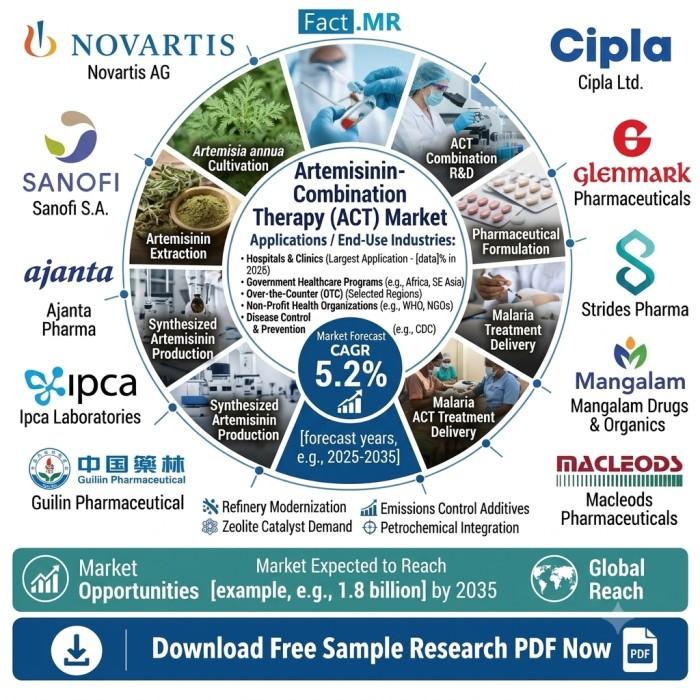
Rockville, Maryland — October 28, 2026 The global artemisinin combination therapy market is projected to reach USD 1,658.7 million by 2036, up from USD 747.3 million in 2026, according to Fact.MR. The market is forecast to expand at a compound annual growth rate (CAGR) of 8.3% during the 2026–2036 period. Persistent malaria treatment demand, government procurement programs, and the development of improved antimalarial formulations are influencing market opportunities for pharmaceutical manufacturers.
Fact.MR’s Artemisinin Combination Therapy Market report identifies Novartis AG, Sanofi S.A., Cipla Ltd., KPC Pharmaceuticals, Fosun Pharmaceutical, Ajanta Pharma, and Ipca Laboratories Ltd. among the companies competing in this market. Manufacturers are navigating the need for affordable treatment, reliable medicine supply, and product development that responds to emerging antimalarial drug resistance.
Get detailed market forecasts, competitive benchmarking, and pricing trends:
Key Takeaways: Artemisinin Combination Therapy Market
- Market size in 2026: USD 747.3 million.
- Forecast market value by 2036: USD 1,658.7 million.
- Market growth rate: 8.3% CAGR from 2026 to 2036.
- Leading product category: Artemisinin-based combination therapies, accounting for 48.6% of product-type share in 2026.
- Leading application: Uncomplicated malaria treatment, projected to account for 52.3% of application share in 2026.
- Leading end-use segment: Hospitals, with a 44.9% share in 2026.
- Fast-growing countries: India at 9.2% CAGR and China at 8.9% CAGR over the forecast period.
What Is Driving the Artemisinin Combination Therapy Market?
Artemisinin-based combination therapies (ACTs) combine an artemisinin derivative with a partner antimalarial medicine. These treatments are important in malaria management, particularly for uncomplicated Plasmodium falciparum malaria, under established treatment guidelines.
According to Fact.MR, demand is supported by the continuing malaria burden and the expansion of national malaria control programs, particularly across sub-Saharan Africa and Southeast Asia. Government purchasing programs and international health organizations remain important channels for medicine distribution in endemic regions.
For manufacturers, this demand creates a need to maintain dependable production, meet applicable quality and prequalification requirements, and supply products at prices that public-health procurement systems can sustain. Competitive positioning therefore depends on more than product availability: manufacturing reliability and access to established distribution channels also matter.
Which Product Trends Are Creating Opportunities?
Artemisinin-based combination therapies are forecast to account for 48.6% of product-type share in 2026. Important treatment combinations include artemether-lumefantrine, artesunate-amodiaquine, artesunate-mefloquine, and dihydroartemisinin-piperaquine.
Fixed-dose combinations represent another important part of the market. Fact.MR projects these products to account for 61.8% of drug-type share in 2026. Combining medicines into a single formulation can simplify treatment administration and support adherence when used according to the appropriate clinical guidance.
Pediatric formulations, including dispersible tablets, are also an important development area. Products designed for younger patients can help address formulation and dosing needs in malaria-endemic communities.
The market is also being shaped by efforts to develop next-generation non-artemisinin combinations. Growing concern about artemisinin resistance creates a strategic incentive for pharmaceutical companies to invest in new treatment approaches while maintaining reliable supplies of established medicines.
For commercial decision-makers, these trends point to three priorities: strengthening formulation capabilities, evaluating research and development opportunities, and improving supply access in high-burden markets.
Regional Outlook: India and China Lead Country Growth
Fact.MR identifies Asia Pacific as the fastest-growing regional market, supported by country-level demand and pharmaceutical manufacturing capabilities. Sub-Saharan Africa remains the largest demand region because of its substantial malaria burden.
India is projected to register the fastest country-level growth among the markets highlighted in the report, at a CAGR of 9.2% from 2026 to 2036. Domestic generic manufacturing capabilities, endemic malaria treatment needs, and national health programs support its market outlook.
China follows with an anticipated CAGR of 8.9%. Its artemisinin raw-material production capabilities and pharmaceutical manufacturing base contribute to its position in the market.
Brazil is forecast to grow at 8.6% CAGR, reflecting demand associated with malaria-endemic areas, including the Amazon basin. Germany is projected to record 7.9% CAGR, followed by the United States at 7.6%, the United Kingdom at 7.3%, and Japan at 6.8%.
For companies evaluating expansion, these growth rates provide a basis for comparing market opportunities. Investment decisions should also account for local procurement requirements, regulatory obligations, distribution infrastructure, and the ability to supply affordable products consistently.
Top Companies in the Artemisinin Combination Therapy Market
Fact.MR identifies the following companies in its competitive landscape:
- Novartis AG
- Sanofi S.A.
- Cipla Ltd.
- KPC Pharmaceuticals
- Fosun Pharmaceutical (Guilin Pharma)
- Ajanta Pharma
- Ipca Laboratories Ltd.
- Desano Inc.
- Hovid Berhad
- Mylan
These companies participate in a market where product portfolios, manufacturing capacity, pricing, and access to public-health procurement channels influence competitive positioning.
Novartis AG is associated with Coartem and the development of ganaplacide-lumefantrine, a potential non-artemisinin treatment approach. Sanofi S.A. and Cipla Ltd. are also identified among the established participants. Fosun Pharmaceutical, Ajanta Pharma, and Ipca Laboratories are highlighted for their generic manufacturing capabilities and pricing competitiveness.
The report does not establish a numerical market-share ranking for these ten companies. Their inclusion should therefore be understood as identification within the competitive landscape, not as a verified ranking by revenue or market share.
Competitive Challenges and Strategic Priorities
Manufacturers face several challenges despite the market’s projected expansion. Emerging artemisinin resistance creates uncertainty around the long-term effectiveness of existing treatment approaches. Meanwhile, low prices in government procurement can restrict margins, and fragile supply chains can complicate medicine distribution in endemic regions.
These conditions make operational execution particularly important. Companies can assess opportunities in pediatric formulations, fixed-dose combinations, and research into new antimalarial mechanisms while maintaining quality standards and reliable supply.
For procurement teams and healthcare organizations, supplier evaluation should consider product suitability, regulatory and prequalification status, supply continuity, and affordability. For investors and pharmaceutical executives, the projected market expansion offers a reason to assess these factors alongside research and development costs and the requirements of individual markets.
About the Fact.MR Artemisinin Combination Therapy Market Report
Fact.MR’s Artemisinin Combination Therapy Market report examines market size, growth forecasts, product categories, applications, end users, drug types, administration routes, distribution channels, regional performance, and the competitive landscape.
The report covers the 2026–2036 forecast period and evaluates markets across North America, Latin America, Europe, East Asia, South Asia and the Pacific, and the Middle East and Africa. Its methodology combines secondary research, primary interviews, and forecast modelling using demand, treatment, pricing, procurement, and regional market inputs.
Explore More Related Studies Published by Fact.MR Research
Percutaneous Screw Placement Systems Market
About Fact.MR
Fact.MR is a market research and consulting firm providing syndicated research, customized research, investment research, and market intelligence across a broad range of industries. Its research coverage includes food and beverage, healthcare, pharmaceuticals, biotechnology, consumer products, chemicals and materials, technology, industrial goods, and packaging.
Fact.MR provides market intelligence designed to help organizations understand market dynamics, emerging opportunities, competitive developments, and changing industry requirements.
Media Contact
Fact.MR
Email: sales@factmr.com
Phone: +1 (628) 251-1583
Website: www.factmr.com

 English
 Arabic
 French
 Spanish
 Portuguese
 Deutsch
 Dutch
 Italiano
 Russian
 Romaian
 Portuguese (Brazil)
 Greek
