


Computer-aided Engineering Market to Grow at 10.4% CAGR Through 2036; US and Japan Offer Strong Growth Opportunities
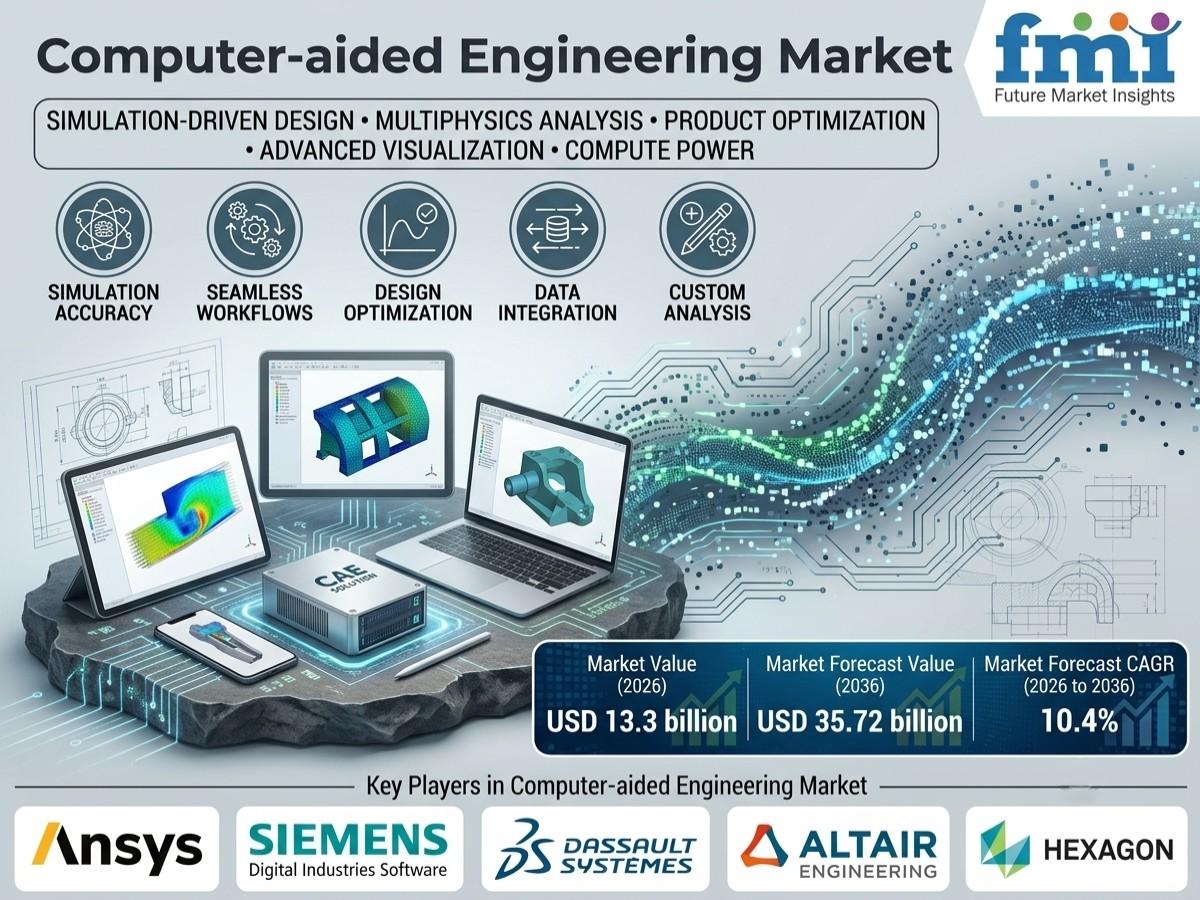
NEWARK, Del. — The global Computer-aided Engineering Market is projected to grow from USD 13.3 billion in 2026 to USD 35.72 billion by 2036, registering a compound annual growth rate (CAGR) of 10.4%, according to Future Market Insights (FMI). The market outlook reflects the role of engineering simulation software and services in evaluating product designs, analyzing performance, and supporting decisions before physical testing.
Computer-aided engineering (CAE) allows engineers to assess how products and components may behave under defined operating conditions. Its applications include structural analysis, fluid-flow simulation, thermal assessment, and other engineering calculations. These capabilities support product development across automotive, aerospace and defense, electronics, energy and utilities, and industrial manufacturing.
Access the Sample Report — Explore Key Insights Today!
https://www.futuremarketinsights.com/reports/sample/rep-gb-14962
Computer-aided Engineering Market Growth Drivers
Product complexity is an important factor supporting demand for CAE solutions. Engineering teams often need to assess several performance requirements during product development. Simulation can help them compare design alternatives, identify areas requiring further investigation, and plan physical testing more effectively.
Automotive development is one of the key application areas. Engineers use simulation to examine structural performance, airflow, heat transfer, and other characteristics relevant to vehicle components and systems. The expansion of product-development requirements creates opportunities for software vendors serving automotive manufacturers and their engineering partners.
The broader use of simulation across industrial design also supports market development. Engineering organizations can use software and specialist services to examine different design scenarios and bring analysis into established development workflows. However, the usefulness of a simulation depends on the accuracy of the model, the quality of the input data, and appropriate verification and validation.
Computing requirements remain a consideration for buyers. Complex simulations can require substantial processing capacity, technical expertise, and software investment. Organizations therefore need to assess licensing, infrastructure, training, and implementation requirements alongside the capabilities of a CAE platform.
On-Premise Deployment Leads the Market
FMI reports that the on-premise deployment segment accounts for 75.3% of deployment demand in 2026. This segment's position reflects the continuing role of locally managed software and computing environments in engineering operations.
On-premise deployment can fit organizations that manage their own infrastructure, engineering data, and software configurations. These arrangements may be particularly relevant where established workflows and computing resources are already in place. Buyers must still ensure that their systems can support the processing and storage requirements of their simulation workloads.
Cloud-based CAE offers another deployment option, providing access to computing resources without requiring every workload to run on locally maintained infrastructure. The choice between cloud-based and on-premise platforms depends on technical requirements, data management practices, collaboration needs, and overall implementation costs.
Automotive Remains a Key End-Use Industry
The automotive segment is projected to account for 28.2% of end-use industry demand in 2026, according to FMI. Automotive engineering involves multiple design considerations, including structural behavior, vibration, airflow, and thermal performance. Simulation tools allow teams to examine these factors as part of product development.
As manufacturers evaluate vehicle designs and components, CAE platforms can support analysis before physical prototypes are available. The results must be interpreted in the context of the intended application and validated where necessary. This makes the combination of suitable software, engineering expertise, and reliable model inputs important when selecting a solution.
Beyond automotive, FMI's report covers aerospace and defense, electronics, energy and utilities, industrial manufacturing, and other industries. These segments represent varied engineering requirements, creating demand for software and services suited to different simulation disciplines.
Regional Outlook: India and China Offer Growth Opportunities
FMI's country-level forecasts indicate strong projected growth across several markets between 2026 and 2036. India is forecast to register a 15.9% CAGR, followed by China at 14.7%, the United States at 13.4%, Japan at 13.2%, and Germany at 12.0%.
India's engineering development and manufacturing activity support opportunities for simulation tools and related services. As organizations assess product designs and technical requirements, access to specialist engineering capabilities can influence adoption.
China's industrial and automotive development creates demand for tools that examine product performance across structural, thermal, and fluid-related applications. The United States represents another important market, with simulation used in automotive, aerospace, and other engineering programs. In Germany and Japan, established automotive, electronics, and industrial engineering activities provide additional application settings for CAE solutions.
These figures are country-level projections from FMI's 2026–2036 outlook, rather than reported historical growth rates.
Top Players in the Computer-aided Engineering Market
FMI identifies five representative companies in its competitive analysis:
- Ansys — engineering simulation software covering structural, fluid, and other analysis applications.
- Siemens Digital Industries Software — Simcenter simulation portfolio supporting product-development analysis.
- Dassault Systèmes — SIMULIA software for structural, fluid, electromagnetic, and multibody simulation.
- Altair Engineering — simulation and design software, including engineering optimization offerings.
- Hexagon — engineering analysis software within a broader industrial technology portfolio.
Competition involves the breadth of supported simulation disciplines, software capabilities, implementation requirements, and service support. Buyers may compare vendors based on the engineering problems they need to solve, the compatibility of solutions with existing workflows, and the expertise available to support implementation.
The companies listed above are representative participants identified by FMI. They are not presented as a ranked list by revenue or market share.
Outlook for the Computer-aided Engineering Market
The market is projected to expand as engineering teams continue to use simulation to evaluate designs and support product-development decisions. Cloud deployment, connected analysis workflows, and AI-assisted tools are relevant areas of development, although their value depends on the specific engineering task and implementation.
For buyers, the priority is to select solutions that fit their technical requirements and provide a dependable basis for interpreting results. For software vendors, opportunities include supporting multiple analysis disciplines, improving workflow integration, and providing services that help engineering teams use simulation appropriately.
Access the full Computer-aided Engineering Market report from Future Market Insights for detailed forecasts, segmentation, regional analysis, and competitive insights: https://www.futuremarketinsights.com/reports/computer-aided-engineering-market
Explore More Related Reports -
Workstation Market - https://www.futuremarketinsights.com/reports/workstation-market
Contract Lifecycle Management Market - https://www.futuremarketinsights.com/reports/contract-lifecycle-management-market
Smart/AI Toy Market - https://www.futuremarketinsights.com/reports/smart-ai-toys-market
About Future Market Insights (FMI)
Future Market Insights provides market intelligence, industry analysis, and strategic research to support business decision-making. Its research covers market sizing, forecasts, segmentation, competitive landscapes, and regional opportunities.

 English
 Arabic
 French
 Spanish
 Portuguese
 Deutsch
 Turkish
 Dutch
 Italiano
 Russian
 Portuguese (Brazil)
 Greek
