


The Core 3D Reconstruction Technology Market Platform and Its Evolving Architecture by 2035
The Digital Factory for Creating 3D Worlds
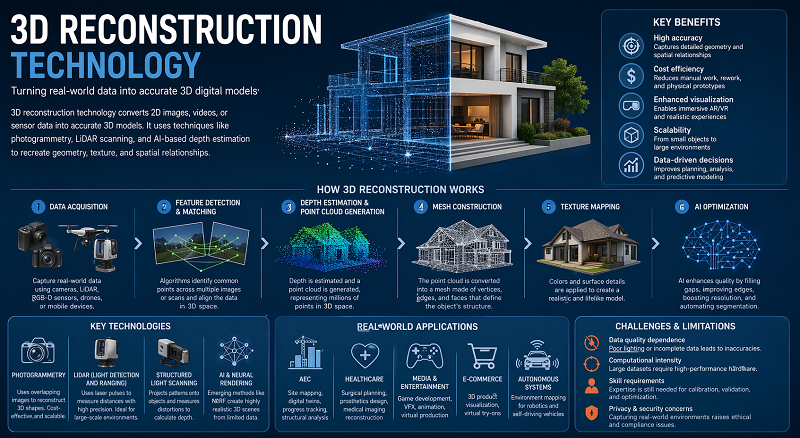
The engine room of the digital twin revolution is the 3D Reconstruction Technology Market Platform. This platform is not a single piece of software, but rather a sophisticated pipeline of tools and algorithms designed to transform raw sensor data into a polished, usable 3D model. Whether cloud-based or running on a powerful desktop, this platform provides the environment where the complex computational work of 3D reconstruction takes place. It is a digital factory that ingests 2D images or 3D point clouds at one end and outputs a fully textured, geometrically accurate mesh at the other. The architecture of these platforms is constantly evolving, driven by the need to handle ever-larger datasets, achieve higher levels of accuracy, and automate what was once a highly manual and expert-driven process. The quality and efficiency of this platform directly determine the viability of using 3D reconstruction for any given application.
The Photogrammetry Platform Pipeline
For photogrammetry, the most common type of reconstruction platform, the workflow follows several key stages. It begins with Image Ingestion and Alignment. The platform analyzes hundreds or thousands of overlapping images, detects common features, and calculates the precise position and orientation of the camera for each photo. This is a computationally intensive step that creates a sparse point cloud. The next stage is Dense Cloud Generation, where the platform uses the camera position data to generate a much more detailed point cloud, creating the fundamental shape of the object or scene. Following this, the Mesh Generation stage connects these points into a solid surface of polygons (typically triangles). Finally, the Texturing stage projects the original photographic information back onto the mesh to create a photorealistic appearance. Leading platforms like RealityCapture and Metashape are highly optimized to execute this complex pipeline as efficiently as possible, often leveraging the parallel processing power of GPUs.
The Point Cloud Processing Platform
For active scanning methods like LiDAR, the platform is centered around Point Cloud Processing. The raw output from a laser scanner is a massive, unstructured collection of millions or even billions of individual 3D points. The first job of the platform is Registration, which is the process of aligning and stitching together multiple scans taken from different positions into a single, cohesive point cloud. Once registered, the platform provides tools for Cleaning and Filtering the data to remove noise and unwanted objects (like people or cars that moved through the scan). A crucial step is Classification and Segmentation, where the platform, often using machine learning, can automatically identify and classify different parts of the point cloud, such as ground, vegetation, and buildings. The platform then provides tools to either generate a mesh from the point cloud or to extract features and measurements directly from it for use in CAD and GIS software. Platforms from Trimble, Leica, and Autodesk are leaders in this space.
The Rise of the Cloud-Based Platform
A major architectural shift in the market is the move from desktop-based software to Cloud-Based Platforms. The processing demands of 3D reconstruction are immense, often requiring powerful, expensive workstations with high-end GPUs and large amounts of RAM. Cloud platforms solve this problem by offloading the heavy computational work to a distributed network of powerful servers. Users can upload their images or scans from any device, and the platform handles the processing in the cloud, notifying the user when the model is ready. This makes the technology accessible to users without specialized hardware. Cloud platforms like RealityCapture, Autodesk ReCap, and a host of others also facilitate collaboration, allowing teams to view, annotate, and share large 3D models through a simple web browser. This pay-as-you-go, scalable, and collaborative model is rapidly becoming the standard for many reconstruction workflows, especially for large projects.
The Future Platform: AI-Driven and Real-Time
The 3D reconstruction platform of the future will be defined by two key characteristics: it will be profoundly AI-driven and it will operate in real-time. Artificial intelligence will be woven into every stage of the pipeline. AI will help guide users during the capture process to ensure they have adequate coverage. It will automate the cleaning and classification of data, dramatically reducing manual post-processing work. It will even be able to semantically understand a scene, identifying objects like chairs, tables, and windows within the final model. The other major evolution will be towards Real-Time Reconstruction. As on-device processing power (especially in smartphones and AR/VR headsets) increases, platforms will be able to build a 3D model of the environment instantly and continuously as the user moves. This capability, known as Simultaneous Localization and Mapping (SLAM), is the foundational technology that will enable truly immersive augmented reality and intelligent robotic navigation, transforming the platform from a post-processing tool into a live perception system.
➤ In-Depth Market Studies by Market Research Future:
In-Vehicle Video Surveillance Market

 English
 French
 Spanish
 Portuguese
 Deutsch
 Turkish
 Dutch
 Italiano
 Russian
 Romaian
 Portuguese (Brazil)
 Greek
