


Telecommunications Services Market to Gain Momentum from Enterprise Connectivity
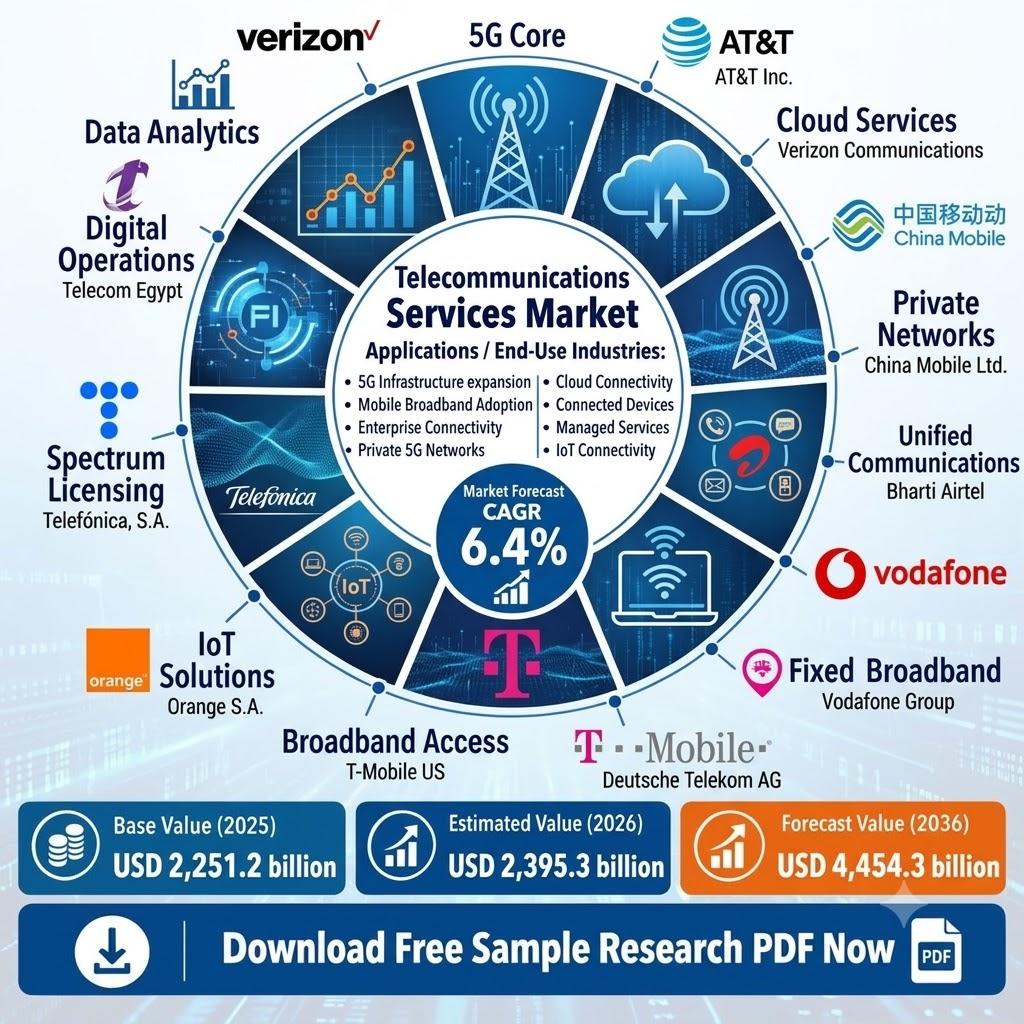
Fact.MR projects the telecommunications services market will grow at a 6.4% CAGR through 2036, driven by 5G expansion and enterprise connectivity demand.
October 28, 2026 The global telecommunications services market is projected to reach USD 4,454.3 billion by 2036, rising from USD 2,395.3 billion in 2026 at a compound annual growth rate (CAGR) of 6.4%, according to Fact.MR. The forecast reflects expanding 5G infrastructure, increasing mobile broadband adoption, and growing enterprise demand for managed connectivity. India is expected to lead country-level growth at an 8.5% CAGR through 2036.
The market's expansion reflects a shift in telecom spending. Operators are moving beyond traditional voice and consumer data plans to serve businesses that require private 5G networks, cloud connectivity, and connected-device infrastructure. These changes create new revenue opportunities, while spectrum licensing costs and infrastructure investment continue to pressure operator margins.
Get detailed market forecasts, competitive benchmarking, and pricing trends: https://www.factmr.com/connectus/sample?flag=S&rep_id=14532
Telecommunications Services Market Growth Driven by 5G and Enterprise Networks
Fact.MR estimates that the telecommunications services market was valued at USD 2,251.2 billion in 2025. The market is expected to reach USD 2,395.3 billion in 2026, creating a projected absolute dollar opportunity of USD 2,059.0 billion between 2026 and 2036.
Mobile telecom services are expected to account for approximately 64% of the market in 2026. Rising subscriber numbers and upgrades to 5G plans support this position. Fixed-network services remain relevant as operators expand fibre broadband infrastructure and businesses seek dependable connections for digital operations.
Enterprise connectivity is also changing purchasing priorities. Banks need secure networks for real-time transactions, while healthcare providers require reliable connections across hospital systems. Fact.MR estimates that the banking, financial services, and insurance (BFSI) sector will account for approximately 24% of market demand in 2026.
These requirements are encouraging telecom operators to develop private networks and managed connectivity services. Such offerings allow operators to compete through service performance and business-specific solutions rather than relying solely on consumer subscription volumes.
India Leads Telecommunications Services Market Growth Through 2036
India is forecast to record the fastest country-level growth, with an 8.5% CAGR from 2026 to 2036. Fact.MR attributes this outlook to nationwide 5G expansion, rising mobile broadband demand, and greater enterprise adoption of connectivity services.
The report highlights a specific indicator of this transition: Reliance Jio reported more than 130 million active 5G users following its standalone 5G rollout across all 22 telecom circles in 2024. Bharti Airtel has also expanded its enterprise connectivity business through Airtel Business, targeting organizations that need private 5G and managed network services.
China is projected to grow at a 7.1% CAGR through 2036. Network investment and 5G-Advanced deployment support the country's outlook. China Mobile announced capital expenditure of CNY 180 billion for 2025, with 60% allocated to 5G, according to the report.
The United States is forecast to expand at a 6.4% CAGR. Enterprise managed connectivity and private network deployments contribute to its outlook. South Korea is projected to grow at 5.8%, while Germany is expected to record a 5.0% CAGR over the same period.
Telecom Operators Face Investment Costs and Competitive Pressure
Growth prospects come with operational challenges. Telecom companies must finance network expansion while managing spectrum costs, infrastructure-sharing requirements, and competitive pricing in mature markets. These pressures can restrict margins when operators depend heavily on consumer voice and broadband services.
Competition is increasingly focused on enterprise capabilities. AT&T, Verizon Communications, China Mobile, Bharti Airtel, Vodafone Group, T-Mobile, Orange S.A., Telefónica, Deutsche Telekom, and Telecom Egypt are among the companies profiled in the report.
Operators with extensive spectrum holdings, fibre infrastructure, and established business relationships can pursue higher-value contracts. Private 5G networks, software-defined wide area networking (SD-WAN), and Internet of Things (IoT) connectivity provide routes to serve industrial facilities and digitally connected businesses.
Large enterprises also commonly use multiple telecom providers across regions. This approach helps maintain service continuity and manage costs, while requiring operators to demonstrate reliable performance and competitive contract terms.
Fact.MR Analysis Examines Market Segments and Regional Outlook
Fact.MR's telecommunications services market report evaluates fixed-network and mobile services across consumer and enterprise applications. Its coverage includes mobile broadband, managed enterprise connectivity, private 5G networks, IoT connectivity, fixed-line voice, IPTV, and cloud-based unified communications.
The geographical analysis spans Asia Pacific, Europe, North America, Latin America, and the Middle East and Africa. Asia Pacific holds the leading regional position, supported by large subscriber bases and investment in 5G infrastructure.
The research methodology combines subscriber data, average revenue per user (ARPU), enterprise contract benchmarks, and network rollout timelines. Fact.MR states that its forecasts are validated using operator revenue disclosures, regulatory subscriber statistics, spectrum auction records, and primary interviews with industry participants.
For operators planning investment, the findings provide a basis for assessing country growth, service opportunities, and competitive positioning. Businesses can consult the [LINK: telecommunications services market research report] for detailed forecasts and segment-level analysis.
The report also places telecom demand within a wider regulatory context. Spectrum policy, network security requirements, and infrastructure deployment rules influence how quickly operators can expand services and recover investment costs. These factors remain relevant as 5G networks support more industrial and enterprise applications.
Analyst perspective: Shambhu Nath Jha, Principal Consultant at Fact.MR, notes that the research can help business leaders assess 5G network expansion, enterprise private network deployment, and managed connectivity demand across BFSI, IT, and e-commerce. The report provides country-level growth forecasts to support these evaluations.
Market definition: Telecommunications services are fixed-network and mobile connectivity services provided by licensed operators to consumers, enterprises, and governments, including broadband, managed networks, IoT connectivity, and private 5G solutions.
View Related Reports :
https://ayushjadhavblogs.blogspot.com/2026/10/food-additives-market-to-reach-usd-244.html
https://fridayad.co.in/article/automobile-insurance-market-forecast-india-to-lead-growth-at-70-cagr
https://uddokta64.com/blogs/14265/Online-Modular-UPS-Systems-to-Hold-56-2-Product-Share
About Fact.MR
Fact.MR is a market research and consulting firm that provides market sizing, forecasting, competitive analysis, and industry insights to support business planning and strategic decisions. Its telecommunications services market study examines global revenue trends, service categories, end-user demand, and regional growth prospects through 2036.

 English
 Arabic
 Spanish
 Portuguese
 Deutsch
 Turkish
 Dutch
 Italiano
 Russian
 Romaian
 Portuguese (Brazil)
 Greek
