


Litigation Funding Investment Market to Reach USD 53.73 Billion by 2036; US Leads Among Profiled Markets at 9.4% CAGR
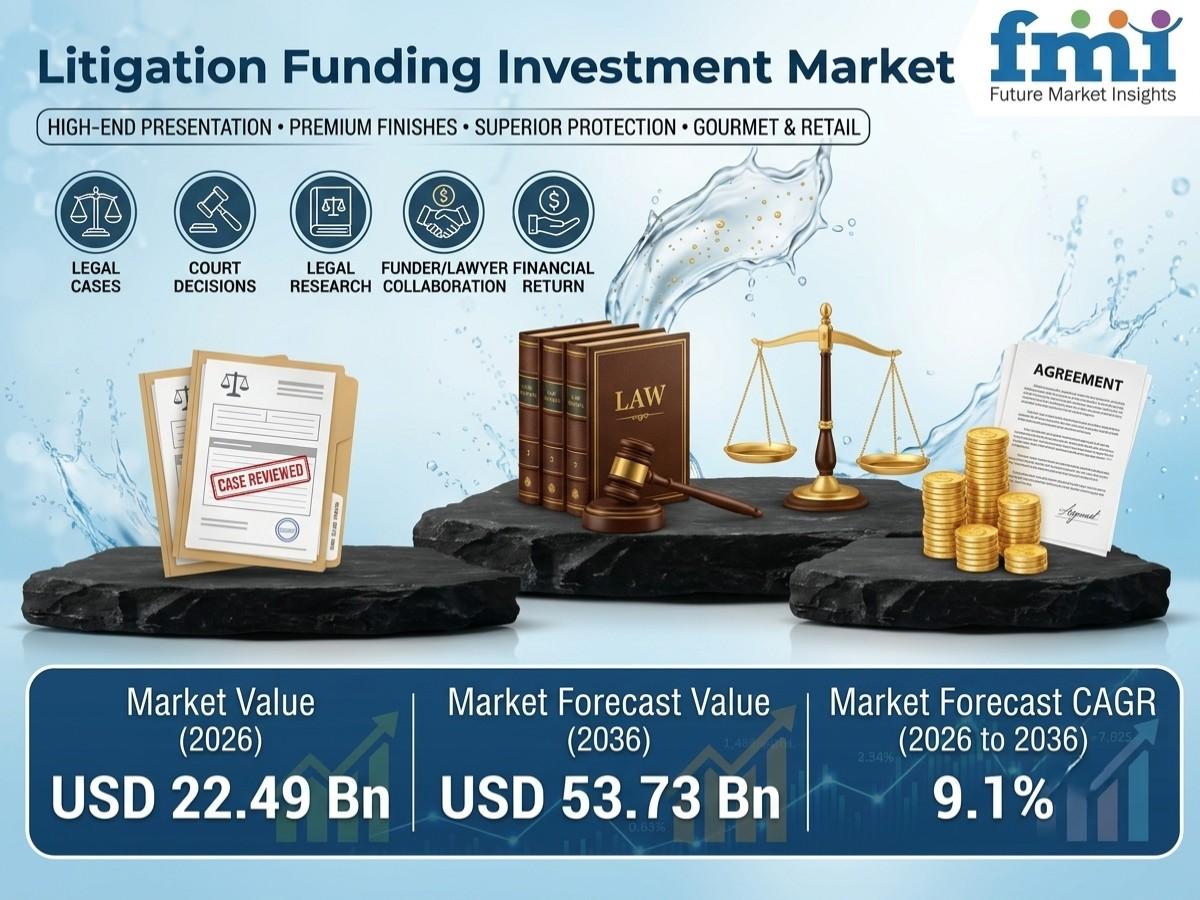
NEWARK, Del. — The global Litigation Funding Investment Market is projected to increase from USD 22.49 billion in 2026 to USD 53.73 billion by 2036, registering a compound annual growth rate (CAGR) of 9.1%, according to Future Market Insights (FMI). The market was valued at USD 20.61 billion in 2025. Growing demand for third-party legal finance is creating opportunities for specialist funders and institutional investors as companies seek ways to manage the cost and financial uncertainty of commercial disputes.
Litigation funding enables eligible claimants to obtain capital to pursue legal claims in exchange for an agreed share of potential proceeds or another contractually defined return. The model can help businesses preserve operating capital while pursuing disputes, although funding decisions depend on legal merits, recoverability, duration, and the terms of the agreement.
Access the Sample Report — Explore Key Insights Today!
https://www.futuremarketinsights.com/reports/sample/rep-gb-17261
Litigation Funding Investment Market Forecast and Growth Drivers
FMI projects the market to expand by approximately USD 31.24 billion between 2026 and 2036. This outlook reflects demand for financing arrangements that address legal expenditure and the financial risks associated with complex proceedings.
Key growth drivers include:
- Rising legal cost exposure: Businesses may seek external funding when legal proceedings require substantial capital over an extended period.
- Commercial disputes: Contract disagreements, intellectual property claims, and other business disputes can create demand for financing.
- Capital preservation: Companies may consider third-party funding to retain resources for ordinary business operations.
- Portfolio funding: Financing multiple claims under a structured arrangement can offer an alternative to funding each dispute separately.
- Institutional participation: Specialist investment firms and other capital providers are evaluating legal finance as a distinct investment opportunity.
The market nevertheless remains exposed to uncertain case outcomes, extended timelines, enforcement challenges, and jurisdiction-specific rules. These factors make disciplined underwriting and transparent funding agreements important to sustainable growth.
Top Players in the Litigation Funding Investment Market
FMI identifies the following companies among the notable participants in the market:
- Burford Capital — commercial legal finance and asset recovery.
- Omni Bridgeway — cross-border dispute funding.
- Litigation Capital Management (LCM) — commercial dispute finance.
- Therium Capital Management — litigation and arbitration financing.
- Harbour Litigation Funding — single-case, portfolio, and working-capital funding.
These companies illustrate different approaches to financing legal disputes. Their competitive positioning depends on case selection, funding structures, geographic reach, and the ability to assess the potential recovery from a claim.
For prospective clients, the relevant comparison is not simply the amount of capital available. Businesses should examine eligibility criteria, contractual terms, the allocation of proceeds, decision-making responsibilities, and the funder's experience with the relevant dispute type.
The five companies above are the participants identified in FMI's current competitive analysis. This list is not a ranking by market share.
Commercial Litigation Leads the Type Segment
The Commercial Litigation segment is projected to account for 42.0% of type demand in 2026, according to FMI.
Commercial disputes can involve contractual disagreements, business claims, and other matters in which the cost of pursuing legal remedies competes with operating and investment priorities. Third-party funding can provide an alternative source of capital for eligible claims, subject to the assessment of legal merits and recovery prospects.
Other types covered in the report include bankruptcy claims, international arbitration, and personal injury. International disputes can introduce additional considerations, including jurisdictional differences, enforcement procedures, confidentiality, and the location of recoverable assets.
For funders, a structured assessment of the claim, likely duration, potential recovery, and enforcement route is essential. For claimants, understanding the economic implications of the funding agreement is equally important.
MSMEs Represent a Major Enterprise-Size Opportunity
FMI estimates that micro, small, and medium-sized enterprises (MSMEs) will account for 54.0% of enterprise-size demand in 2026.
Smaller businesses may find it difficult to finance lengthy legal proceedings without affecting working capital. Funding can provide a potential route to pursuing eligible claims while limiting the need to commit operating resources upfront.
However, external financing is not suitable for every dispute. MSMEs should evaluate the proportion of any potential recovery payable to the funder, the agreement's conditions, and the implications if a claim settles or proceeds for longer than expected.
Funders can address this opportunity by developing clear assessment processes and funding structures suited to the financial circumstances of smaller claimants.
Regional Outlook: United States, Japan, and South Korea
FMI's country and market projections indicate varied growth prospects during 2026–2036:
- United States: 9.4% CAGR.
- Japan: 9.0% CAGR.
- South Korea: 8.9% CAGR.
- United Kingdom: 8.8% CAGR.
- European Union: 8.7% CAGR.
The United States records the highest projected CAGR among these five profiled markets. Japan and South Korea also offer potential opportunities for providers assessing demand for dispute-related financing.
In the United Kingdom and European Union, cross-border disputes and funding arrangements require careful attention to the applicable legal framework and the practical route to recovery. Across all markets, growth rates should be interpreted as projections rather than guarantees of investment performance.
Providers considering geographic expansion should evaluate local legal requirements, enforceability, dispute volumes, capital availability, and governance expectations before entering new markets.
Technology, Risk Assessment, and Regulatory Considerations
Data-led case assessment is an important consideration for the future of litigation finance. Better-organized case documentation and analytical tools may help funders evaluate legal merits, likely duration, and recovery prospects. Technology can support this process, but it cannot eliminate legal uncertainty or replace appropriate professional assessment.
Regulatory scrutiny also remains relevant. The UK Civil Justice Council published its final litigation funding review on June 2, 2025, while the Australian Securities and Investments Commission's guidance addresses conflict management in litigation funding arrangements. These developments underline the importance of clear responsibilities, appropriate governance, and transparent contractual terms.
Business Outlook Through 2036
The projected expansion of the Litigation Funding Investment Market creates opportunities for specialist funders, eligible claimants, law firms, and institutional capital providers. Commercial success will depend on disciplined case selection, suitable financing structures, realistic recovery assessments, and compliance with applicable requirements.
Explore the complete FMI Litigation Funding Investment Market report:
https://www.futuremarketinsights.com/reports/litigation-funding-investment-market
Explore More Related Reports -
Sales Coaching Software Market - https://www.futuremarketinsights.com/reports/sales-coaching-software-market
Medical Billing Outsourcing Market - https://www.futuremarketinsights.com/reports/medical-billing-outsourcing-market
Computer-aided Engineering Market - https://www.futuremarketinsights.com/reports/computer-aided-engineering-market
The report provides further analysis of market forecasts, type and enterprise-size segments, end-user categories, country-level growth, and the competitive landscape.
About Future Market Insights (FMI)
Future Market Insights (FMI) provides market research, industry analysis, and strategic insights to help businesses evaluate market opportunities, competitive dynamics, and long-term growth prospects.

 English
 Arabic
 French
 Portuguese
 Deutsch
 Turkish
 Dutch
 Italiano
 Russian
 Romaian
 Portuguese (Brazil)
 Greek
