


AMD Market Forecast Highlights Growing Demand for Advanced Retinal Care
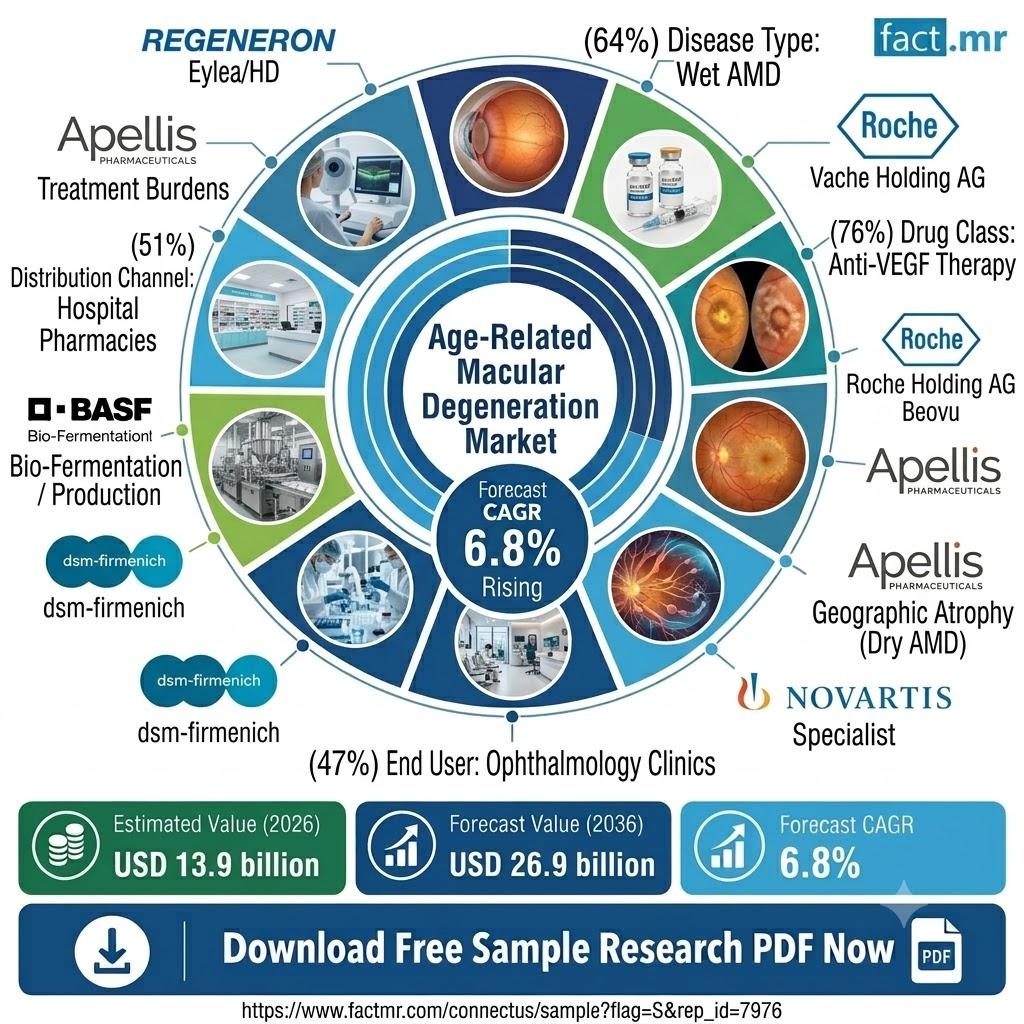
The age-related macular degeneration market is projected to grow at a 6.8% CAGR through 2036, driven by anti-VEGF therapies and geographic atrophy treatments.
May 29, 2026 The global age-related macular degeneration (AMD) market is projected to reach USD 26.9 billion by 2036, rising from USD 13.9 billion in 2026, according to Fact.MR. The market, valued at USD 13.1 billion in 2025, is forecast to expand at a compound annual growth rate (CAGR) of 6.8% between 2026 and 2036. Wider adoption of anti-VEGF therapies and emerging treatment options for geographic atrophy are expected to support demand as aging populations require continued retinal care.
Get detailed market forecasts, competitive benchmarking, and pricing trends: https://www.factmr.com/connectus/sample?flag=S&rep_id=7976
Age-Related Macular Degeneration Market Growth Driven by Treatment Demand
AMD affects the macula, the part of the retina responsible for central vision. As the condition progresses, patients may experience difficulty reading, driving, and performing everyday tasks. Wet AMD requires active treatment to slow vision loss, while geographic atrophy therapies are expanding treatment options for patients with advanced dry AMD.
The distinction between these conditions is shaping pharmaceutical demand. Fact.MR projects wet AMD to account for 64.0% of the market by disease type in 2026. Anti-VEGF therapy is expected to represent 76.0% of the market by drug class in the same year, reflecting its established role in treating neovascular AMD. According to a 2025 review published in the International Journal of Molecular Sciences, intravitreal anti-VEGF therapy remains the gold-standard treatment for neovascular AMD.
Patients often require ongoing care. BrightFocus Foundation reported on July 25, 2025, that most people with wet AMD need eye injections every four to 12 weeks. This treatment schedule places continuing demands on patients and retinal specialists, making dosing frequency and follow-up arrangements important considerations in therapy selection.
Product Competition and the Shift Toward Longer Treatment Intervals
Eylea and Eylea HD, which contain aflibercept, are projected to hold a combined 35.0% share of the AMD market by product in 2026, according to Fact.MR. Their established use in retinal care supports repeat treatment demand. Longer treatment intervals also offer potential to reduce the frequency of clinic visits for eligible patients.
Other therapies contribute to competition across the market. Roche Holding AG markets Vabysmo and Lucentis, while Novartis AG competes with Beovu. Apellis Pharmaceuticals offers Syfovre for geographic atrophy, extending the competitive landscape beyond wet AMD treatment.
For drug developers, clinical performance alone may not determine market uptake. Specialists also need practical dosing schedules and clear evidence of safety and vision outcomes. Patients require reliable access to treatment, while payers need evidence to assess coverage decisions.
Shambhu Nath Jha, Senior Analyst at Fact.MR, said, “AMD treatment demand is becoming more therapy-specific. Retina specialists need durable response and practical dosing. Companies that combine clinical evidence with patient access support can protect repeat use.”
Distribution Channels and Specialist Care Shape the Market
Hospital pharmacies are expected to account for 51.0% of the market by distribution channel in 2026. Their position reflects the handling requirements associated with retinal medicines and their connection to specialist treatment settings. Specialty pharmacies also support access by helping patients navigate reimbursement and insurance approval processes.
Ophthalmology clinics are projected to represent 47.0% of the market by end user in 2026. Retina specialists manage repeated injections, assess treatment response, and determine follow-up schedules. Hospitals remain important for complex cases and patients requiring additional clinical support.
Treatment burden remains a central market restraint. Repeated appointments can create practical difficulties for patients and clinics, while treatment costs may affect access. Longer-acting therapies could help address visit pressure, but adoption will depend on clinical evidence, affordability, and the ability to maintain appropriate monitoring.
United States and China Lead Country Growth Outlook
Fact.MR forecasts the United States AMD market to grow at a 6.7% CAGR from 2026 to 2036. Established anti-VEGF use and continued adoption of geographic atrophy therapies are expected to support demand. China follows with a projected CAGR of 6.5%, supported by improving hospital access and rising diagnosed AMD volumes.
The United Kingdom is forecast to expand at 6.3% CAGR over the same period, reflecting demand for specialist retinal services and follow-up care. India is projected to record 6.1% growth as hospital-based retinal care and screening improve. South Korea is expected to grow at 5.7%, Germany at 5.6%, and Japan at 5.4%.
These forecasts indicate different priorities across healthcare systems. Markets with established specialist services must manage ongoing treatment demand, while improving diagnosis and access can help expand the treated patient population elsewhere.
Strategic Priorities for AMD Therapy Developers
Companies competing in the AMD market will need to demonstrate clear clinical value through 2036. Longer dosing intervals may reduce appointment pressure, while geographic atrophy therapies create additional opportunities in advanced dry AMD. Patient support and reimbursement assistance will also matter where repeated treatment creates financial or logistical barriers.
Fact.MR's assessment draws on primary interviews with retina specialists, ophthalmology clinic managers, hospital pharmacy staff, and specialty pharmacy operators. Supplier checks and desk research support its review of product adoption, distribution patterns, and regional treatment access. The forecast uses a hybrid top-down and bottom-up model, with estimates reviewed against disease-type demand and product adoption assumptions.
View Related Reports :
https://ayushjadhavblogs.blogspot.com/2026/10/wi-fi-market-to-reach-usd-1625-billion.html
https://uddokta64.com/blogs/14015/Drain-Cleaning-Chemicals-Industry-Forecast-Points-to-USD-1-84
About Fact.MR
Fact.MR is a market research and consulting firm that provides industry analysis, market forecasts, competitive assessments, and strategic insights for businesses across global markets. Its research combines primary interviews, desk research, and market-sizing methods to assess industry developments and commercial opportunities.

 English
 Arabic
 French
 Spanish
 Portuguese
 Deutsch
 Turkish
 Dutch
 Italiano
 Romaian
 Portuguese (Brazil)
 Greek
