


Additive Manufacturing Generative AI Copilots Market to Hit USD 528.4 Million by 2036; USA Growth 11.0%, Germany 10.5%, China 10.0%
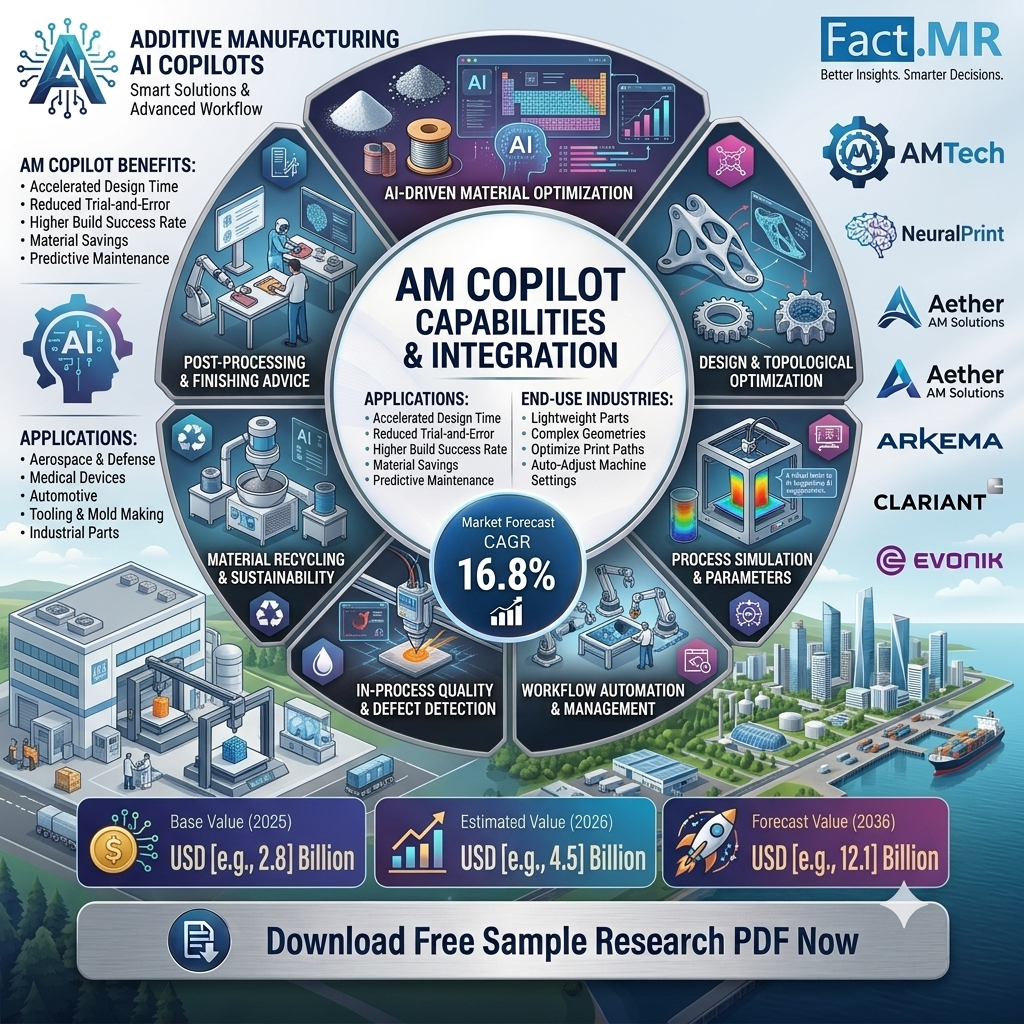
Demand for additive manufacturing generative AI copilots is expected to increase from USD 179.3 million in 2026 to USD 528.4 million by 2036, registering an 11.4% CAGR over the forecast period. According to Fact.MR, the market is anticipated to generate an absolute dollar opportunity of USD 349.13 million between 2026 and 2036. Growing adoption of artificial intelligence in industrial 3D printing, increasing requirements for lightweight components, and demand for faster engineering workflows are supporting market expansion.
Manufacturers are increasingly using generative AI copilots to address complex design requirements associated with additive manufacturing. These software solutions assist engineers in developing optimized component geometries, evaluating material performance, and improving production efficiency. Aerospace manufacturers, automotive suppliers, and industrial engineering companies are adopting AI-assisted design tools to reduce development cycles and material waste. Integration with computer-aided design, simulation software, and manufacturing platforms is also improving the practical application of generative AI in industrial production.
Get detailed market forecasts, competitive benchmarking, and pricing trends:
https://www.factmr.com/connectus/sample?flag=S&rep_id=13331
Generative Design Retains Dominant Position
By function, generative design is expected to account for 34.0% of the additive manufacturing generative AI copilots market in 2026. Its leading position reflects increasing demand for automated component optimization and lightweight engineering solutions. Generative design software evaluates engineering objectives and manufacturing constraints to develop alternative component structures that balance material consumption, weight, and mechanical performance.
Aerospace represents another major area of demand, projected to capture 32.0% of the end-use segment in 2026. Aircraft manufacturers require lightweight, high-strength components that can withstand demanding operating conditions. Generative AI copilots support the development of complex components while assisting engineers with simulation, design validation, and manufacturing qualification. The high value of aerospace components also encourages investment in technologies that reduce development risks and improve design accuracy.
Cloud deployment accounts for 59.0% of the market in 2026, making it the leading deployment model. Cloud-based platforms provide access to computational resources required for generative design and advanced engineering simulation. These systems allow geographically distributed engineering teams to collaborate on design projects without substantial investment in local computing infrastructure. Smaller manufacturers can also access advanced AI capabilities through scalable cloud environments.
USA, Germany, and China Show Strong Growth Potential
The USA is expected to record the fastest growth among the countries specifically assessed in the report, with additive manufacturing generative AI copilot demand rising at an 11.0% CAGR from 2026 to 2036. The country's established engineering software industry, aerospace manufacturing capabilities, and defense investment are supporting adoption. Initiatives associated with America Makes and the Department of Defense are encouraging the development of qualified additive manufacturing components. Increasing integration of AI capabilities into established engineering platforms is also supporting market growth.
Germany follows with a projected 10.5% CAGR through 2036. Its advanced industrial manufacturing base and strong automotive engineering capabilities are encouraging the adoption of AI-assisted additive manufacturing solutions. German manufacturers are focusing on connecting generative design, engineering simulation, and production processes through integrated digital workflows. Compatibility with existing computer-aided design and product lifecycle management systems remains an important consideration for industrial buyers.
China is projected to advance at a 10.0% CAGR during the same period. Government strategies supporting domestic industrial software development and technological self-sufficiency are encouraging investment in generative AI applications. The country's extensive electronics and consumer goods manufacturing industries provide opportunities for AI-assisted component optimization and customized production. Domestic software development is also contributing to the expansion of additive manufacturing capabilities.
Japan is expected to register a 9.5% CAGR through 2036. Its established precision manufacturing industry and expertise in materials engineering are supporting demand for reliable AI-assisted design tools. Manufacturers are emphasizing simulation accuracy, process validation, and improved production consistency, particularly in metal additive manufacturing. Medical devices and precision instrumentation represent important applications where component quality and engineering reliability remain critical.
Competitive Landscape
Competition in the additive manufacturing generative AI copilots market includes established engineering software providers with extensive design, simulation, and manufacturing technology portfolios. Key companies profiled by Fact.MR include Autodesk, Siemens Digital Industries, Dassault Systèmes, PTC, Ansys, and Hexagon.
Autodesk provides generative design capabilities through Fusion 360 and additive manufacturing simulation tools through Netfabb. Siemens Digital Industries offers integrated engineering solutions through NX Additive Manufacturing, Simcenter, and HEEDS. Dassault Systèmes supports generative engineering through its 3DEXPERIENCE platform, while PTC integrates generative design capabilities into Creo.
Competition is increasingly influenced by algorithm performance, simulation accuracy, manufacturing process compatibility, and integration with existing engineering software. Manufacturers are evaluating solutions based on their ability to reduce design iterations, support material selection, and improve the transition from digital models to qualified printed components.
Technology and Industrial Integration Developments Shape the Market
Generative AI copilots are evolving from individual design assistance tools into integrated engineering systems capable of supporting multiple stages of additive manufacturing. Fact.MR highlights growing interest in AI-assisted topology optimization, process simulation, material recommendations, and manufacturing cost estimation. These capabilities can help engineering teams identify design limitations before physical production begins.
Qualification automation represents an emerging opportunity. AI-enabled systems can potentially predict component quality and mechanical performance using design and manufacturing parameters, helping reduce the time required for validation. However, high computational requirements, specialized engineering expertise, and integration challenges with existing enterprise systems remain important barriers to wider adoption.
As manufacturers increase investment in digital engineering and industrial automation, generative AI copilots are expected to play a larger role in additive manufacturing workflows. Continued development of integrated design platforms and simulation technologies will influence adoption across aerospace, automotive, medical, and industrial manufacturing applications through 2036.
Top Reports:
https://adamaamresearch.blogspot.com/2026/10/mobile-device-management-market-to.html
https://net-pals.com/blogs/57692/Global-Mobile-Device-Management-Market-Set-for-USD-34-1
https://acmingle.com/blogs/32080/Global-Mobile-Device-Management-Market-to-Hit-USD-34-1
https://ikofficial.com/blogs/60531/Mobile-Device-Management-Market-Anticipated-to-Reach-USD-34-1
About Fact.MR
Fact.MR is a market research and consulting company providing market intelligence, competitive analysis, and forecasting across global industries. Its research supports businesses with data-driven insights into emerging markets, technology trends, competitive dynamics, regional opportunities, and changing demand patterns.

 English
 Arabic
 French
 Spanish
 Deutsch
 Turkish
 Dutch
 Italiano
 Russian
 Romaian
 Portuguese (Brazil)
 Greek
