


Robotic Applications: Transforming Modern Manufacturing and Industrial Operations
Introduction
Modern industries are continuously exploring new technologies to improve productivity, maintain product quality, and simplify complex operations. Among these technologies, Robotic Applications have become an important part of manufacturing, logistics, automotive production, and industrial automation. Robots can perform repetitive tasks, handle materials, assist with assembly, and support processes that require consistent precision. By integrating robotics into suitable workflows, businesses can improve operational efficiency and respond more effectively to changing production requirements.
What Are Robotic Applications?
Robotic Applications refer to the practical use of robotic systems to perform specific tasks in industrial, commercial, and technical environments. These systems combine mechanical components, sensors, control software, and specialised programming to complete operations with minimal direct human intervention.
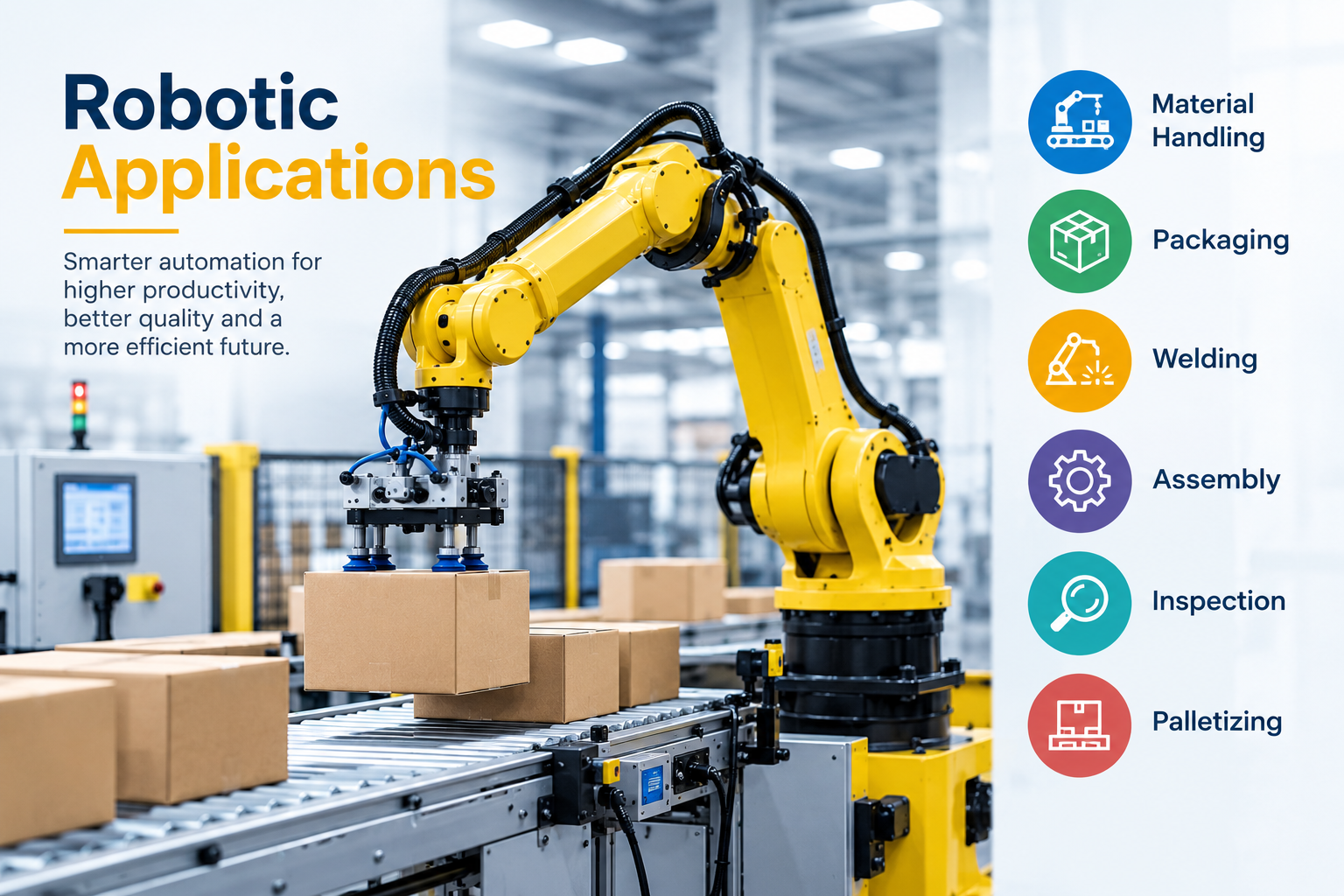
Depending on the purpose, robots may be designed for welding, packaging, inspection, material handling, assembly, or other specialised activities. Some systems operate in predefined environments, while collaborative robots can work alongside people when the equipment and workspace are appropriately designed for safety.
The selection of a robotic system depends on factors such as task complexity, payload requirements, operating speed, workspace, accuracy, and integration with existing equipment.
1. Robotics in Manufacturing
Manufacturing is one of the most established areas for robotic technology. Production facilities use industrial robots to perform tasks such as welding, painting, component placement, machine tending, and assembly.
Automating repetitive operations can help manufacturers maintain consistent processes and manage higher production volumes. Robots can also perform tasks in environments where heat, dust, or repetitive movements create additional challenges for workers.
Successful implementation requires proper equipment selection, programming, safety planning, and coordination with the production line. When these elements are considered together, robotics can support more organised manufacturing operations.
2. Material Handling and Packaging
Moving products between production stages can require considerable time and effort. Robotic systems help automate activities such as picking, sorting, palletising, and packaging.
For example, a robotic palletising system can arrange boxes or containers into predefined patterns for storage and transportation. Robotic picking systems can also help move components between workstations, depending on the equipment and application.
These solutions can improve workflow consistency, reduce repetitive manual handling, and support more efficient movement of goods. Businesses should evaluate product characteristics, cycle times, and available floor space before choosing a suitable system.
3. Robotics in Quality Inspection
Product quality is essential for maintaining customer confidence and reducing manufacturing waste. Robotic systems can support inspection processes by positioning cameras, sensors, and measuring equipment at specific locations.
When integrated with suitable machine vision software, robots can help identify visible defects, check component placement, and examine product dimensions. Automated inspection can also provide repeatable testing conditions for suitable applications.
However, inspection accuracy depends on factors such as lighting, sensor quality, software configuration, and the characteristics of the products being examined. Human expertise remains valuable for interpreting complex results and addressing unusual defects.
4. The Role of Software and Control Systems
Robots require reliable control software to coordinate movement, process sensor information, and communicate with other equipment. Programming defines how a robot performs its assigned tasks and responds to different operating conditions.
Depending on the application, robotic systems may interact with programmable logic controllers, industrial networks, safety devices, and manufacturing execution systems. Effective integration helps coordinate robotic movements with conveyors, machines, and production processes.
Simulation and offline programming can also help engineers evaluate robot movements before physical deployment. This approach may reduce commissioning time and reveal potential workspace or motion-planning problems earlier in the development process.
5. Benefits of Implementing Robotic Applications
Businesses can gain several benefits from well-planned robotic integration.
Improved consistency: Robots can repeat programmed movements, supporting consistent execution of suitable tasks.
Greater productivity: Automated systems can perform repetitive operations at predictable speeds and help reduce production bottlenecks.
Enhanced workplace safety: Robots can handle selected hazardous or physically demanding tasks when supported by appropriate risk assessments and protective measures.
Better process control: Integration with sensors and control software can improve monitoring and coordination across production activities.
Operational flexibility: Some robotic systems can be reprogrammed or equipped with different end effectors to support changing product requirements.
The actual benefits depend on the application, installation quality, maintenance requirements, and overall production environment.
6. Challenges to Consider Before Adoption
Although robotics offers many opportunities, implementation requires careful planning. Initial equipment costs, integration complexity, employee training, and ongoing maintenance can affect the overall investment.
Businesses should first identify tasks that are suitable for automation and evaluate the expected return on investment. They should also consider equipment compatibility, cycle-time requirements, operator training, and safety standards.
A pilot project can help organisations assess performance before introducing robotics across a larger facility. Regular maintenance and software updates are important for maintaining dependable operation over time.
7. The Future of Robotic Applications
Robotic technology continues to develop through improvements in machine vision, artificial intelligence, sensors, simulation, and connected control systems. These technologies are creating opportunities for robots to handle more variable tasks and operate within increasingly flexible production environments.
Collaborative robotics, autonomous mobile robots, and intelligent inspection systems are also expanding the range of potential industrial uses. However, each application requires appropriate technical evaluation to determine whether automation is practical and cost-effective.
Companies that assess their operational needs carefully can identify opportunities to use robotics where it provides measurable value.
Conclusion
Robotic Applications are helping modern industries improve repetitive processes, streamline material handling, support product inspection, and coordinate manufacturing operations. Their successful implementation depends on choosing suitable equipment, developing reliable control software, integrating existing systems, and maintaining appropriate safety measures.
By evaluating business requirements and planning each stage of deployment, organisations can use robotic technology to support productivity, consistent quality, and long-term operational development.

 English
 Arabic
 Spanish
 Portuguese
 Deutsch
 Turkish
 Dutch
 Italiano
 Russian
 Romaian
 Portuguese (Brazil)
 Greek
