


Wi-Fi Market Research Report: Key Trends, Segments and Forecast to 2036
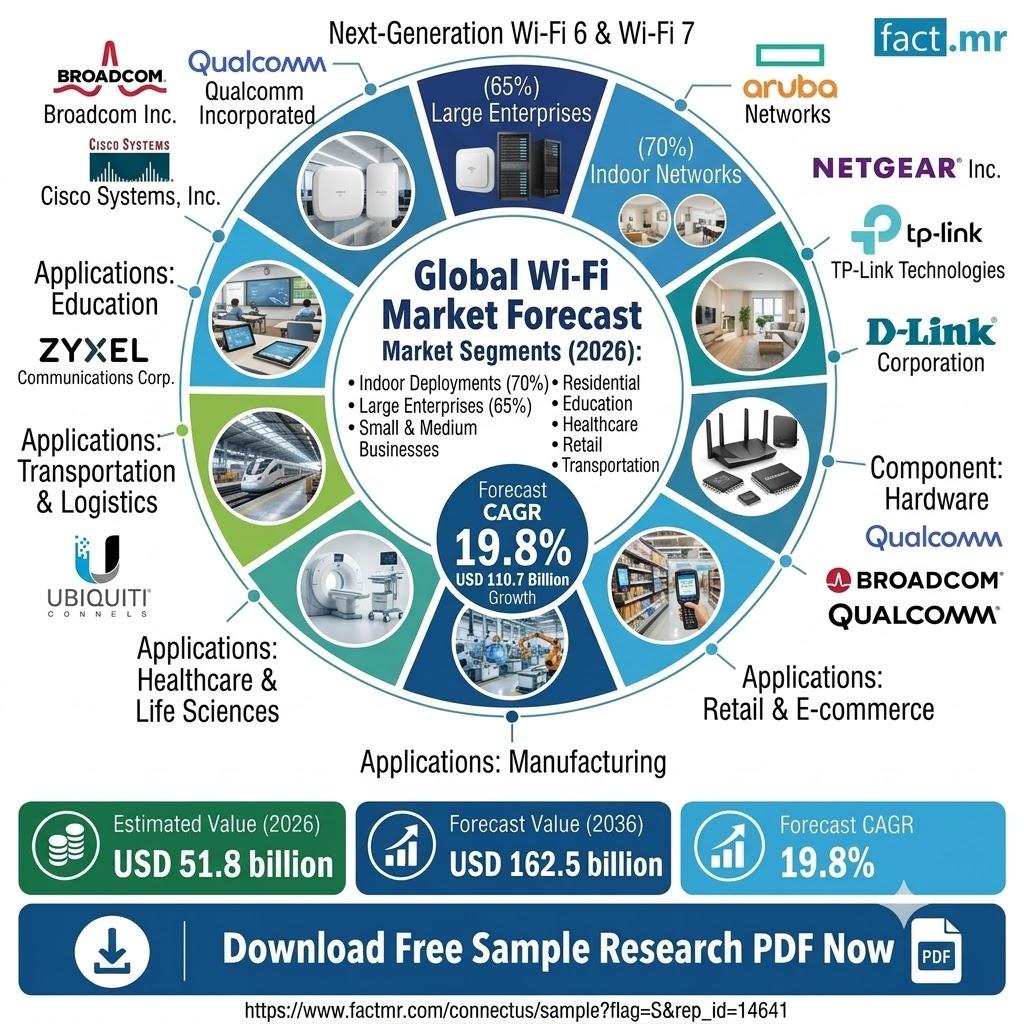
Fact.MR projects the Wi-Fi market to grow at a 19.8% CAGR through 2036, driven by connected devices and next-generation wireless infrastructure.
October 26, 2026 The global Wi-Fi market is projected to reach USD 162.5 billion by 2036, rising from USD 51.8 billion in 2026, according to Fact.MR analysis published in its Wi-Fi Market Forecast report. The forecast represents a compound annual growth rate (CAGR) of 19.8% between 2026 and 2036, with demand supported by connected devices, enterprise networking requirements, and adoption of advanced wireless standards.
The projected increase of USD 110.7 billion over the forecast period highlights the growing importance of wireless infrastructure across residential, commercial, and industrial environments. Businesses upgrading enterprise networks and households adding connected devices are among the users driving demand. The analysis also identifies semiconductor component costs, spectrum management policies, and network security requirements as factors that could influence deployment decisions.
Get detailed market forecasts, competitive benchmarking, and pricing trends: https://www.factmr.com/connectus/sample?flag=S&rep_id=14641
Wi-Fi Market Growth Reflects Demand for Higher Network Capacity
Wireless connectivity has become an essential part of everyday internet access. Homes use Wi-Fi for connected devices and entertainment, while businesses depend on wireless networks to support cloud applications, internal communications, and employee access. Public venues and industrial facilities also rely on wireless infrastructure to connect users and equipment.
Fact.MR identifies Wi-Fi 6 and Wi-Fi 7 as important technologies in the market's development. These standards support improvements in bandwidth, network efficiency, and the handling of multiple connected devices. Their adoption is encouraging equipment upgrades in environments where older networking systems may not meet changing performance requirements.
However, the transition is not uniform. Earlier-generation routers and access points remain suitable for some residential and small-office applications. Organizations with higher device density or greater data-transfer requirements may have stronger reasons to invest in newer equipment.
The cost of advanced chipsets can influence purchasing decisions. Network security requirements and spectrum availability also affect how organizations plan deployments, particularly when wireless connectivity supports critical business operations.
Indoor Networks and Large Enterprises Lead Key Segments
Fact.MR's segment analysis identifies indoor deployments as a major part of the Wi-Fi market. Indoor installations are projected to account for approximately 70% of market share in 2026. Homes, offices, educational institutions, healthcare facilities, and commercial buildings require wireless coverage for users and connected equipment.
Large enterprises are another important segment, expected to represent approximately 65% of the market in 2026. Their extensive facilities and high device density create requirements for network capacity, coverage, security, and centralized management.
These figures provide a useful indication of where demand is concentrated. Indoor connectivity serves routine internet access and business operations, while large-enterprise deployments often involve more extensive infrastructure planning.
The market is segmented by component into hardware, solutions, and services. The report also covers high-density and enterprise-class deployments, alongside applications in education, healthcare and life sciences, transportation and logistics, retail and e-commerce, government, manufacturing, and hospitality.
China Leads Country-Level Growth Projections
Fact.MR projects China to record a 10.5% CAGR in Wi-Fi demand between 2026 and 2036. Large-scale wireless infrastructure deployment and demand for connected consumer devices support the country's growth outlook.
The United States follows with a projected CAGR of 9.8%. Enterprise network upgrades and expanding home broadband connectivity are identified as contributing factors. Japan is forecast to grow at 9.3%, while South Korea is projected to record a 9.2% CAGR over the same period.
Germany has the lowest projected growth among the five countries highlighted in the report, at 8.9%. Fact.MR links this outlook to a mature networking equipment market where demand increasingly depends on replacement and upgrade cycles.
These country-level projections help network equipment manufacturers and service providers assess differences in market development. Regional decisions remain influenced by infrastructure investment, spectrum policies, broadband adoption, and the availability of compatible devices.
Competition Spans Chipsets and Networking Equipment
The Wi-Fi market includes semiconductor suppliers, network equipment manufacturers, and enterprise connectivity providers. Fact.MR identifies Broadcom Inc. and Qualcomm Incorporated among the companies with strong positions in Wi-Fi chipset supply.
Networking equipment companies include Cisco Systems, Inc., Hewlett Packard Enterprise Company, NETGEAR, Inc., TP-Link Technologies Co., Ltd., D-Link Corporation, Ubiquiti Inc., Zyxel Communications Corp., and Samsung Electronics Co., Ltd. Aruba Networks, Inc., a subsidiary of Hewlett Packard Enterprise Company, also participates in enterprise networking.
Competition depends on data throughput, network reliability, security, compatibility with evolving standards, and ease of deployment. Enterprise buyers may use multiple suppliers to maintain flexibility and reduce dependence on one vendor. Long-term support and security compliance also remain relevant to procurement decisions.
Shambhu Nath Jha, Principal Consultant at Fact.MR, said, “Wireless connectivity infrastructure continues to expand across residential and enterprise environments. Wi-Fi technologies support high-speed data transmission and network access across connected devices. Companies developing advanced networking equipment and supporting next-generation wireless standards will maintain strong positions in the global connectivity market.”
Research Methodology and Market Outlook
Fact.MR developed its forecast using a hybrid market-sizing approach that combines bottom-up equipment shipment analysis with top-down demand assessment across residential, enterprise, and public networking sectors. The research includes interviews with networking equipment manufacturers, telecommunications providers, system integrators, and enterprise IT managers.
Desk research draws on telecommunications industry publications, company reports, regulatory filings, and international trade statistics. Findings are cross-checked against multiple data sources and expert consultations.
The report's findings point to several planning priorities for industry participants. Manufacturers may assess opportunities in next-generation wireless equipment, while enterprise IT teams can evaluate network capacity and security needs before scheduling upgrades. Semiconductor supply and spectrum management will also remain relevant to deployment planning.
Fact block: Fact.MR is a market research and consulting company that provides industry analysis, market sizing, and forecasts to support business and strategic decision-making.
View Related Reports :
https://ayushjadhavblogs.blogspot.com/2026/10/machine-condition-monitoring-market-to.html
About Fact.MR
Fact.MR is a market research and consulting firm that provides market intelligence, industry analysis, and forecasting across a range of sectors. Its research combines primary interviews, secondary sources, and quantitative modeling to assess market size, demand patterns, competitive developments, and future growth opportunities.

 English
 Arabic
 French
 Spanish
 Portuguese
 Deutsch
 Dutch
 Italiano
 Russian
 Romaian
 Portuguese (Brazil)
 Greek
