


Anchor Bolt Selection for High-Load and Heavy-Duty Applications
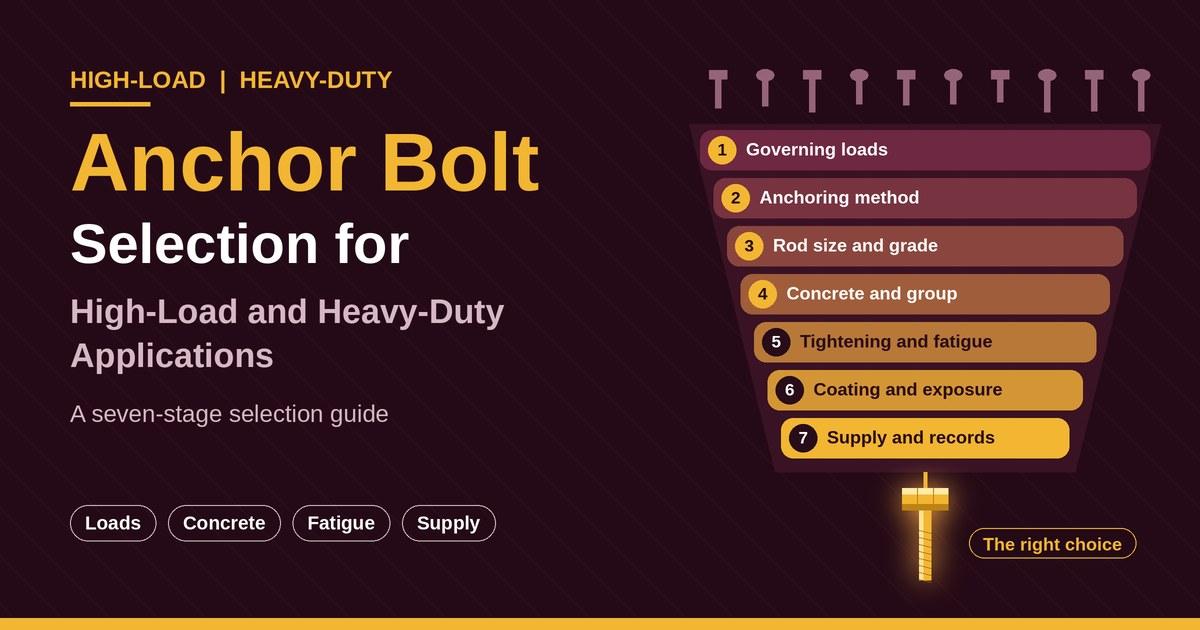
When loads are small, almost any sound anchor will do. When loads are large, repeated, or tied to expensive consequences, the margin for a poor choice disappears. Heavy equipment bases, tall vessels, crane supports, and transmission structures all ask Anchor Bolts to carry forces that can break weak links in the concrete, the steel, or the installation. This guide walks through selection as a series of stages, narrowing the options step by step until one clear choice remains.
What “High-Load” and “Heavy-Duty” Really Mean
The terms are used loosely, so it helps to define them. A connection usually qualifies when one or more of these are true:
- Large forces, from heavy equipment, overturning moments, or crane reactions
- Repeated or reversing loads, such as vibration, wind gusts, or traffic
- Serious consequences of failure, affecting safety, production, or the environment
- Long service life, where replacing a buried anchor later would be costly
- Harsh surroundings, including heat, chemicals, or coastal salt
The more of these apply, the more selection should rely on engineering calculation and verified products, not catalog convenience.
Stage 1: Identify the Governing Demand
Selection starts with the load that actually controls the design. For each bolt group, work out:
- Tension and shear, including uplift and overturning, not only gravity
- Combined effects, since tension and shear acting together reduce capacity
- Cyclic content, meaning how often the load repeats and how large the swing is
- Thermal movement, from hot piping, boilers, or long steel runs
- Construction-stage loads, when a partly braced frame relies on its base
Many selection errors begin here, when a designer sizes for dead weight and overlooks the storm or earthquake case that governs.
Stage 2: Choose the Anchoring Method
For heavy-duty work, the method matters as much as the size. A rough guide:
| Option | Suits | Watch for |
|---|---|---|
| Cast-in headed rods | New foundations, heavy tension and shear | Positioning during the pour |
| Plate-washer or anchor-cage assemblies | Large groups, very high tension | Congestion with reinforcement |
| Undercut post-installed | Retrofits needing high capacity, cracked concrete | Specialized drilling |
| Adhesive rods | Flexible placement, deep embedment | Hole cleaning, temperature, sustained load approval |
| Expansion or screw anchors | Moderate loads only | Edge distance, cracked-concrete limits |
Hooked bolts generally resist less pullout than headed ones, so they are a weaker choice where tension is significant. Where a post-installed anchor is needed, use a product qualified for the conditions, such as cracked concrete or seismic loading, tested under programs like ACI 355.2 for mechanical anchors or ACI 355.4 for adhesive ones.
Stage 3: Size and Grade the Rods
Once the method is set, the rod itself has to be chosen. Three decisions dominate.
Strength grade. ASTM F1554 offers several grades, and the right one follows the design. Higher strength lets you reduce diameter, but it is not automatically better. Very high-strength steels need extra care with galvanizing because of hydrogen embrittlement risk, so leave that call to the engineer.
Diameter and thread. Steel capacity depends on the tensile stress area of the threads, which is smaller than the plain shank. Large rods often use coarse-pitch or constant-pitch thread series, and the nuts must match.
Ductility. Design codes favor steel that yields and stretches before the concrete breaks, because that gives warning. For seismic use, ACI 318 requires the anchor’s steel to meet ductility limits on elongation and reduction of area, so confirm the product qualifies.
Always specify the rod, nut, and washer as a matched set. A strong rod with a weaker nut can strip before it yields.
Stage 4: Check the Concrete and the Group
In heavy-duty applications, the concrete is usually the limiting material. Failure modes include breakout of a cone of concrete, pullout, side-face blowout near edges, splitting, and pryout in shear.
Group behavior adds another layer. Closely spaced Anchor Bolts share overlapping breakout cones, which reduces the capacity of each bolt. Engineers address this with:
- More embedment depth, which enlarges the available concrete
- Greater edge distance and spacing, where the pedestal allows
- Supplementary reinforcement, properly developed on both sides of the likely failure surface, so it can carry load instead of the concrete
- Coordination with the rebar drawings, so bars neither block the bolts nor prevent concrete from flowing around the embedded ends
If the geometry cannot support the load, change the geometry. Enlarging a pedestal costs little on paper, while repairs after the pour cost a great deal.
Stage 5: Plan for Tightening, Vibration, and Fatigue
Repeated loads change the selection. Machines, wind, and traffic can loosen nuts and start fatigue cracks, often at thread roots. For these cases, consider:
- Pretensioned rods, because a clamped joint means the rod sees only part of each load swing
- Locking nuts or double nuts, plus a recheck after initial operation
- Rolled threads, which generally resist fatigue better than cut ones
- Sleeved anchors, which give free length so the rod can stretch evenly
ACI 351.3R offers guidance for dynamic equipment foundations, and ACI 318’s anchoring provisions do not cover fatigue or impact, so those conditions call for added engineering judgment.
Stage 6: Match Coatings to the Environment
Heavy-duty installations often sit in tough settings. Moisture, chlorides, and chemicals attack steel where the rod leaves the concrete, and water trapped beneath the plate speeds the process.
- Hot-dip galvanizing suits many outdoor sites
- Stainless steel suits aggressive chemical or marine exposure, though mixing metals in damp conditions can cause galvanic corrosion
- Grouting and drainage details matter as much as the coating, because they keep water from pooling at the base
Stage 7: Verify the Supply Chain
Once Anchor Bolts are buried, you cannot easily inspect what they are, so quality has to be proven before installation. Ask for mill test certificates, grade markings, thread and coating details, and dimensional records, then compare each with the specification.
Large rods are also harder to replace, so lead times and tolerances matter. Suppliers differ in what they make, test, and document, so evaluate them on certification, traceability, and size range as well as price. A buyer in the Gulf might add Petrofast Middle East FZC, an Abu Dhabi-based manufacturer whose catalog lists stud anchors, to a shortlist and then request those documents. Whoever you choose, reject any delivery that does not match its certificates, and settle the substitution rule early: any change goes back to the engineer for written approval before it is installed.
Installation Details That Protect the Selection
Even a well-chosen anchor loses capacity if installation goes wrong. A few habits matter most:
- Hold cast-in rods in a rigid template, and survey them before and after the pour
- Confirm embedment, spacing, and edge distance against the drawings
- Never bend or heat a rod to fit a misaligned plate
- Grout fully so the plate bears evenly, and account for leveling nuts in the design
- Tighten using the specified method and keep records
- Clean drilled holes thoroughly for adhesive anchors, since leftover dust is a well-known cause of weak results
Red Flags During Selection
Pause and escalate to the engineer if you see any of these:
- Loads quoted without uplift, cyclic, or thermal cases
- A catalog value used without checking edge distance, spacing, or cracked concrete
- Mixed grades of rod, nut, and washer
- A last-minute substitution “of equal size”
- No tightening procedure for a vibrating machine
- Certificates that do not match the delivered markings
Conclusion: Selecting Anchor Bolts With Confidence
For high-load and heavy-duty work, good selection is a funnel: define the governing demand, choose the method, size and grade the rod, check the concrete and group effects, plan for tightening and fatigue, match the coating, and verify the supply. Each stage removes options until the right Anchor Bolts remain. Final sizing and detailing always belong with the engineer of record and the governing code.

 English
 Arabic
 French
 Portuguese
 Deutsch
 Turkish
 Dutch
 Italiano
 Russian
 Romaian
 Portuguese (Brazil)
 Greek
