


Mobile Scaffold: Types, Uses, Safety & Rental Guide 2026
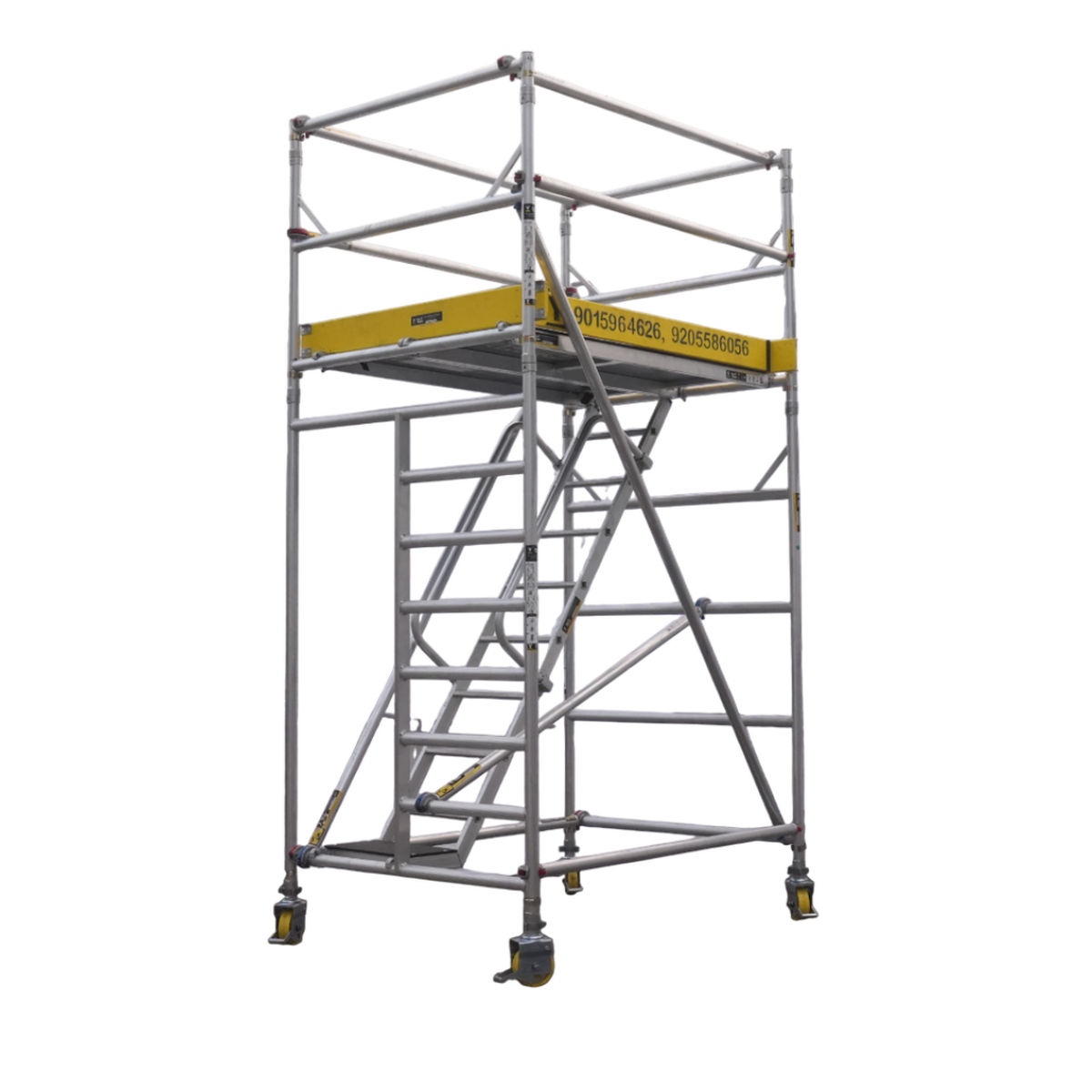
Working at height is one of the most common jobs on any site. It is also one of the riskiest. Painters, electricians, facility teams and fit-out crews often lose time and take risks because they use makeshift ladders or fixed scaffolds that cannot move. An Aluminium Mobile Scaffold Tower fixes this. It gives you a stable, guarded platform that rolls to the next work spot, goes up fast and comes down just as fast.
This guide explains how mobile scaffolds work, which type suits which job, how to use them safely and how to decide between renting and buying. It is written for site engineers, contractors, facility managers and anyone planning overhead work in India in 2026.
Summary: What You Will Learn
-
A mobile scaffold is a freestanding, wheeled work platform that you can reposition without dismantling it.
-
Aluminium towers are light, corrosion resistant and quick to assemble, so they suit both indoor and outdoor work.
-
Five main tower styles cover most jobs: modular, non-conductive FRP, stairway, compact interior and single-person.
-
Safe use depends on level ground, locked wheels, complete guardrails, trained users and daily checks.
-
Rental works well for short projects. Buying makes sense for ongoing maintenance.
-
Y Group supplies EN1004-certified towers across 23+ locations in India.
What Is a Mobile Scaffold?
A mobile scaffold is a temporary work platform built from lightweight frames, braces and a deck. It stands on wheels or castors that lock in place. Workers can move it to a new position as the job progresses, which is why it suits tasks that change location often, such as painting a corridor, fixing ceiling services or inspecting overhead equipment.
It differs from a fixed scaffold in three ways:
-
It moves. You roll it, lock the brakes and work. You do not rebuild it for every position.
-
It stands on its own. It needs no tie-in to a wall, though stabilisers or outriggers may be needed at greater heights.
-
It goes up fast. A trained crew can assemble it quickly, and some compact models need only one person.
Why Aluminium Is the Preferred Material
Steel is strong but heavy. Aluminium gives you strength without the weight. That matters on a busy site because heavy equipment takes more time, more people and more effort to carry up stairs or through doorways.
Aluminium has four practical benefits:
-
Light to carry. One or two people can move the components.
-
Rust resistant. Aluminium handles humidity, monsoon exposure and dusty conditions well.
-
Quick to assemble. Modular, quick-lock designs cut setup time.
-
Easy to move. Lower weight makes repositioning simpler on suitable floors.
How an Aluminium Mobile Scaffold Tower Works
An Aluminium Mobile Scaffold Tower is built from vertical frames joined by horizontal and diagonal braces. Platforms sit at working height, and guardrails surround the deck. Castors at the base let the tower roll, and brakes lock it before anyone climbs.
Stabilisers or outriggers widen the base on taller setups. Together these parts give a steady platform that does not sway under normal working loads.
Types of Mobile Scaffold Towers
No single tower fits every job. The right choice depends on height, location, environment and how often you climb. Y Group offers five access tower models, each designed for a different working situation.
1. Modular Quick-Lock Tower (XO Tower)
The XO Tower is the flagship modular aluminium tower. Its quick-lock system gives working heights from 3 m to 12 m and is certified to EN1004 for indoor and outdoor use. It suits general construction, plant maintenance and large-area finishing work.
2. Non-Conductive FRP Tower (XO FRP Tower)
Some sites cannot allow a conductive structure. The XO FRP Tower is made from fibreglass reinforced polymer. It is non-conductive, non-sparking and corrosion resistant. It is built for live electrical environments, oil and gas facilities and other spark-risk areas.
3. Staircase Access Tower (XO Stairway Tower)
Climbing a ladder while carrying tools gets tiring and risky. The XO Stairway Tower has a staircase for access, so workers can climb often and move materials more safely than on a ladder-access tower. It suits long jobs with repeated trips up and down.
4. Compact Interior Tower (FitOut Master)
Interior work has its own problems: narrow doorways, finished floors and tight corridors. The FitOut Master has a narrow profile, rubber wheels and a protective frame to avoid floor damage. It is a good fit for retail, hospitality and office fit-outs.
5. Lightweight Single-Person Tower (EazY Tower)
For quick maintenance, inspection or routine overhead tasks, the EazY Tower is simple and light. One person can assemble it in about 10 minutes and move it without help.
Quick Comparison Table
|
Tower Model |
Best For |
Key Feature |
Typical Setting |
|
XO Tower |
General construction and maintenance |
Modular quick-lock system, 3 m to 12 m working heights |
Indoor and outdoor |
|
XO FRP Tower |
Electrical and spark-risk areas |
Non-conductive, non-sparking, corrosion resistant |
Power, oil and gas |
|
XO Stairway Tower |
Frequent climbing and tool carrying |
Staircase access |
Long-duration site work |
|
FitOut Master |
Interior fit-out |
Narrow profile, rubber wheels, protective frame |
Retail, hospitality, offices |
|
EazY Tower |
Quick maintenance and inspection |
Single-person assembly in about 10 minutes |
Routine overhead work |
Where Mobile Scaffolds Are Used
Mobile towers are not just for building sites. Wherever someone needs safe access above floor level, a tower can help. Common industries include:
-
Construction: plastering, painting, façade finishing and services installation.
-
Power and energy: panel, cable and line maintenance, where non-conductive FRP towers add a layer of protection.
-
Oil and gas: inspection and repair work in areas where sparks must be avoided.
-
Railways and metro: station finishing, overhead equipment checks and depot maintenance.
-
Iron and steel: plant upkeep and shutdown work.
-
Pharma and FMCG: cleanroom and production-area maintenance where floor protection and tidy access matter.
-
Mining, automotive and manufacturing: machinery servicing and assembly-line upkeep.
-
Data centres and warehouses: lighting, cabling and racking work in large indoor spaces.
-
Defence, government and infrastructure facilities: routine maintenance across large premises.
-
Ports and maritime: equipment inspection and repair in coastal conditions.
Common Problems and How the Right Tower Solves Them
Problem: Ladders are slow and unsafe for long tasks.
A ladder offers no platform, no guardrail and no room for tools. A tower gives you a wide, guarded deck so you can work with both hands.
Problem: We keep dismantling and rebuilding scaffolds.
A fixed scaffold needs rebuilding for each new area. A wheeled tower rolls to the next spot, so work continues without long pauses.
Problem: Our floors get damaged.
Choose a tower with non-marking wheels and a protective base frame, such as the FitOut Master, for finished interiors.
Problem: Our site has live electrical equipment.
A conductive structure adds risk. A non-conductive FRP tower is made for this setting.
Problem: We only need access for a few days.
Buying makes little sense for a short job. Renting gives you the equipment for exactly the time you need.
Problem: Workers keep carrying tools up a ladder.
A staircase-access tower removes that strain and makes repeated trips safer.
How to Choose the Right Mobile Scaffold Tower
Before you pick a tower, answer these questions:
-
How high do you need to work? Match the tower's working height to your task. Models range from compact units to towers reaching 12 m.
-
Is the job indoors or outdoors? Indoor work calls for narrow, floor-friendly towers. Outdoor work needs stable bases and, where required, stabilisers.
-
Is there an electrical or spark risk? If yes, choose a non-conductive, non-sparking tower.
-
How often will people climb? For frequent trips with tools, choose staircase access.
-
What is the floor like? Hard, level surfaces are best. Uneven ground needs levelling adjustments.
-
How many people will assemble it? Compact towers suit one person, while taller modular towers need a trained team.
Not sure which fits? A site survey removes the guesswork. A proper Aluminium Mobile Scaffold Tower selection starts with your height, floor and environment, not with a catalogue guess.
Mobile Scaffold Safety Guide for 2026
Even the best tower is only as safe as the way it is used. These practices follow widely accepted work-at-height guidance. Always read the manufacturer's manual for your specific model.
Before You Climb
-
Use trained people. Only trained and competent workers should assemble, alter or dismantle a tower.
-
Check every component. Look for bent frames, damaged locks, missing pins or worn castors.
-
Pick the right ground. Use a firm, level surface free of holes, debris and obstructions.
-
Keep away from edges. Do not place a tower close to a slab edge, opening or step-down.
-
Lock the wheels. Apply the brakes on all castors before anyone climbs.
-
Fit all guardrails. Make sure every open side of the platform has guardrails and toe boards where required.
-
Use the built-in access. Climb only by the ladder or stairs on the inside of the tower. Never climb the frame.
While You Work
-
Respect load limits. Do not overload the platform with people, tools or materials.
-
Stay inside the guardrails. Do not lean out, jump or use planks to extend your reach.
-
No ladders on the platform. Adding height this way is unsafe.
-
Mind the weather. Strong wind makes outdoor towers unstable, so pause work when conditions worsen.
-
Keep the area clear. Keep other workers away from the base while overhead work is under way.
When You Move the Tower
-
Move it only when nobody is on it, unless the manufacturer has designed it for that purpose.
-
Clear the path of obstacles and check for overhead hazards such as cables.
-
Move it slowly and re-lock the brakes in the new position.
-
Re-check that the tower is level and the stabilisers are in place before use.
After the Job
-
Dismantle in the reverse order of assembly.
-
Lower components safely. Never drop them.
-
Inspect and clean all parts before storage.
-
Report any damage so it can be repaired before the next use.
Standards and Certification
Look for towers certified to recognised standards. Y Group's access towers are EN1004 and BS1139 certified, and Y Group holds ISO 9001:2015 certification for its quality management. Certification is not a substitute for training and inspection, but it shows that the design has been tested against set requirements.
Rent or Buy? Making the Right Call
Both options have their place.
Renting suits you if:
-
Your project has a fixed timeline.
-
You need different tower types at different stages.
-
You do not want to manage storage, transport or maintenance.
-
You want equipment that is inspected and ready to use.
Buying suits you if:
-
You do regular maintenance across a facility.
-
You need the same tower every day.
-
You have storage space and a trained team to maintain the equipment.
Y Group offers both rental and sale of its access towers. For a clear quotation, share your working height, location and project duration with the team, and they can recommend a configuration. A free site survey is available.
Why Choose Y Group for Mobile Scaffolds
Choosing a supplier matters as much as choosing a tower. Here is what stands behind Y Group:
-
Experience: Founded in 2011, and formerly known as Youngman India.
-
Scale: More than 500 enterprise clients across industries.
-
Quality: ISO 9001:2015 certified, with EN1004:2020 certified access towers.
-
Complete range: Five tower models for different heights and environments.
-
End-to-end support: Equipment rental through YES, manufacturing through YAM and safety training for site teams.
-
Pan-India reach: 23+ locations across the country.
Serving Your City
Y Group offers scaffolding and equipment rental in Greater Noida, Gurugram, Mumbai, Pune, Bangalore, Chennai, Hyderabad, Kolkata, Ahmedabad, Jaipur, Lucknow, Kochi, Visakhapatnam, Guwahati, Bhubaneswar, Nagpur, Zirakpur, Goa, Coimbatore, Surat, Jamshedpur and Indore. The head office is in Greater Noida, so teams working across the NCR belt can reach the company quickly.
Conclusion
Working at height should not mean working at risk. A well-chosen mobile scaffold gives your team a stable platform, saves hours of setup and moves with the job. The key is matching the tower to the task: modular for general work, FRP for electrical zones, stairway for frequent climbing, compact for interiors and single-person for quick jobs.
Pair the right equipment with trained users, level ground, locked wheels and daily inspections, and you cut both delays and danger. If you are planning a project in 2026, a certified Aluminium Mobile Scaffold Tower from a trusted supplier is one of the simplest ways to keep people safe and work on schedule.
FAQ
1. What is a mobile scaffold used for?
A mobile scaffold is a wheeled work platform for tasks at height, such as painting, ceiling work, electrical maintenance, inspections and fit-outs. You can move it to the next work area without taking it apart.
2. How tall can a mobile scaffold tower go?
Height depends on the model. The XO Tower from Y Group offers working heights from 3 m to 12 m. Compact models such as the FitOut Master and EazY Tower suit lower, interior and routine tasks.
3. Which mobile scaffold is safe near electrical equipment?
A non-conductive fibreglass reinforced polymer tower is the right choice. The XO FRP Tower is non-conductive, non-sparking and corrosion resistant, so it suits live electrical environments and spark-risk sites.
4. Can one person assemble a mobile scaffold?
Lightweight single-person towers like the EazY Tower are designed for quick assembly by one person in about 10 minutes. Taller modular towers should be assembled by a trained team following the manufacturer's instructions.
5. Should I rent or buy a mobile scaffold tower?
Rent for short or changing projects. Buy if you need the same tower regularly for ongoing maintenance. Y Group offers both, plus a free site survey to help you decide.
Get in Touch with Y Group
Address: Plot No.14, Ecotech 1 Ext, Greater Noida, UP 201310, India
Email: info@ygroup.co.in
Phone: +91-9015964626
Explore the range: Access Towers at Y Group
About the Writer
Y Group Team is the in-house team of work-at-height specialists at Y Group, formerly Youngman India. With experience since 2011 in scaffolding, access towers, ladders and safety services, the team writes practical guides based on real site needs across construction, power, oil and gas, railways, manufacturing and more.

 English
 French
 Spanish
 Portuguese
 Deutsch
 Turkish
 Dutch
 Italiano
 Russian
 Romaian
 Portuguese (Brazil)
 Greek
