


What role does an air quality monitoring system play in IVF Labs Design?
INTRODUCTION
Air quality is a critical consideration in IVF Labs Design because laboratory air can contain airborne particles, volatile organic compounds (VOCs), and other contaminants that may affect the laboratory environment and sensitive reproductive cells. An air quality monitoring system helps laboratory teams assess environmental conditions, identify deviations, track contamination trends, and verify whether air-handling and filtration measures are performing as intended. When integrated with appropriate HVAC systems, HEPA filtration, VOC control, temperature and humidity monitoring, and documented operating procedures, it becomes an important part of laboratory quality management. Current European Society of Human Reproduction and Embryology (ESHRE) recommendations emphasize controlled laboratory environments, regular air-quality assessment, suitable construction materials, and documented responses to environmental deviations. [1]
Understanding Air Quality Monitoring in IVF Laboratories
An air quality monitoring system consists of sensors, sampling equipment, measurement instruments, data-recording tools, and, where appropriate, alarms. The system selected for an IVF laboratory should reflect its procedures, environmental risks, equipment, and applicable guidance.
Monitoring may assess:
- Airborne particle concentrations
- VOC levels or trends
- Temperature and relative humidity
- Differential pressure between selected rooms
- HVAC operating conditions
- Microbial contamination through appropriate sampling methods
- Filter performance indicators, such as pressure drop
These measurements provide different types of information. For example, particle counters measure airborne particles, while VOC monitoring requires instruments or sampling methods appropriate to the compounds being assessed. Temperature and humidity sensors cannot establish whether air is free from chemical contaminants.
The purpose is to build a reliable picture of environmental performance rather than depend on a single measurement.
1. Supporting Contamination Control
An air quality monitoring system helps laboratories identify changes in airborne particle levels and evaluate whether contamination-control measures remain effective.
Particles may enter through personnel movement, incoming materials, building activities, equipment, or inadequately controlled air distribution. Although particle counts do not directly measure every type of biological contamination, they can provide useful information about changes in environmental cleanliness.
During IVF Labs Design, monitoring locations should be selected according to the room layout, laboratory activities, airflow pattern, and risk assessment. Sampling may be appropriate in general laboratory areas, near critical work zones, or at other locations identified during commissioning.
Results should be compared with predefined acceptance criteria. Unexpected readings should trigger an investigation rather than automatically be interpreted as proof of microbial contamination.
2. Identifying Volatile Organic Compound Risks
VOCs deserve particular attention in IVF laboratories because some airborne chemicals may be harmful to gametes or embryos at relevant exposure levels. Potential sources include paints, adhesives, sealants, flooring, furniture, cleaning agents, and certain equipment or consumables.
An air quality monitoring programme can help identify possible contamination trends and evaluate whether source-control measures are effective.
Useful practices include:
- Selecting construction materials with suitable low-emission characteristics
- Reviewing technical and safety documentation
- Allowing appropriate curing and off-gassing time after construction
- Controlling chemical storage and cleaning-product use
- Assessing VOC trends before and after relevant changes
- Evaluating gas-phase filtration where justified
Not all VOCs have the same properties, and a single total-VOC reading does not identify every compound or establish its toxicity. Where results indicate a concern, specialist assessment or compound-specific testing may be necessary.
ESHRE's 2026 recommendations address VOC control and recommend considering trend analysis as part of environmental management. [1]
3. Verifying HVAC Performance
The HVAC system influences air supply, filtration, temperature, humidity, airflow distribution, and pressure relationships. Monitoring can help identify deviations from the laboratory's intended operating conditions.
For example, a change in differential pressure may indicate an issue with airflow balance, a door left open, a filter becoming loaded, or a mechanical fault. A rise in particle levels may prompt inspection of the air-handling system, work practices, or a nearby construction activity.
A monitoring system should therefore be coordinated with the HVAC design. It should not be installed as an isolated device without defining how its readings relate to system performance.
During commissioning, engineers should establish baseline measurements, verify sensor operation, and document the expected operating range for each parameter.
4. Maintaining Stable Temperature and Humidity
Environmental temperature and humidity influence staff comfort, equipment operation, and laboratory conditions. Changes in room conditions may also affect the performance of equipment used to maintain reproductive cells and culture media at their required conditions.
Temperature and humidity monitoring can alert staff to HVAC faults, unusual heat loads, or control-system problems.
However, room measurements must be distinguished from the conditions inside incubators and other critical equipment. Embryo culture requires appropriate monitoring of factors such as incubator temperature, gas concentrations, and culture-medium conditions in accordance with laboratory protocols. ESHRE recommends systematic monitoring of relevant embryo-culture conditions. [1]
For reliable performance, sensors should be appropriately located, calibrated, and maintained. Alarm thresholds and response procedures should be documented before the laboratory begins operation.
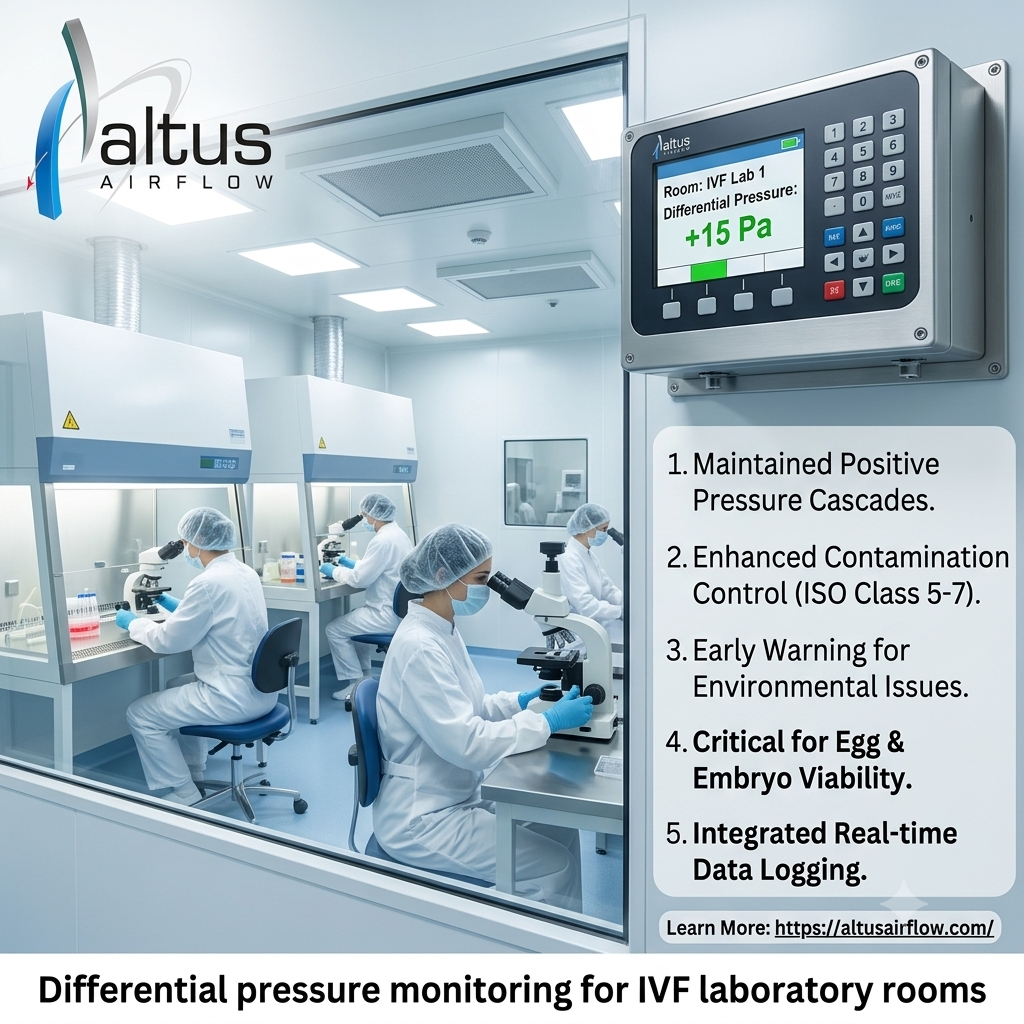
5. Tracking Differential Pressure
Pressure relationships between rooms can help control the direction of airflow. Where positive pressure is part of the approved IVF laboratory design, differential pressure monitoring can help verify that the intended relationship with adjacent spaces is maintained.
Pressure monitoring may help identify:
- HVAC imbalance
- Unexpected air movement
- Door or access-control issues
- Changes caused by filter loading
- Mechanical system faults
Pressure readings should be interpreted alongside airflow measurements and room-use conditions. Opening doors, moving equipment, or changing HVAC settings can temporarily affect readings.
A pressure alarm should prompt staff to follow a defined response procedure, which may include checking doors, reviewing HVAC status, and contacting the facilities team.
6. Supporting Air Filtration Management
HEPA filtration can reduce airborne particles when the filters and associated air-handling system are correctly designed, installed, and maintained. It does not, by itself, eliminate all chemical or gaseous contaminants.
Air quality monitoring provides information that can help determine when further investigation or maintenance may be needed. Filter pressure-drop readings, airflow measurements, and scheduled integrity testing each provide different information about filtration performance.
A suitable maintenance programme should include:
- Inspection of filter housings and seals
- Filter pressure-drop monitoring where applicable
- Airflow verification
- HEPA integrity testing where specified
- Documented replacement and maintenance records
- Reassessment after major HVAC changes
Particle measurements alone cannot prove that a HEPA filter is intact. Filter performance should be verified using the appropriate test method and acceptance criteria.
7. Establishing Baseline Environmental Conditions
Before an IVF laboratory begins clinical operations, the team should establish baseline environmental conditions under defined circumstances.
Measurements may be collected with the laboratory unoccupied and during representative operation, where appropriate. This helps reveal differences caused by personnel, equipment, routine activities, and airflow conditions.
The baseline record should document:
- Measurement locations
- Instruments and calibration status
- Date and operating conditions
- Environmental readings
- Acceptance criteria
- Any corrective actions
- Results of follow-up verification
A baseline makes later results easier to interpret. It also supports investigations when unusual readings appear or when construction materials, cleaning agents, equipment, or HVAC settings change.
8. Enabling Early Warning and Corrective Action
A monitoring system becomes more useful when it is linked to clear procedures.
For example, a high particle reading may prompt staff to check sampling conditions, personnel movement, cleaning activity, or HVAC performance. An unusual VOC trend may trigger a review of recently introduced materials, cleaning products, or equipment. A temperature alarm may require an immediate check of the room controls and critical equipment.
The laboratory should define:
- Which readings trigger an alert.
- Who receives the alert.
- Who investigates the cause.
- What immediate precautions are required.
- How corrective actions are recorded.
- How the team verifies that conditions have returned to an acceptable range.
Alarm thresholds should be established from documented risk assessment, applicable guidance, instrument capability, and the laboratory's validated operating conditions—not chosen arbitrarily.
9. Improving Documentation and Quality Management
Reliable records help laboratories identify recurring problems and demonstrate that environmental controls are being managed consistently.
A monitoring dashboard or laboratory information system may record measurements, alarms, maintenance activity, sampling results, and corrective actions. Trend reports can reveal gradual changes that may be overlooked when staff review only individual readings.
Documentation should include instrument calibration, maintenance, environmental excursions, investigations, and follow-up verification.
Access to monitoring records should be controlled appropriately, and staff should be trained to understand the limits of each measurement. Automated systems can improve visibility, but they cannot replace professional judgement or laboratory quality-management procedures.
10. Guiding Better Laboratory Layout and Zoning
Air quality monitoring can also inform design decisions before construction is finalized. The location of sampling points, air supply outlets, return-air grilles, workstations, and equipment should be considered together.
The laboratory may need separate areas for embryo culture, sample preparation, cleaning, chemical handling, storage, and administrative activities. The exact arrangement depends on the services offered and the laboratory's workflow.
Activities involving fixatives or toxic reagents should be appropriately separated from sensitive reproductive-cell handling. Construction and renovation plans should also allow sufficient time for materials to cure and off-gas before the laboratory is used. [1][2]
Monitoring results gathered after installation can help the team assess whether the intended layout and environmental controls are working as planned.
11. Supporting Regulatory and Guidance-Based Compliance
Air quality monitoring can contribute to a laboratory's quality-assurance and documentation programme. However, the monitoring system alone does not establish compliance with every applicable requirement.
Laboratories should identify the laws, accreditation criteria, professional recommendations, and internal quality standards relevant to their location and activities. ESHRE's 2026 recommendations provide guidance on laboratory organization, safety, environmental conditions, and clinical laboratory procedures. The Cairo Consensus also discusses air quality, HVAC, VOC control, commissioning, and ongoing environmental management in assisted reproduction laboratories. [1][2]
A documented monitoring programme should specify the parameters being assessed, sampling frequency, acceptance criteria, responsible personnel, and corrective-action process.
12. Planning for Long-Term Monitoring and Maintenance
Environmental monitoring must continue after commissioning because laboratory conditions can change over time. Filter loading, sensor drift, new equipment, changes in cleaning products, and building work may affect environmental performance.
Long-term planning should include:
- Regular sensor calibration
- Scheduled air-quality assessments
- HVAC and filtration maintenance
- Review of environmental trends
- Investigation of repeated alarms
- Reassessment after renovation or equipment changes
- Staff training and emergency procedures
The frequency and scope of monitoring should be based on documented risk assessment and applicable guidance. Critical parameters may require continuous monitoring, while other tests may be conducted periodically.
Conclusion
An air quality monitoring system plays an important role in IVF Labs Design by providing information about airborne particles, VOC trends, temperature, humidity, pressure relationships, and the performance of environmental controls. When integrated with suitable HVAC engineering, filtration, low-emission materials, documented procedures, and preventive maintenance, monitoring helps laboratories identify deviations and respond systematically. It does not guarantee embryo safety or successful treatment outcomes, but it supports evidence-informed environmental management and quality assurance. For healthcare facilities planning reliable IVF laboratory infrastructure, Altus Airflow offers modular engineering and controlled-environment solutions tailored to project requirements and coordinated with the needs of clinical and laboratory teams.
Frequently Asked Questions
1. What is the role of an air quality monitoring system in IVF Labs Design?
An air quality monitoring system supports IVF Labs Design by tracking relevant environmental parameters, identifying unusual readings, documenting trends, and helping verify the performance of HVAC and filtration systems.
2. Which parameters should be monitored in an IVF laboratory?
In IVF Labs Design, monitoring may include airborne particles, VOCs, temperature, humidity, differential pressure, and selected HVAC parameters. The exact programme should be based on the laboratory's documented risk assessment.
3. How does air quality monitoring help control VOCs?
During IVF Labs Design, suitable VOC monitoring or assessment can help identify contamination trends and evaluate source-control measures. Results should be interpreted according to the measurement method and the compounds being assessed.
4. Can an air quality monitoring system detect HEPA filter failure?
In IVF Labs Design, particle readings and filter pressure-drop measurements can indicate a potential problem, but they cannot independently confirm filter integrity. Appropriate HEPA integrity testing and airflow verification may also be required.
5. Why is temperature monitoring important in IVF laboratories?
Temperature monitoring is important in IVF Labs Design because room conditions affect equipment operation and staff comfort, while incubators and other critical equipment need their own appropriate monitoring to maintain required culture conditions.
Read Our Previous Blog------>How can Modular Ophthalmic OT Engineering Company reduce environmental risks in embryology laboratories?

 English
 Arabic
 French
 Spanish
 Portuguese
 Deutsch
 Turkish
 Dutch
 Russian
 Romaian
 Portuguese (Brazil)
 Greek
