


International Patient Travel Supports Medical Tourism Market Growth Through 2036
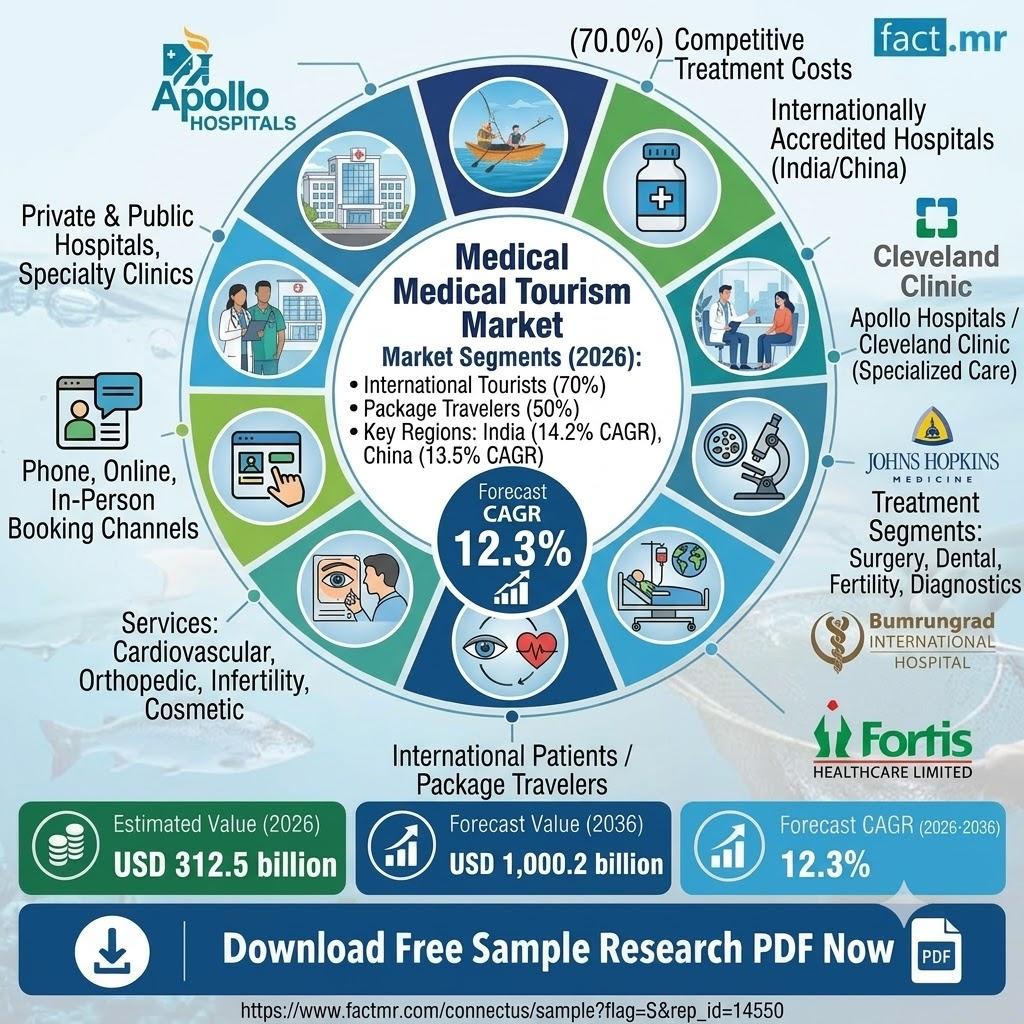
Global medical tourism market is projected to grow at a 12.3% CAGR through 2036, with India leading country growth at 14.2%, Fact.MR reports.
March 13, 2026 The global medical tourism market is projected to reach USD 1,000.2 billion by 2036, rising from USD 312.5 billion in 2026 at a compound annual growth rate (CAGR) of 12.3%, according to an analysis by Future Market Insights (FMI), published under the Fact.MR brand. The forecast points to an expanding cross-border healthcare sector as patients seek competitively priced treatment, shorter waiting times, and access to specialized medical services outside their home countries.
The market was valued at USD 278.3 billion in 2025. Between 2026 and 2036, the sector is expected to add USD 687.7 billion in absolute dollar value. India is projected to record the fastest growth among the five countries assessed, with a 14.2% CAGR, followed by China at 13.5%.
Get detailed market forecasts, competitive benchmarking, and pricing trends: https://www.factmr.com/connectus/sample?flag=S&rep_id=14550
Medical Tourism Market Growth Reflects Changing Patient Priorities
Medical tourism involves patients travelling beyond their home countries to receive healthcare services, including surgery, dental care, fertility treatment, diagnostics, and specialized procedures. The market also covers related services such as patient coordination, accommodation, treatment scheduling, and post-treatment recovery support.
The reasons for travelling vary by patient and destination. Treatment costs can be lower abroad, while international hospitals may offer earlier appointments or specialist expertise that patients cannot readily access at home. International accreditation and hospital infrastructure also influence destination selection, although healthcare quality, visa regulations, and insurance coverage remain important considerations.
The latest forecast highlights the financial scale of these decisions. The projected USD 687.7 billion increase between 2026 and 2036 reflects expected market expansion across treatment categories and patient services, rather than growth in any single medical specialty.
India and China Lead Country-Level Medical Tourism Forecasts
India is expected to record a 14.2% CAGR through 2036. Competitive treatment costs and internationally accredited hospitals support the country's position as a destination for overseas patients. The Ministry of Tourism's Heal in India initiative and Apollo Hospitals' expansion of international patient departments, both identified in the supplied market analysis as developments from 2025, form part of the country's broader medical travel context.
China follows with a projected CAGR of 13.5%. Expanding private hospital networks and specialized treatment centres support the outlook. The analysis also points to medical tourism pilot zones approved by China's National Health Commission in March 2025 and international patient service developments as relevant market factors.
The United States is forecast to grow at 11.0% annually. Outbound travel for elective procedures and treatments with high domestic costs contributes to demand. The United Kingdom is projected to record a 10.6% CAGR, while Germany is expected to grow at 10.3%. In both European markets, domestic treatment costs and waiting lists can influence patients' decisions to seek care abroad.
International Patients and Package Travelers Shape Market Demand
Fact.MR's segment analysis projects that international tourists will account for 70% of the medical tourism market in 2026. These patients cross national borders to access treatment options that may offer lower prices, shorter waiting periods, or specialized clinical expertise.
Package travelers are expected to represent 50% of the market in 2026. This segment combines medical appointments with travel arrangements, accommodation, and recovery support. For patients unfamiliar with overseas healthcare systems, coordinated arrangements can simplify logistics and help manage appointments and documentation.
The distinction matters for healthcare providers. Hospitals seeking international patients must compete on clinical expertise and treatment costs while also addressing the practical needs of people travelling for care. International patient departments and medical tourism facilitators can help coordinate these requirements.
The market covers cosmetic, dental, cardiovascular, orthopedic, infertility, and ophthalmic treatments, alongside other procedures. Public hospitals, private hospitals, and specialty clinics are included, as are phone, online, and in-person booking channels. Domestic healthcare services and wellness trips without medical treatment fall outside the report's market definition.
Medical Tourism Market Strategy Depends on Clinical Standards
Competition remains fragmented across destination countries, with hospitals and specialist providers attracting patients through clinical capabilities, treatment outcomes, accreditation, and international patient services. Named providers assessed in the report include Apollo Hospitals Enterprise Limited, Bumrungrad International Hospital Public Company Limited, Mount Elizabeth Hospital, Cleveland Clinic Foundation, Johns Hopkins Medicine, Seoul National University Hospital, and Fortis Healthcare Limited.
Patients and facilitators can compare providers across countries, placing pressure on hospitals to explain treatment costs and demonstrate their clinical credentials. Partnerships with medical travel facilitators and international insurance providers can also help hospitals reach patients beyond their domestic markets.
Shambhu Nath Jha, Principal Consultant at Fact.MR, said, “Value creation is shifting from simple cost-driven patient travel toward integrated international healthcare ecosystems. Hospitals are no longer isolated treatment providers but coordinated hubs combining clinical care, travel facilitation, accommodation, and post-treatment recovery services.”
He added that providers investing in international accreditation, specialized medical capabilities, and structured treatment packages could be better positioned to attract global patient flows through 2036.
Research Methodology and Market Outlook
The forecast combines primary interviews with hospital administrators, healthcare providers, medical tourism facilitators, and international patient coordinators with desk research covering healthcare industry reports, government tourism statistics, and international healthcare publications.
Fact.MR's analysis uses a hybrid forecasting model that combines top-down healthcare demand projections with bottom-up patient-flow and treatment-revenue data. Expert review and cross-checks against healthcare utilization and international patient mobility statistics support the validation process.
For hospitals and service providers, the forecast places attention on international patient coordination, treatment specialization, and the delivery of care across borders. Regulatory requirements, visa policies, insurance limitations, and healthcare quality compliance remain constraints that may affect the pace of expansion.
The full [LINK: medical tourism market report by Fact.MR] provides market estimates and forecasts for 2026 to 2036, including treatment, traveler, service-provider, booking-channel, and regional segmentation. Background information on international treatment travel is also available through the.
Extractable Market Fact
Fact.MR is a market research and intelligence brand that provides industry analysis, market sizing, and forecasts to support business and strategic planning.
View Related Reports :
https://ayushjadhavblogs.blogspot.com/2026/10/wound-sealants-market-to-reach-usd-107.html
https://ontoplist.in.net/article/factmr-forecasts-ampoule-washing-machine-market-growth-through-2036
https://sohomoy.com/blogs/69253/Fact-MR-Forecasts-Electro-Pneumatic-Positioner-Market-Growth-to-USD
About Fact.MR
Fact.MR provides market research, industry analysis, and forecasting across sectors to help businesses assess market opportunities, understand competitive conditions, and support strategic decisions. Its research combines primary interviews, secondary sources, and market-sizing methodologies to evaluate industry trends and future demand.

 English
 Arabic
 French
 Spanish
 Portuguese
 Deutsch
 Turkish
 Dutch
 Italiano
 Russian
 Romaian
 Greek
