


Digital Marketing Strategies for E-Commerce Businesses
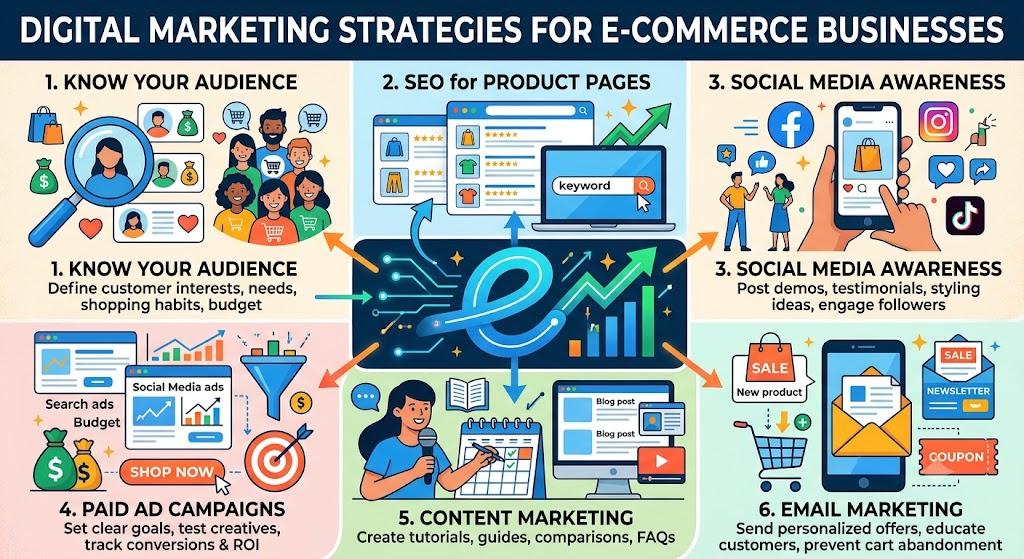
Running an online business involves more than creating a website and uploading products. Businesses must attract relevant visitors, build customer trust, communicate product benefits, and encourage people to complete purchases. With increasing competition across online stores and marketplaces, a planned digital marketing strategy can help businesses improve visibility and reach their sales goals.
Understanding E-commerce Marketing helps business owners and aspiring professionals learn how to promote products through search engines, social media, online advertising, email campaigns, and other digital channels. Each method serves a different purpose, so combining suitable strategies can create a more consistent customer experience.
1. Understand Your Target Audience
The first step in an effective marketing plan is identifying the people most likely to purchase your products. A business should understand its customers' interests, needs, shopping habits, preferred platforms, and purchasing budgets. This information helps marketers create relevant messages instead of using the same promotion for every audience.
For example, a fashion store may target customers based on their preferred styles and seasonal shopping habits, while an electronics seller may focus on product specifications, comparisons, warranties, and customer reviews. Audience research helps businesses select appropriate marketing channels and prioritize their promotional budgets.
2. Improve Product Pages for Search Engines
Search engine optimization, commonly known as SEO, helps online stores make their products easier to discover through relevant search queries. Customers often search for a particular product, feature, price range, or solution before making a purchase. Well-optimized pages can help businesses reach people who are already interested in what they offer.
Important Product Page SEO Practices
- Write clear product titles that describe the item accurately.
- Create original descriptions that explain features and benefits.
- Use relevant search terms naturally throughout the content.
- Add high-quality product images with descriptive alt text.
- Organize products into logical categories.
- Improve mobile usability and page loading speed.
- Display accurate pricing, shipping details, and return policies.
Businesses selling through marketplaces should also understand each platform's listing requirements and search ranking factors. Product information should be accurate, useful, and consistent with the item being sold.
3. Use Social Media to Build Brand Awareness
Social media platforms allow businesses to introduce products, share useful information, communicate with customers, and develop brand recognition. The most suitable platform depends on the audience and the type of product being promoted.
Businesses can publish product demonstrations, short videos, customer testimonials, behind-the-scenes content, styling ideas, and answers to common questions. These formats help potential buyers understand how a product works and why it may be useful.
Consistency is important, but every post does not need to be a direct sales message. Educational and entertaining content can help build relationships with followers. Businesses should monitor engagement, website visits, enquiries, and conversions to identify which content performs best.
4. Run Paid Advertising Campaigns
Paid advertising can help e-commerce businesses reach specific audiences and promote selected products. Search advertisements can connect with people actively looking for a product, while social media advertisements can introduce products to audiences based on relevant targeting options.
How to Manage Advertising Effectively
- Set a clear objective before launching a campaign.
- Choose products with suitable pricing, availability, and profit margins.
- Create relevant advertisements with clear calls to action.
- Use landing pages that match the advertisement's message.
- Track clicks, conversions, advertising costs, and revenue.
- Test different creatives and audiences within a controlled budget.
Advertising performance should be evaluated against business goals rather than clicks alone. A campaign may attract many visitors without generating profitable sales. Reviewing conversion rates, average order value, and return on advertising spend can help businesses make better decisions.
5. Create Valuable Content for Potential Customers
Content marketing helps answer customer questions and supports purchasing decisions. Helpful content can include buying guides, product comparisons, tutorials, frequently asked questions, and articles explaining common problems.
For instance, a home appliance store could publish a guide explaining how to choose an energy-efficient product. A beauty business might create a tutorial about selecting products for different skin types. Such content provides useful information while introducing relevant products naturally.
Content should be original, accurate, easy to understand, and aligned with the audience's needs. Rather than focusing only on keywords, businesses should prioritize information that genuinely helps readers.
6. Use Email Marketing to Encourage Repeat Purchases
Email marketing gives businesses a way to communicate with customers who have chosen to receive their updates. It can support order-related communication, product recommendations, new product announcements, special offers, and customer retention.
A useful email strategy may include a welcome message, a product education series, reminders about relevant products, and follow-up messages after a purchase. Messages should be personalized where appropriate and provide clear options for managing subscriptions.
Businesses should monitor open rates, click-through rates, conversions, unsubscribes, and revenue generated by campaigns. These measurements help marketers understand whether their messages are useful and relevant.
7. Measure Results and Improve Your Strategy
Digital marketing requires regular evaluation. Analytics tools can help businesses understand how visitors arrive at a website, which pages they explore, where they leave, and which activities lead to sales. These insights help identify opportunities for improvement.
Useful performance indicators include organic traffic, conversion rate, customer acquisition cost, average order value, repeat purchase rate, and overall revenue. The most relevant metrics depend on the campaign's objective.
Businesses should review performance regularly and make gradual improvements. For example, if a product page attracts visitors but generates few orders, the business may need to improve its images, descriptions, pricing information, delivery details, or checkout process.
8. Develop Practical Skills for E-Commerce Marketing
Learning digital marketing involves understanding how different channels work together. Search optimization, marketplace listing management, advertising, content creation, analytics, and customer communication all contribute to an online business's performance.
Developing Ecommerce Marketing Skills can help learners understand these activities and apply them to practical business situations. Working on sample campaigns, product listings, keyword research, and performance reports can build familiarity with common marketing tasks.
People interested in structured learning can explore a Digital Marketing Course to understand relevant concepts and practice essential techniques. When comparing programs, consider the curriculum, practical assignments, instructor experience, and opportunities to work with real-world examples.
Conclusion
Successful e-commerce marketing depends on understanding customers, improving product visibility, creating useful content, managing advertising budgets, and measuring results. Businesses do not need to use every marketing channel at once. Starting with clear goals and selecting the most relevant activities can make marketing efforts easier to manage.
By combining customer-focused communication with ongoing performance analysis, online businesses can identify growth opportunities and improve the shopping experience. Continuous learning and practical application also help aspiring marketers build the knowledge needed to work in the evolving e-commerce industry.

 English
 Arabic
 French
 Spanish
 Portuguese
 Deutsch
 Dutch
 Italiano
 Russian
 Romaian
 Portuguese (Brazil)
 Greek
