


Bioplastics for Packaging Market to Achieve USD 39.5 Billion by 2036, India 10.9%, Germany 9%, France 7% CAGR
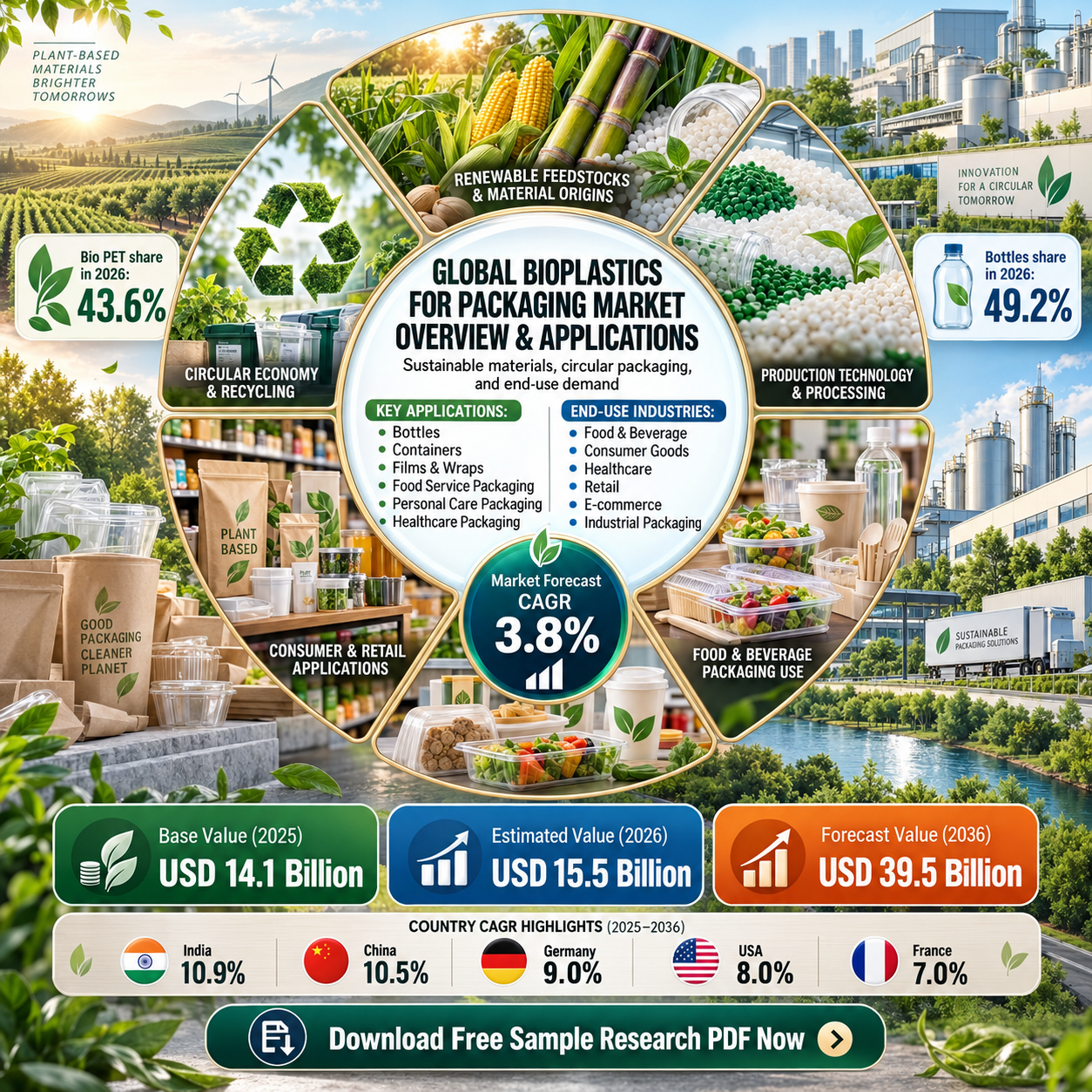
The bioplastics for packaging market is forecast to expand from USD 15.5 billion in 2026 to USD 39.5 billion by 2036, registering a reported 3.8% CAGR over the forecast period. Fact.MR attributes this expansion to increasing demand for sustainable packaging, growing environmental awareness, and government regulations aimed at reducing conventional plastic waste. The market was valued at USD 14.1 billion in 2025 and is expected to generate an absolute dollar opportunity of USD 24 billion between 2026 and 2036.
Growing concern about plastic pollution is encouraging packaging manufacturers to adopt renewable and biodegradable materials. Food and beverage producers, consumer goods companies, and pharmaceutical manufacturers are exploring alternatives to petroleum-based plastics as sustainability requirements become more important. Government restrictions on single-use plastics and corporate environmental commitments are also supporting the adoption of bioplastics across packaging applications.
Get detailed market forecasts, competitive benchmarking, and pricing trends:
https://www.factmr.com/connectus/sample?flag=S&rep_id=14443
Bio PET Retains Dominant Position
By material type, bio-based polyethylene terephthalate (Bio PET) is expected to account for 43.6% of the bioplastics for packaging market in 2026. Its leading position is supported by recyclability, durability, and performance characteristics similar to conventional PET. Bio PET is manufactured using renewable feedstocks, including sugarcane-derived materials, making it suitable for manufacturers seeking to reduce dependence on fossil-based resources.
Compatibility with existing PET recycling infrastructure provides another advantage. Packaging companies can incorporate bio-based PET into established production and recycling processes without requiring entirely new systems. Its strength, clarity, and versatility support applications across bottles, containers, and packaging films.
Bottles represent the leading application segment, projected to capture 49.2% of market demand in 2026. Beverage manufacturers and producers of household liquids are increasingly considering bioplastic bottles to address sustainability commitments and consumer preferences. The ability of bio-based PET to provide familiar packaging performance while incorporating renewable materials supports its position in this segment.
Other packaging applications include cups, trays, clamshell containers, films, bags, and pouches. Demand across these categories is influenced by material performance, regulatory compliance, production costs, and the availability of suitable waste-management infrastructure.
India, Germany, and France Show Strong Growth Potential
India is expected to record the fastest growth among the countries assessed in the report, with bioplastics for packaging demand rising at a 10.9% CAGR from 2026 to 2036. Increasing environmental awareness, government sustainability initiatives, and growing consumer interest in environmentally preferable packaging are supporting adoption. Manufacturers are also responding to changing packaging requirements across food, beverages, and consumer goods.
Germany is projected to advance at a 9% CAGR during the same period. Strong packaging regulations, established recycling practices, and demand for sustainable materials are encouraging the use of bioplastics. Manufacturers are focusing on packaging alternatives that support waste reduction while meeting product protection and performance requirements.
France is forecast to register a 7% CAGR through 2036. Consumer awareness of environmental issues and the country's emphasis on greener packaging are supporting market development. Businesses are increasingly evaluating renewable materials as they respond to sustainability expectations and packaging waste requirements.
China is also expected to demonstrate strong growth, with demand increasing at a 10.5% CAGR. Its large manufacturing base, environmental policies, and expanding adoption of sustainable packaging materials are contributing to market expansion. The United States is projected to grow at an 8% CAGR, supported by consumer demand and regulatory encouragement for environmentally preferable packaging.
Competitive Landscape
Competition in the bioplastics for packaging market includes established polymer manufacturers and packaging companies investing in renewable materials. Key companies profiled by Fact.MR include Braskem S.A., Corbion N.V., Novamont S.p.A., NatureWorks LLC, Amcor plc, Mondi Group, and Tetra Pak International S.A.
Other participants include ALPLA Werke, Berry Global Group, Uflex Ltd., Toray Industries, Danimer Scientific, and Mitsubishi Chemical Group Corporation. Companies are focusing on material innovation, packaging performance, production efficiency, and sustainability-related product development.
Procurement decisions remain influenced by material costs, availability, recyclability, and compatibility with existing packaging equipment. Higher production costs and limited renewable feedstock availability continue to present challenges compared with conventional plastics.
Technology and Regulatory Developments Shape the Market
The market is experiencing developments in bio-based polymers and packaging production technologies. In March 2025, NatureWorks expanded its Ingeo Extend platform for biaxially oriented PLA films, targeting improved processing performance and packaging applications. The development reflects continued efforts to increase the commercial suitability of renewable polymer materials.
In February 2026, TotalEnergies Corbion introduced a label-free Luminy PLA bottle in South Korea. The design uses embossed branding instead of conventional plastic labels, supporting recycling objectives and reducing additional packaging components.
Fact.MR also highlights Avantium's progress toward commercial production of plant-based polyethylene furanoate (PEF), demonstrating continued investment in renewable alternatives to conventional packaging polymers.
Despite these developments, production costs, raw-material availability, and competition from petroleum-based plastics remain important considerations. Continued innovation in material performance and recycling compatibility is expected to influence adoption through 2036.
To View Top Reports
https://adamaamresearch.blogspot.com/2026/10/tallow-market-to-reach-usd-213-billion.html
https://net-pals.com/blogs/53454/Tallow-Market-Expansion-Led-by-India-at-9-1-CAGR
https://acmingle.com/blogs/30242/Tallow-Market-Forecast-to-Hit-USD-21-3-Billion-by
About Fact.MR
Fact.MR is a market research and consulting company providing market intelligence, competitive analysis, and forecasting across global industries. Its research supports businesses with data-driven insights into emerging markets, technology trends, competitive dynamics, regional opportunities, and changing demand patterns.

 English
 French
 Spanish
 Portuguese
 Deutsch
 Turkish
 Dutch
 Italiano
 Russian
 Romaian
 Portuguese (Brazil)
 Greek
