


Generative Design Market Set to Reach USD 2.9 Billion by 2036, India Leads Growth
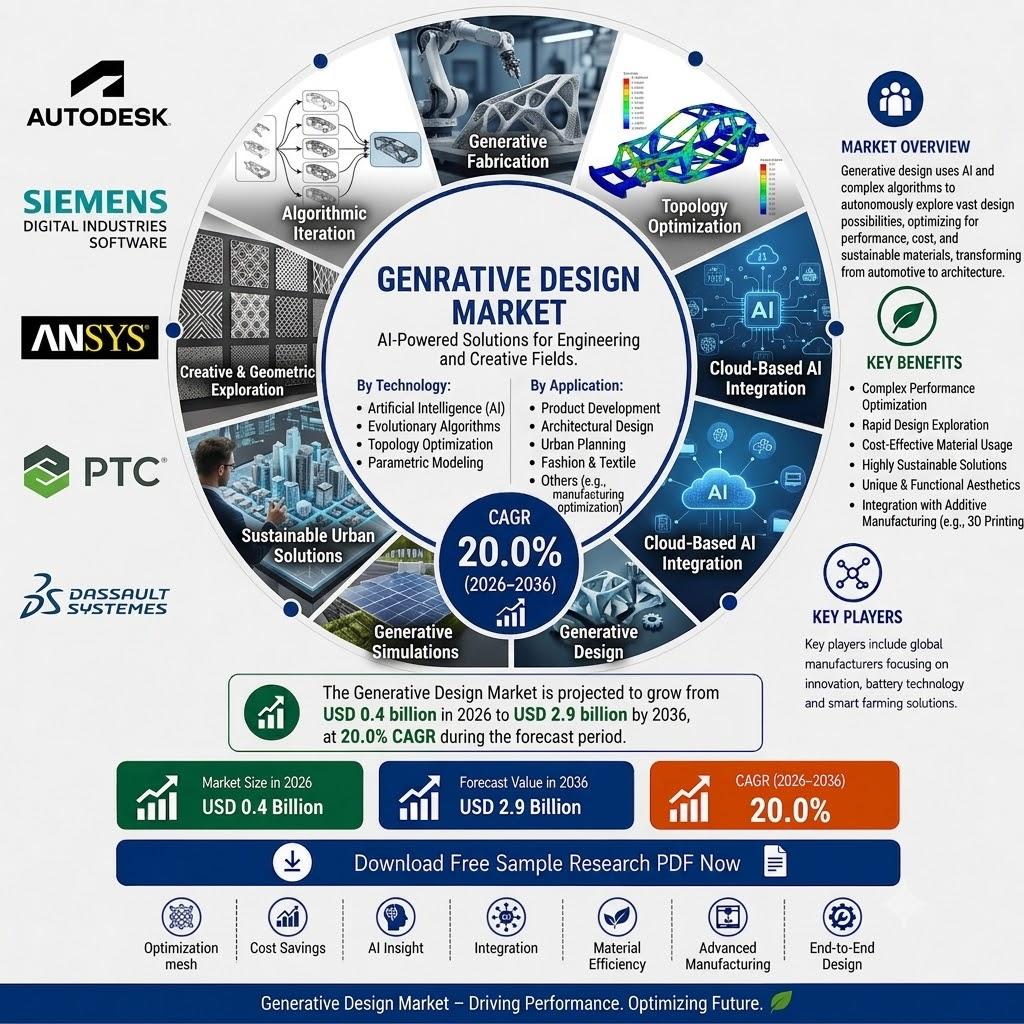
The global generative design market is projected to reach USD 0.4 billion in 2026 and expand to USD 2.9 billion by 2036, registering a compound annual growth rate (CAGR) of 20.0%, according to Fact.MR. Rising demand for material-efficient components, advances in artificial intelligence, and growing integration with engineering software are creating new opportunities for technology providers.
Generative design helps engineers develop and evaluate multiple design options based on weight, strength, material, cost, and manufacturing requirements. Its applications are expanding across automotive, aerospace, industrial equipment, and healthcare, where manufacturers seek to improve product performance and shorten development cycles.
Get detailed market forecasts, competitive benchmarking, and pricing trends: https://www.factmr.com/connectus/sample?flag=S&rep_id=15046
Software and Cloud Deployment Support Adoption
Software is projected to account for approximately 75% of the market in 2026, supported by the integration of generative design into computer-aided design (CAD) and product lifecycle management (PLM) platforms. Cloud-based deployment is expected to hold around 60% of the market, enabling scalable computing and collaboration among distributed engineering teams.
Automotive manufacturers are using generative design to optimise electric vehicle components, while aerospace companies apply it to lightweight structural parts. Adoption challenges include software integration, computing requirements, data security, and the need for specialised engineering skills.
Topology Optimisation Shapes Technology Demand
Topology optimisation is projected to account for approximately 47% of the technology segment in 2026. It helps engineers identify efficient material distribution within defined design constraints, supporting lighter components without compromising performance requirements.
AI-enabled design tools are also helping engineering teams explore more alternatives and reduce manual work. Integration with existing simulation and manufacturing systems will remain important to broader commercial adoption.
India Leads Country-Level Growth
India's generative design market is projected to grow at a CAGR of 23.8% through 2036, supported by manufacturing digitisation, engineering services, and expanding automotive and aerospace activities. China is forecast to grow at 23.0%, followed by the United States at 21.5%.
Germany is expected to register a CAGR of 19.4%, while France and Japan are projected to grow at 18.9% and 18.6%, respectively. Demand across these markets will depend on industrial investment and the integration of advanced design tools into engineering workflows.
Analyst Perspective
Shambhu Nath Jha, Principal Consultant at Fact.MR, observes that software providers integrated into established engineering and product lifecycle management workflows are well positioned to benefit as generative design adoption expands. AI-driven optimisation and platform integration will remain important competitive factors.
Competitive Landscape
Competition centres on software capabilities, optimisation performance, platform integration, and industry-specific solutions. Key companies profiled in the Fact.MR report include Autodesk Inc., Dassault Systèmes SE, Siemens AG, PTC Inc., Altair Engineering Inc., nTopology Inc., and ANSYS Inc.
Vendors are strengthening their offerings through AI integration, cloud deployment, and connections with simulation and manufacturing platforms.
Market Snapshot
- Estimated market value (2026): USD 0.4 billion
- Forecast market value (2036): USD 2.9 billion
- CAGR (2026–2036): 20.0%
- Leading component segment: Software
- Leading deployment segment: Cloud-based
- Leading technology segment: Topology optimisation
- Fastest-growing profiled country: India
To View Top Reports
https://afgbfh.blogspot.com/2026/10/implants-and-medical-alloys-market-to.html
https://sportgalax.com/read-blog/25848
About Fact.MR
Fact.MR is a market research and competitive intelligence provider delivering market intelligence, competitive analysis, and forecasting across global industries. Its research helps businesses evaluate market demand and identify growth opportunities.

 English
 Arabic
 French
 Spanish
 Portuguese
 Deutsch
 Turkish
 Dutch
 Italiano
 Russian
 Romaian
 Greek
