


Wound Sealants Market Growth Driven by Surgery and Diabetes Care
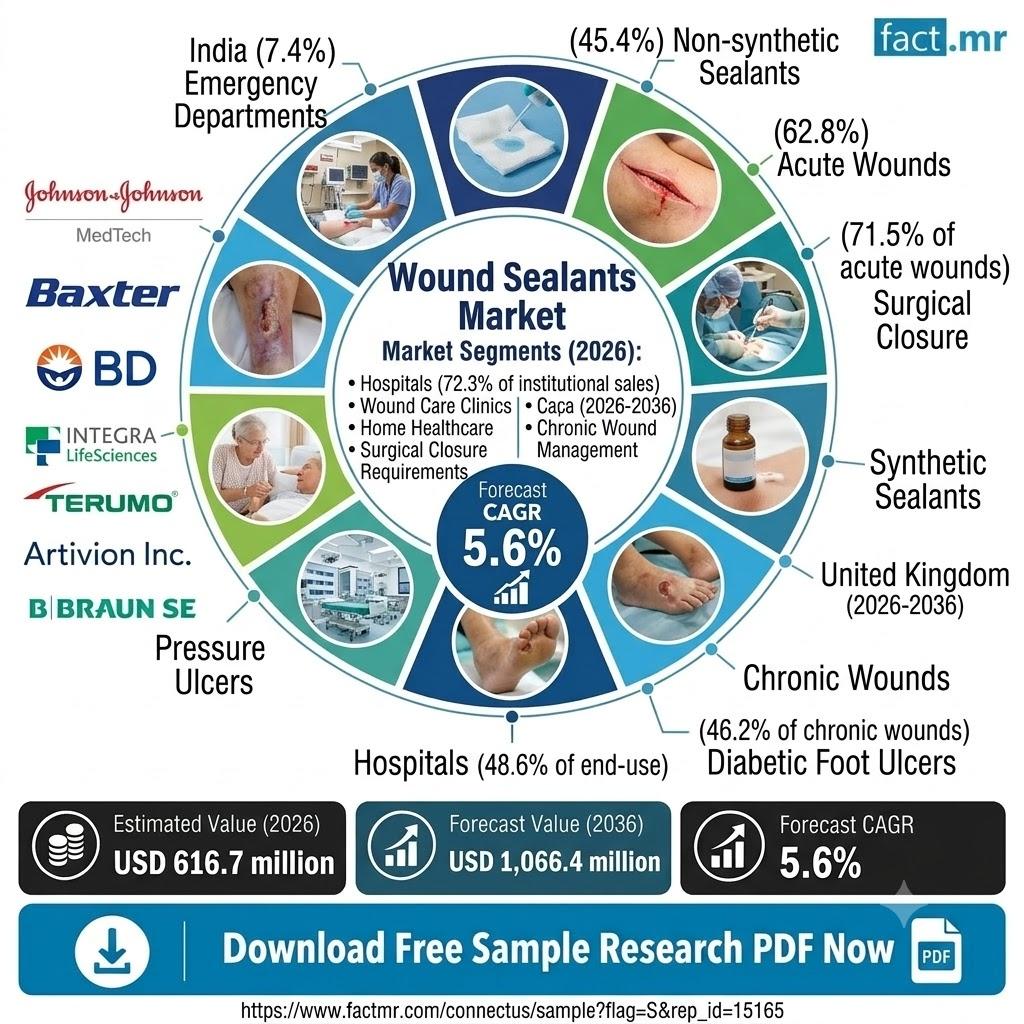
Fact.MR projects 5.6% annual growth as surgical procedures and chronic wound treatment sustain global demand for tissue closure products.
October 21, 2026 The global wound sealants market is projected to reach USD 1,066.4 million by 2036, rising from USD 616.7 million in 2026, according to Fact.MR. The market, valued at USD 583.8 million in 2025, is forecast to expand at a compound annual growth rate (CAGR) of 5.6% from 2026 to 2036. Surgical closure requirements and growing demand for chronic wound management are expected to support this expansion over the forecast period.
The market is expected to generate an additional USD 449.7 million in revenue between 2026 and 2036. Hospitals remain the primary demand center, while wound care clinics and home healthcare settings offer additional opportunities for manufacturers. Diabetes-related complications and an aging patient population are also increasing the need for continued wound management, particularly in markets where chronic ulcers require repeated clinical attention.
Get detailed market forecasts, competitive benchmarking, and pricing trends: https://www.factmr.com/connectus/sample?flag=S&rep_id=15165
Wound Sealants Market Growth Reflects Hospital Procurement Priorities
Institutional sales are projected to account for 72.3% of the market in 2026, reflecting hospitals' reliance on approved procurement systems and planned supply contracts. Acute care hospitals are expected to represent 48.6% of end-use demand during the same year. These figures underline the importance of hospital purchasing decisions, clinical training, and product availability in determining manufacturer performance.
Fact.MR is a market research and consulting firm that provides industry forecasts, competitive assessments, and strategic market intelligence. Its wound sealants analysis evaluates demand across more than 40 countries, examining product types, wound categories, distribution channels, surgical applications, and healthcare settings.
Surgical procedures are projected to account for 71.5% of the acute-wound application segment in 2026. Acute wounds overall are expected to hold a 62.8% market share. Operating rooms rely on sealants when tissue closure requires additional support or when controlling fluid leakage is a clinical consideration. Emergency departments also use selected products for suitable lacerations and minor wounds.
Non-synthetic sealants are forecast to capture 45.4% of the market in 2026. Their compatibility with sensitive tissue and absorption characteristics make them relevant to selected surgical applications. Collagen-based products are also attracting attention where clinicians require tissue support and fluid management during early healing. Synthetic sealants retain a role in external closure and laparoscopic procedures, although product selection depends on clinical requirements and handling characteristics.
Diabetes-Related Wounds Expand the Chronic Care Opportunity
Chronic wound management provides another source of demand. Fact.MR projects diabetic foot ulcers to account for 46.2% of the chronic-wound application segment in 2026, reflecting the recurring treatment needs associated with slow-healing wounds.
The International Diabetes Federation reported that India had 89.8 million adults living with diabetes in 2024. The World Health Organization reported that 830 million people worldwide were living with diabetes in 2022. These figures provide important context for wound care providers assessing the patient population at risk of diabetes-related complications.
Repeated clinical visits can create opportunities for sealant products used in wound management. Pressure ulcers and venous leg ulcers also contribute to demand, particularly in settings caring for older patients and individuals requiring extended treatment. However, sealants must be selected according to wound characteristics and clinical guidance; they do not replace comprehensive wound care.
India Leads Country-Level Growth Forecasts
India is projected to record the fastest growth among the seven highlighted markets, with a 7.4% CAGR through 2036. China follows at 6.8%, while Brazil is forecast to expand at 6.4%. Fact.MR attributes these outlooks to factors including chronic wound care requirements, hospital capacity, and procedure volumes.
The United States is projected to grow at 5.7% CAGR, supported by surgical activity and ongoing chronic wound care needs. The United Kingdom is forecast to expand at 5.4%, followed by Germany at 5.1%. Japan is expected to record a 4.8% CAGR as hospitals continue addressing the needs of an older patient population while reviewing healthcare expenditure.
For manufacturers, these differences point to the importance of country-specific commercial strategies. Suppliers targeting India may need accessible pricing and strong distributor networks, while companies competing in Germany and Japan must demonstrate clinical value within cost-conscious hospital procurement systems.
Product Training and Pricing Shape Competitive Strategy
Premium pricing and training requirements remain constraints, particularly for healthcare facilities operating under tight budgets. Improper application can lead to product waste or inconsistent closure, making clinical education an important part of supplier support.
Fact.MR's analysis indicates that manufacturers should strengthen institutional distribution while developing product formats suited to different care settings. Smaller retail packs could serve selected minor-wound and post-surgical care needs under appropriate clinical guidance. Hospital-focused products, meanwhile, require clear instructions, suitable applicators, and training for surgical teams.
Competition includes Johnson & Johnson MedTech, Baxter International Inc., Becton, Dickinson and Company, Integra LifeSciences Holdings Corporation, Terumo Corporation, Artivion Inc., and B. Braun SE. These companies operate in a market where tissue compatibility, handling characteristics, clinical evidence, and access to hospital supply lists influence product positioning.
Shambhu Nath Jha, Principal Consultant at Fact.MR, said, “CXOs will see wound sealant demand coming from two needs. Hospitals need reliable closure during procedures, and wound clinics need products that reduce repeated dressing work.”
The distinction between these settings is commercially important. Hospitals typically purchase through institutional contracts, while retail channels serve a smaller market for consumer-oriented wound care products. Suppliers must therefore match product positioning and clinical support to the intended application.
Market Outlook Through 2036
Fact.MR's forecast points to continued expansion as surgical care and chronic wound treatment sustain demand. The projected USD 449.7 million incremental revenue opportunity between 2026 and 2036 gives manufacturers a measurable basis for evaluating investment in product development, hospital relationships, and regional distribution.
The full report examines the market by sealant type, wound type, end use, distribution channel, surgical application, and chronic wound application. It also assesses regional opportunities across North America, Europe, Asia Pacific, Latin America, and the Middle East and Africa.
View Realted Reports :
https://ayushjadhavblogs.blogspot.com/2026/10/walnut-ingredients-market-to-reach-usd.html
About Fact.MR
Fact.MR is a market research and consulting firm providing market intelligence, industry forecasts, and strategic analysis across global sectors. Its research combines primary interviews, company portfolio assessments, market-sizing models, and relevant public datasets to evaluate market demand, competitive positioning, and growth opportunities.

 English
 French
 Spanish
 Portuguese
 Deutsch
 Turkish
 Dutch
 Italiano
 Russian
 Romaian
 Portuguese (Brazil)
 Greek
