


What role does laboratory pressure control play in IVF Lab Design?
INTRODUCTION
Laboratory pressure control is an important component of IVF Lab Design because it helps manage airflow direction, reduce the entry of unwanted contaminants, and maintain suitable environmental conditions for handling reproductive cells and embryos. A properly designed pressure-control system works alongside HVAC, HEPA filtration, volatile organic compound (VOC) control, room sealing, and environmental monitoring. In fertility laboratories, these measures support contamination-control procedures and help protect the laboratory environment during sensitive embryology processes. Pressure control is not simply about maintaining a positive pressure reading; it requires coordinated room design, appropriate air distribution, reliable monitoring, and regular verification to ensure that the system performs according to its specifications.
1. Understanding Laboratory Pressure Control
Laboratory pressure control refers to maintaining a planned pressure difference between a room and its surrounding spaces. This difference is usually created by balancing the amount of air supplied to a room against the amount exhausted or returned.
When a room has higher pressure than an adjacent space, air tends to move outward through openings and leakage paths. When a room has lower pressure, air tends to move inward from surrounding areas.
In an IVF laboratory, positive pressure is commonly recommended to help minimize the entry of less-controlled air. The 2026 European Society of Human Reproduction and Embryology (ESHRE) recommendations identify positive pressure, appropriate fresh-air supply, HEPA filtration, and VOC control as important considerations for IVF laboratory air quality. <Cite refs={["turn758269search1","turn758269search2"]}/>
Pressure control must be considered during the initial design stage because room dimensions, door arrangements, wall sealing, HVAC capacity, and adjacent-room functions all influence performance.
2. Why Positive Pressure Is Important in IVF Laboratories
Positive pressure helps establish the intended direction of air movement from a more-controlled laboratory toward adjacent spaces. This can reduce the likelihood of less-controlled air entering through door gaps and other openings.
Potential benefits include:
-
Supporting contamination-control strategies
-
Reducing inward airflow from adjacent areas
-
Helping maintain planned room-to-room pressure relationships
-
Supporting controlled laboratory zoning
-
Providing measurable indicators of ventilation performance
-
Improving consistency in environmental management
However, positive pressure alone cannot eliminate contamination risks. Its effectiveness depends on filtration, air quality, construction integrity, cleaning, personnel practices, and equipment maintenance.
The International Society for Assisted Reproduction (ISAR) consensus guidance also recommends positive pressure and HEPA-filtered air as considerations in IVF laboratory infrastructure. <Cite refs={["turn758269search4"]}/>
3. Creating a Pressure Cascade Between Laboratory Areas
A pressure cascade is a planned sequence of pressure relationships between connected rooms. It can help direct air movement from cleaner or more-controlled areas toward adjacent areas with less stringent environmental requirements.
For example, an IVF facility may include an access vestibule, an embryology laboratory, a procedure room, storage areas, and technical service spaces. Each area should have a defined function and a pressure relationship established through the facility's engineering design.
A pressure cascade may help:
-
Limit the movement of contaminants into critical work areas
-
Manage air transfer between connected rooms
-
Support separation between laboratory and support functions
-
Reduce uncontrolled airflow through access points
-
Make pressure performance easier to monitor
The exact sequence should be determined by a qualified HVAC designer based on room functions, applicable standards, and a documented risk assessment. Pressure relationships should not be assigned using a universal template without considering the complete facility.
The Cairo Consensus on IVF laboratory air quality discusses pressure cascades, access vestibules, sealed construction, and air distribution as elements of a coordinated laboratory design strategy. <Cite refs={["turn758269search6","turn758269search10"]}/>
4. Integrating Pressure Control With HVAC Design
Pressure control depends on the performance of the heating, ventilation, and air-conditioning system. A room cannot reliably maintain its intended pressure if supply airflow, exhaust airflow, or uncontrolled leakage is not properly managed.
During IVF Lab Design, HVAC planning should consider:
-
Air handling unit capacity
-
Supply and return airflow rates
-
Fresh-air requirements
-
Filter selection and resistance
-
Ductwork design and sealing
-
Room leakage characteristics
-
Door opening frequency
-
Heat generated by laboratory equipment
-
Temperature and humidity requirements
-
Access for filter replacement and maintenance
The system should be balanced and commissioned under defined operating conditions. Adjustments may be required if the actual room leakage or equipment load differs from the original assumptions.
Airflow should also be distributed carefully around embryology workstations and incubators. Strong drafts or poorly positioned supply outlets may disturb working conditions or affect sensitive equipment, so pressure control must be coordinated with the overall airflow layout.
5. The Role of HEPA Filtration and VOC Control
Pressure control and air filtration perform different but complementary functions.
HEPA filters remove airborne particles according to their specified filtration performance. Pressure control helps influence the direction in which air moves between rooms. Neither function replaces the other.
IVF laboratories also need to consider VOCs, which can originate from construction materials, paints, adhesives, cleaning products, furnishings, and other sources. Particle filtration alone does not remove every gaseous chemical contaminant.
A coordinated design may therefore include:
-
Appropriate HEPA filtration
-
Chemical filtration selected for the identified contaminants
-
Low-emission construction materials
-
Sealed filter housings and duct connections
-
Suitable fresh-air provision
-
Air-quality monitoring and trend analysis
ESHRE's 2026 recommendations specifically emphasize HEPA and VOC control in IVF laboratory air management. <Cite refs={["turn758269search1","turn758269search2"]}/>
The design team should select filtration equipment based on the facility's requirements and verify performance after installation. A pressure reading should never be treated as proof that air is free of particles or chemical contaminants.
6. Designing Airtight Walls, Doors, and Penetrations
A pressure-control system performs best when the room enclosure is designed to limit uncontrolled leakage. Gaps around doors, damaged seals, unsealed service penetrations, and poorly fitted wall panels can make pressure difficult to maintain.
The construction specification should address:
-
Sealed modular wall-panel joints
-
Properly fitted door frames
-
Door seals and closers where required
-
Sealed electrical and utility penetrations
-
Ceiling and floor interfaces
-
Access panels and service openings
-
Compatible sealants and cleanable finishes
The aim is not to make the laboratory inaccessible or eliminate all necessary airflow. Instead, leakage should be controlled so that the HVAC system can maintain the intended pressure relationships without excessive airflow or unstable operation.
The Cairo Consensus highlights the importance of sealing the laboratory enclosure to help maintain positive pressure and prevent uncontrolled air entry. <Cite refs={["turn758269search6","turn758269search10"]}/>
7. Pressure Monitoring and Alarm Systems
Continuous or routine pressure monitoring helps facility personnel determine whether the ventilation system is operating as intended.
Differential pressure monitors measure the pressure difference between two spaces. Depending on the design, instruments may provide local displays, building management system (BMS) integration, data logging, or alarms.
A monitoring strategy should define:
-
Which rooms require monitoring
-
The specified operating range for each pressure relationship
-
Where sensors should be installed
-
How often readings are reviewed
-
Alarm thresholds and delay settings
-
Who responds to an alarm
-
How deviations are documented
-
How sensor calibration is managed
Pressure sensors should be selected, installed, and calibrated according to the project requirements. Readings should be interpreted in the context of door position and operating conditions, because opening a door can temporarily change the measured pressure relationship.
An alarm should trigger an appropriate response, such as checking doors, inspecting the HVAC system, reviewing airflow balance, or investigating a sensor fault. Procedures should also specify when laboratory operations need to be restricted while a deviation is assessed.
8. Preventing Cross-Contamination Through Workflow Planning
Pressure control is most effective when supported by a suitable laboratory layout. Staff movement, material transfers, waste handling, and equipment servicing can all affect how contaminants enter or move through the facility.
The laboratory layout should consider:
-
Controlled access for authorized personnel
-
Dedicated changing and handwashing arrangements
-
Suitable transfer points for materials
-
Separation of technical and storage functions
-
Appropriate waste-handling routes
-
Convenient equipment maintenance access
-
Minimization of unnecessary movement through critical areas
ESHRE recommends restricting access to IVF laboratories and separating certain technical, storage, and support functions from the main area used for reproductive-cell handling. <Cite refs={["turn758269search1","turn758269search2"]}/>
Pressure relationships should reinforce these functional arrangements rather than compensate for an unsuitable layout. The design should be reviewed with embryologists, laboratory managers, infection prevention specialists, and engineering personnel before construction begins.
9. Commissioning and Validation of Pressure Control
Pressure-control performance should be verified before the laboratory begins clinical operation. Commissioning establishes whether the installed system meets the approved design specifications.
Testing may include:
-
Inspecting room seals, doors, and service penetrations.
-
Verifying supply and exhaust airflow.
-
Measuring differential pressure between designated spaces.
-
Checking the operation of pressure sensors and alarms.
-
Confirming performance under defined door and operating conditions.
-
Documenting results and investigating deviations.
-
Repeating tests after corrective actions.
Pressure testing should be part of a wider environmental verification programme. Depending on the laboratory's requirements, this may also include particle counts, filter integrity testing, temperature and humidity checks, and VOC or other air-quality assessments.
ESHRE recommends risk-based assessment of IVF laboratory air cleanliness in both at-rest and in-operation conditions, with regular monitoring. <Cite refs={["turn758269search1","turn758269search2"]}/>
The acceptance criteria should be established before testing. There is no single pressure differential that should automatically be applied to every IVF laboratory, as requirements depend on the selected design and applicable guidance.
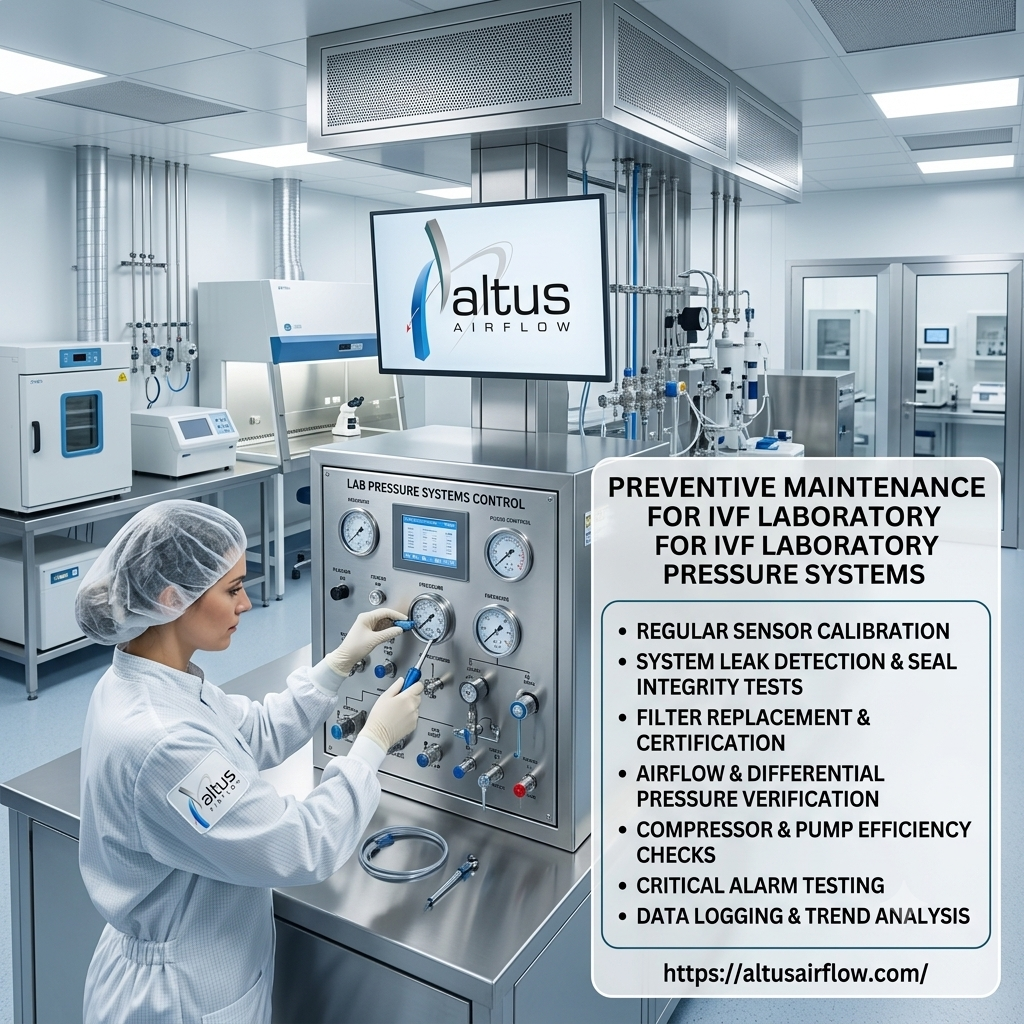
10. Maintenance and Troubleshooting
Pressure performance can change over time because of filter loading, fan deterioration, damaged seals, altered room layouts, or changes in ventilation settings.
Preventive maintenance should therefore include:
-
Reviewing pressure trends
-
Inspecting door seals and panel joints
-
Checking filter condition and pressure drop
-
Verifying fan and control operation
-
Calibrating pressure sensors
-
Testing alarms
-
Rebalancing airflow when required
-
Recording corrective and preventive actions
If pressure falls outside the approved range, staff should investigate the cause rather than simply increasing the supply fan speed. Excessive supply airflow may create drafts, disturb room conditions, or increase energy consumption.
Maintenance and retesting should follow the facility's documented quality procedures and the equipment manufacturer's recommendations.
11. Common Pressure-Control Planning Mistakes
Several planning mistakes can undermine the performance of an IVF laboratory.
Treating positive pressure as a complete contamination solution: Positive pressure must work alongside suitable filtration, VOC control, cleaning, and operational procedures.
Ignoring room leakage: Poorly sealed doors, wall panels, and penetrations may prevent stable pressure control.
Selecting arbitrary pressure targets: The design should use documented, application-specific criteria rather than copying values from unrelated facilities.
Overlooking monitoring and alarms: Without suitable monitoring, pressure deviations may remain unnoticed.
Failing to coordinate doors and HVAC: Frequent door openings and poorly balanced airflow can disrupt pressure relationships.
Skipping commissioning: A completed installation should be tested against the approved specifications before use.
Avoiding these mistakes helps create a more predictable environmental-control system and improves the facility's ability to detect and respond to deviations.
Conclusion
Laboratory pressure control plays a vital role in IVF Lab Design by helping direct airflow, reduce the entry of less-controlled air, and support the environmental conditions required for sensitive embryology procedures. Effective performance depends on coordinated HVAC engineering, HEPA filtration, VOC management, sealed construction, pressure monitoring, commissioning, and preventive maintenance. Pressure requirements must be established according to the laboratory's intended use and applicable standards rather than adopted as universal values. For fertility clinics planning or upgrading their laboratory infrastructure, Altus Airflow can be considered as a partner for engineering and environmental-control solutions tailored to the facility's requirements.
Frequently Asked Questions
1. Why is pressure control important in IVF Lab Design?
IVF Lab Design uses pressure control to help manage airflow direction and reduce the entry of less-controlled air into sensitive laboratory areas. It works alongside filtration, VOC control, cleaning procedures, and environmental monitoring.
2. Is positive pressure recommended for IVF laboratories?
Yes. Positive pressure is recommended in current IVF laboratory guidance to help minimize air contamination. IVF Lab Design should establish suitable pressure relationships based on the laboratory layout, risk assessment, HVAC design, and applicable standards.
3. What is a pressure cascade in an IVF laboratory?
A pressure cascade is a planned sequence of pressure differences between connected rooms. In IVF Lab Design, it can help control airflow between the embryology laboratory, access vestibule, procedure room, and supporting areas.
4. How does HEPA filtration support pressure control?
HEPA filters remove airborne particles, while pressure control influences airflow direction. IVF Lab Design should coordinate both systems to support the laboratory's defined environmental and cleanliness requirements.
5. How is laboratory pressure monitored?
Differential pressure sensors or gauges measure pressure differences between designated spaces. IVF Lab Design should specify monitoring locations, acceptable ranges, alarm settings, calibration, and procedures for responding to deviations.
Read Our Previous Blog------>How does Ophthalmic Modular Operation Theatre accommodate incubators and embryo culture equipment?

 English
 Arabic
 French
 Portuguese
 Deutsch
 Turkish
 Dutch
 Italiano
 Russian
 Romaian
 Portuguese (Brazil)
 Greek
