


Dr. Manish Aggarwal Non-Small Cell Lung Cancer Specialist in Delhi
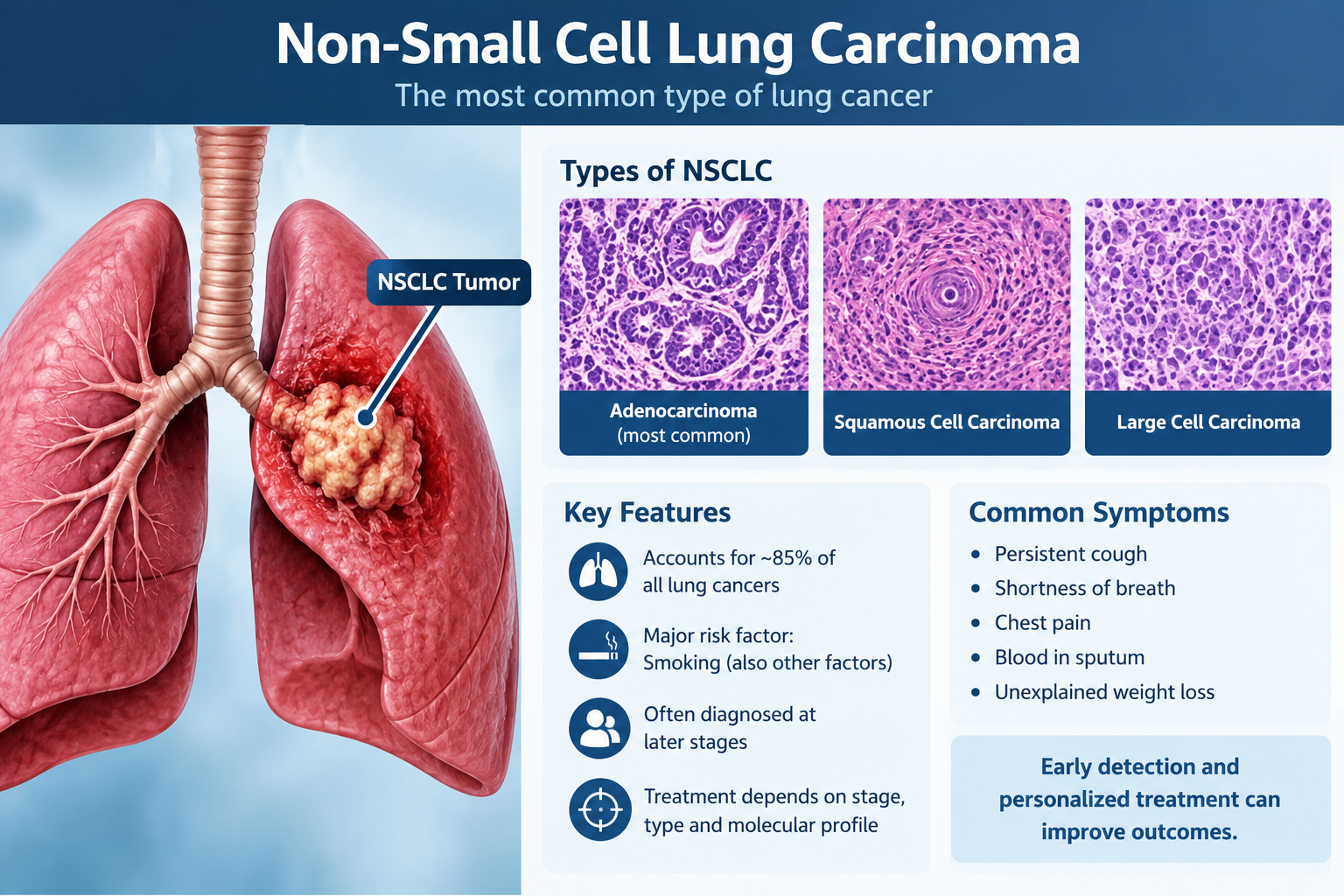
Dr. Manish Aggarwal Non-Small Cell Lung Carcinoma (NSCLC) is the most common broad category of lung cancer. It develops when abnormal cells in the lung grow and divide in an uncontrolled way. NSCLC includes several different types of lung cancer, with adenocarcinoma, squamous cell carcinoma and large cell carcinoma being major subtypes.
Early diagnosis is important because treatment options depend on factors such as the specific type of cancer, its stage, molecular characteristics and the patient's overall health. At Dr. Manish Aggarwal – Delhi Lung & Bronchoscopy Centre, patients with concerning respiratory symptoms can undergo appropriate pulmonary evaluation and investigations.
What Is Non-Small Cell Lung Carcinoma?
Non-Small Cell Lung Carcinoma is a group of lung cancers that do not have the microscopic characteristics of small cell lung cancer. The major types include:
Adenocarcinoma
Adenocarcinoma is a common type of NSCLC and can develop in cells involved in producing substances such as mucus. It may occur in people who have never smoked as well as people with a history of smoking.
Squamous Cell Carcinoma
Squamous cell carcinoma often develops in cells lining the airways. It has a strong association with tobacco smoking, although other factors can also contribute to its development.
Large Cell Carcinoma
Large cell carcinoma is a less common NSCLC subtype characterized by large-appearing cancer cells under microscopic examination. It can occur in different parts of the lung.
The exact diagnosis requires examination of tissue or cells obtained through an appropriate diagnostic procedure.
Symptoms of Non-Small Cell Lung Carcinoma
Lung cancer may not cause noticeable symptoms during its early stages. When symptoms occur, they can vary depending on the location and size of the tumor and whether the disease has spread.
Possible symptoms include:
-
Persistent or worsening cough
-
Coughing up blood
-
Chest pain
-
Shortness of breath
-
Wheezing
-
Recurrent respiratory infections
-
Unexplained weight loss
-
Loss of appetite
-
Persistent fatigue
-
Hoarseness
-
Difficulty swallowing in some cases
These symptoms do not necessarily mean that a person has lung cancer. Similar symptoms can occur with infections, COPD, asthma and other lung conditions. However, persistent or unexplained respiratory symptoms should be medically evaluated.
Risk Factors for NSCLC
Several factors can increase the risk of developing lung cancer. Tobacco smoking is the most important preventable risk factor. Exposure to secondhand smoke can also increase risk.
Other recognized risk factors include exposure to radon, asbestos and certain workplace or environmental substances, as well as air pollution. A personal or family history of lung cancer may also be relevant.
Importantly, lung cancer can occur in people who have never smoked. Therefore, persistent respiratory symptoms should not automatically be attributed to smoking history.
How Is Non-Small Cell Lung Carcinoma Diagnosed?
Diagnosis usually involves several steps. The doctor first reviews symptoms, medical history and risk factors before deciding which investigations are appropriate.
Imaging Tests
A chest X-ray may identify an abnormality in the lung, although further testing is usually required if a suspicious finding is present.
A CT scan of the chest provides more detailed images and can help determine the location and size of a suspected tumor. Depending on the circumstances, additional imaging such as PET-CT or brain imaging may be used for staging.
Bronchoscopy
Bronchoscopy is an important diagnostic procedure for selected patients. A thin flexible tube with a camera is introduced through the airways so that a pulmonologist can examine the bronchial passages.
During bronchoscopy, the doctor may collect tissue or cell samples from a suspicious area. These samples can then be examined by a pathologist.
Biopsy and Molecular Testing
A biopsy is generally needed to establish the specific type of lung cancer. Depending on the tumor's location, tissue may be obtained through bronchoscopy, needle biopsy or another appropriate procedure.
For many patients with advanced NSCLC, testing for specific molecular alterations and biomarkers can influence treatment selection. Depending on the tumor, testing may include genetic alterations and biomarkers such as EGFR, ALK, ROS1, BRAF, KRAS, MET, RET and NTRK, along with PD-L1 assessment.
Stages of Non-Small Cell Lung Carcinoma
NSCLC is commonly staged according to the extent of the cancer. Broadly, it may be described as:
-
Early-stage disease, where the cancer is confined to the lung or nearby structures
-
Locally advanced disease, where the cancer has spread to nearby lymph nodes or structures
-
Advanced or metastatic disease, where cancer has spread to distant organs
More detailed staging is performed using the TNM system, which considers the primary tumor, lymph node involvement and distant metastasis.
Accurate staging is important because it helps the medical team determine the appropriate treatment approach.
Treatment for Non-Small Cell Lung Carcinoma
Treatment is individualized according to the cancer's stage, subtype, molecular profile and the patient's overall condition.
Surgery
For selected patients with localized NSCLC, surgery may be used to remove the tumor and surrounding lung tissue. The type of surgery depends on the location and extent of the cancer.
Radiation Therapy
Radiation therapy may be used as part of treatment for localized, locally advanced or selected metastatic disease. It can also sometimes be used to relieve symptoms caused by cancer.

 English
 Arabic
 French
 Spanish
 Deutsch
 Turkish
 Dutch
 Italiano
 Russian
 Romaian
 Portuguese (Brazil)
 Greek
