


Topical Hemostat Market Trends Point to Growing Healthcare Adoption
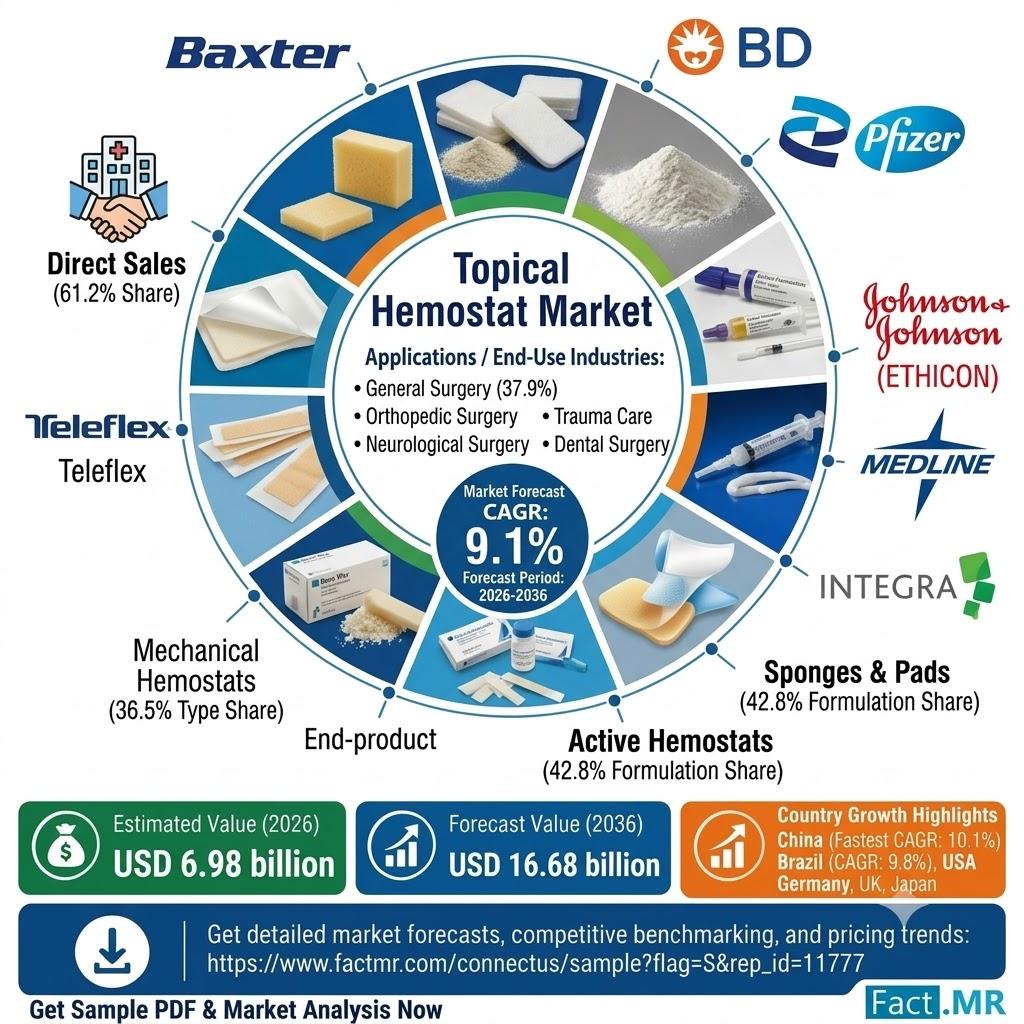
Fact.MR forecasts a 9.1% CAGR through 2036 as surgical demand, institutional adoption, and advanced hemostatic products shape market expansion.
October 19, 2026 The global topical hemostat market is projected to reach USD 16.68 billion by 2036, rising from an estimated USD 6.98 billion in 2026, according to Fact.MR’s latest market analysis. The forecast represents a compound annual growth rate (CAGR) of 9.1% over the ten-year period, with demand supported by expanding healthcare infrastructure, greater institutional adoption, and increased use of advanced products across surgical settings.
The market is expected to generate an additional USD 9.7 billion in absolute dollar opportunity between 2026 and 2036. Hospitals, surgical centres, and specialist healthcare providers are central to this outlook as procurement requirements evolve and access to hemostatic products expands across established and emerging markets. The findings are detailed in the .
Get detailed market forecasts, competitive benchmarking, and pricing trends: https://www.factmr.com/connectus/sample?flag=S&rep_id=11777
Topical Hemostat Market Growth Driven by Surgical Applications
Topical hemostats are used to help control bleeding during medical procedures. The market encompasses mechanical and active hemostats, combination products, sealants, and adhesives supplied through institutional and professional channels. Demand depends on clinical requirements, product availability, procurement practices, and the adoption of formulations suited to specific applications.
General surgery accounts for 37.9% of application demand, according to Fact.MR’s analysis. This share places general surgery at the centre of the market’s application landscape, while orthopedic surgery, neurological surgery, trauma care, and dental surgery represent additional areas covered by the report.
Product preferences also influence market composition. Mechanical hemostats are projected to account for 36.5% of product-type share in 2026. Fact.MR attributes the segment’s position to established clinical protocols, institutional familiarity, regulatory clearances, and cost accessibility. These factors support continued use in primary healthcare settings.
Sponges and pads lead by formulation, accounting for 42.8% of the market segment in 2026. Their established role in routine clinical practice and institutional procurement supports demand. Fact.MR also identifies a shift toward higher-performance alternatives in mature markets, alongside volume expansion in emerging economies.
Direct Sales Remains the Leading Distribution Channel
Distribution arrangements are another defining feature of the topical hemostat market. Fact.MR estimates that direct sales will account for 61.2% of the distribution channel segment in 2026, reflecting hospital procurement practices and the delivery requirements of institutional customers.
Direct relationships can help suppliers respond to purchasing specifications and recurring product requirements. Third-party distribution and online sales also form part of the market, with digital channels offering additional routes to reach healthcare buyers. The relative importance of these channels will depend on regional infrastructure, procurement systems, and product availability.
For manufacturers, market access remains a practical consideration. Companies seeking to expand in developing markets must account for differences in purchasing capacity, regulatory requirements, and institutional supply networks. These conditions can influence which products gain adoption and how quickly suppliers establish a presence in new regions.
China and Brazil Lead Regional Growth Forecasts
China is projected to record the fastest growth among the countries highlighted in the Fact.MR report, with a CAGR of 10.1% through 2036. Infrastructure expansion, increasing institutional adoption, and broader market access are identified as key supporting factors.
Brazil follows with a projected CAGR of 9.8%. Fact.MR links its outlook to demographic shifts, regulatory development, and improving access to the market. The projections suggest that emerging economies will remain important to future demand as healthcare capacity develops.
The United States is forecast to expand at a CAGR of 9.4%, supported by established institutional demand and adoption across core end-use channels. Germany and the United Kingdom are each projected to grow at 9.1%, while Japan is expected to record an 8.8% CAGR over the forecast period.
These regional differences matter for suppliers planning distribution and product investment. Companies must assess local purchasing conditions and regulatory frameworks rather than assume that demand will develop at the same rate across markets.
Competitive Landscape and Market Constraints
The competitive landscape includes Baxter International Inc., BD (Becton, Dickinson and Company), Pfizer Inc., Johnson & Johnson (Ethicon Division), Medline Industries, LP, Integra LifeSciences Holdings Corporation, and Teleflex Incorporated. Hemostasis LLC, HemoSonics LLC, and HemCon Medical Technologies Inc. are also identified among the companies active in the market.
Fact.MR describes competition as moderately fragmented. Portfolio breadth, clinical evidence, regulatory positioning, and institutional distribution relationships influence company positioning. Suppliers are also navigating pricing pressure from competitive manufacturing and consolidated procurement, which can constrain margins.
Regulatory complexity across jurisdictions adds compliance costs and can affect cross-border supply efficiency. Funding and reimbursement gaps may also restrict adoption of advanced products in cost-sensitive healthcare settings. These constraints could shape the pace of premium-product adoption even as demand expands.
Shambhu Nath Jha, Principal Consultant at Fact.MR, said, “The topical hemostat market is evolving beyond its traditional demand base. Growth is increasingly shaped by expanding institutional adoption, infrastructure scaling in emerging markets, and the shift toward higher-value products and services. Companies that combine reliable product performance with stronger distribution reach and digital engagement are better positioned to capture the next phase of market expansion.”
Research Methodology and Forecast Scope
Fact.MR’s research combines secondary research, primary interviews, and forecast modelling. The methodology draws on more than 120 secondary sources and benchmarks over 65 company product portfolios. Market sizing covers more than 30 countries through a demand-side model supported by top-down validation.
The research also incorporates more than 25 interviews with manufacturers, distributors, and end users. This combination supports the report’s assessment of market size, regional demand, product segments, pricing conditions, and competitive positioning. The analysis was updated on May 5, 2026.
As healthcare institutions evaluate product requirements and suppliers pursue regional expansion, the forecast points to a market shaped by both established surgical practices and changing procurement conditions. The projected increase from USD 6.98 billion in 2026 to USD 16.68 billion by 2036 provides a quantitative basis for assessing opportunities across product categories and geographies.
About Fact.MR
Fact.MR is a market research and consulting firm that provides industry analysis, market forecasts, and strategic insights for businesses across sectors. Its research combines primary interviews, secondary-source analysis, and forecasting methodologies to assess market size, competitive conditions, and emerging opportunities.

 English
 Arabic
 French
 Spanish
 Portuguese
 Deutsch
 Turkish
 Dutch
 Italiano
 Russian
 Romaian
 Portuguese (Brazil)
