


Edible Offal Market Set to Hit USD 74.3 Billion by 2036, China Leads at 5.6% CAGR
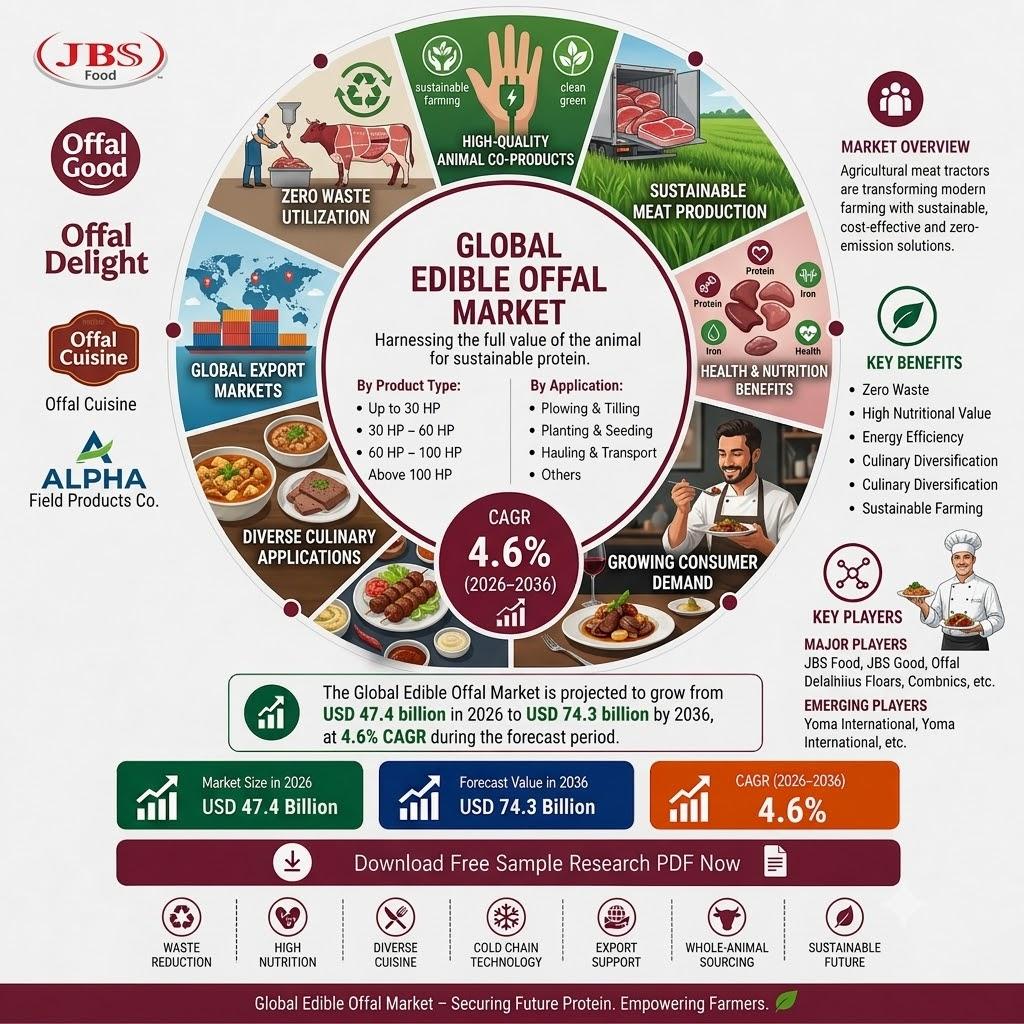
The global edible offal market is projected to grow from USD 47.4 billion in 2026 to USD 74.3 billion by 2036, registering a compound annual growth rate (CAGR) of 4.6%, according to Fact.MR. Valued at USD 45.3 billion in 2025, the market is expected to generate an additional USD 26.9 billion in opportunity between 2026 and 2036. Demand for cost-effective animal protein, expanding food processing operations, and increased utilization of livestock by-products is supporting market development across food manufacturing, retail, and food service industries.
Edible offal includes consumable organs and related animal products such as liver, kidney, heart, and intestines from cattle, pigs, poultry, sheep, and goats. These products serve traditional cuisine, processed meat manufacturing, and pet food applications. Meat processors are increasingly looking at whole-animal utilization to improve processing economics and reduce waste, while improvements in freezing, packaging, and distribution are helping extend the reach of offal products.
Get detailed market forecasts, competitive benchmarking, and pricing trends: https://www.factmr.com/connectus/sample?flag=S&rep_id=12402
Beef Offal Maintains a Leading Position
Beef offal is projected to account for 50% of the edible offal market by product type in 2026. Liver, kidney, and heart products serve both direct-consumption markets and commercial food processing operations. Established cattle processing networks provide a steady supply of these products, supporting demand across regions where organ meats remain part of everyday diets.
Consumer preferences vary significantly by market. In China, organ meats are used in traditional dishes, street food, and restaurant menus. In India and parts of Latin America, offal offers a comparatively affordable source of animal protein for price-conscious consumers. European markets maintain demand through traditional recipes, specialty butchers, and processed meat products.
For meat processors, offal utilization can generate additional revenue from livestock components that might otherwise have limited commercial value. Consistent grading, hygienic handling, and reliable distribution are important to supplying buyers that require standardized products. Processors that can deliver uniform quality and traceable sourcing are better positioned to serve organized retail and food service customers.
Food Processing Drives Commercial Demand
Food processing is projected to account for 55% of the edible offal market by application in 2026. Organ meats are used in sausages, canned meat products, ready-to-cook meals, and other processed food formulations. Industrial buyers value consistent supply and specifications that support large-scale production.
The pet food industry also provides an important demand channel. Manufacturers use ingredients such as liver and heart in selected formulations, responding to demand for animal-derived protein ingredients. This market provides an additional outlet for offal that does not depend solely on household consumption or traditional cuisine.
The food industry is expected to represent 60% of the market by end use in 2026. Meat processors, food manufacturers, and food service operators require dependable procurement arrangements to maintain production schedules. Larger buyers may also require documentation covering product origin, handling procedures, and food safety standards.
Value-added processing is creating opportunities to improve the commercial appeal of edible offal. Frozen portion-controlled products, standardized cuts, and packaged formats can help suppliers meet the requirements of organized retail and restaurant chains. These formats also allow processors to reach customers who may have limited access to fresh offal through traditional markets.
Cold-Chain Development Supports Wider Distribution
Fresh and frozen offal products require careful temperature management to preserve quality and meet food safety requirements. Improvements in cold storage, refrigerated transportation, and packaging are helping suppliers distribute products beyond established local markets.
Offline retail is projected to account for 65% of the distribution channel segment in 2026. Supermarkets, hypermarkets, and butcher shops remain important access points for consumers, while direct sales and commercial procurement arrangements serve food manufacturers and restaurants.
Online meat delivery platforms are creating additional opportunities, particularly in urban areas where consumers can order chilled or frozen products for home delivery. However, expansion depends on reliable refrigeration, appropriate packaging, efficient last-mile delivery, and compliance with local food safety rules.
The market also faces constraints. Consumer acceptance remains limited in some countries where organ meats are less familiar, while fragmented regulations can complicate cross-border trade. Suppliers must manage these barriers through product quality, transparent sourcing, and distribution systems suited to the requirements of individual markets.
China Leads Country-Level Growth
China is projected to record a CAGR of 5.6% through 2036, making it the fastest-growing country market highlighted in Fact.MR's analysis. Established culinary traditions support demand for liver, intestines, stomach, and other organ meats across household consumption and food service. The country's large food processing sector and distribution networks also support the movement of fresh and processed offal products.
India follows with a projected CAGR of 5.3%. Demand for affordable animal protein and the development of food service infrastructure are supporting market opportunities. Improved cold-chain coverage can further expand access to fresh and frozen products, particularly in urban and emerging regional markets.
Australia and New Zealand are forecast to grow at a CAGR of 5.0%, supported by livestock processing capacity, export-oriented meat industries, and interest in whole-animal utilization. Brazil is expected to register a CAGR of 4.7%, benefiting from its substantial cattle production base and the availability of offal for domestic consumption and export markets.
Spain is projected to grow at a CAGR of 4.4%, supported by traditional cuisine and demand for organ-based dishes. The United States is forecast to record a CAGR of 3.8%, with opportunities in specialty food service and pet food manufacturing. Germany is expected to grow at 3.5%, supported by traditional offal-based products and interest in reducing food waste.
These regional trends reflect differences in food culture, livestock production, processing infrastructure, and consumer purchasing power. Suppliers must adapt product formats and distribution strategies to local demand rather than relying on a uniform approach across markets.
Analyst Perspective
S.N. Jha, Principal Consultant at Fact.MR, identifies the shift from traditional fresh-market sales toward processed and packaged offal as an important market development. Investment in freezing technology, traceability, and cold-chain infrastructure can help meat processors serve larger commercial buyers and reach customers beyond established distribution channels.
Affordable protein sourcing remains a structural demand driver, particularly in markets where consumers seek lower-cost alternatives to premium meat cuts. At the same time, pet food manufacturers and processed food producers provide additional outlets for organ meats, helping processors improve the utilization of livestock resources.
For companies operating in this market, commercial growth depends on maintaining food safety, consistent quality, and reliable supply. Investments in processing and distribution must be matched with local consumer preferences and the regulatory requirements of destination markets.
Competitive Landscape
The edible offal market includes large integrated meat processors, regional suppliers, and specialized businesses serving retail, food service, and industrial buyers. JBS Food holds an estimated 13% market share, according to Fact.MR, with competition shaped by processing scale, supply availability, and distribution capabilities.
Other participants identified in the report include Offal Good, Offal Delight, Offal Cuisine, Alpha Field Products Co., Yoma International, Cenfood International Inc., Organic Meat Company, Sure Good Foods Ltd., and Offal Good Canada.
Competition is driven by procurement reliability, pricing, food safety compliance, and the ability to supply products in the formats required by customers. Large processors can benefit from established livestock operations and distribution networks, while regional suppliers may compete through local market knowledge and relationships with restaurants and specialty retailers.
Investment in traceability, cold-chain infrastructure, and value-added processing can help suppliers strengthen their position. As organized food service and retail buyers place greater emphasis on consistency and documented handling practices, reliable supply and quality assurance will remain important factors in commercial purchasing decisions.
Market Snapshot
- Market value (2025): USD 45.3 billion
- Market value (2026): USD 47.4 billion
- Forecast value (2036): USD 74.3 billion
- Global CAGR (2026–2036): 4.6%
- Absolute dollar opportunity (2026–2036): USD 26.9 billion
- Leading product type: Beef offal, with a projected 50% share in 2026
- Leading application: Food processing, with a projected 55% share in 2026
- Leading distribution channel: Offline retail, with a projected 65% share in 2026
- Leading country by growth: China, at 5.6% CAGR
To View Top Reports
https://net-pals.com/blogs/52231/Roofing-Material-Market-to-Reach-USD-254-4-Billion-by
https://uddokta64.com/blogs/12418/Global-Roofing-Material-Market-Set-to-Hit-USD-254-4
https://acmingle.com/blogs/29675/Roofing-Material-Market-Forecast-to-Reach-USD-254-4-Billion
https://gulfsena.com/blogs/105754/Roofing-Material-Market-to-Worth-USD-254-4-Billion-by
About Fact.MR
Fact.MR is a market research and competitive intelligence provider delivering market intelligence, competitive analysis, and forecasting across global industries. Its research helps businesses evaluate market demand, understand competitive developments, and identify growth opportunities across established and emerging markets.

 English
 Arabic
 French
 Spanish
 Portuguese
 Deutsch
 Turkish
 Dutch
Dutch
 Italiano
 Russian
 Portuguese (Brazil)
 Greek
Greek
