


ESG Investment Strategies and Compliance Certification: Build Skills for Sustainable Finance
The financial industry is increasingly considering how environmental, social, and governance factors influence investment decisions. Investors, businesses, and financial professionals are paying closer attention to sustainability, corporate responsibility, ethical leadership, and long-term financial risks. This shift has made ESG investment strategies an important area of learning for people interested in modern finance.
Environmental, Social and Governance (ESG) investing involves examining factors beyond traditional financial measurements when evaluating investments. Environmental considerations may include climate-related risks and resource use, social factors can involve employee welfare and customer relationships, while governance focuses on leadership, accountability, and corporate oversight.
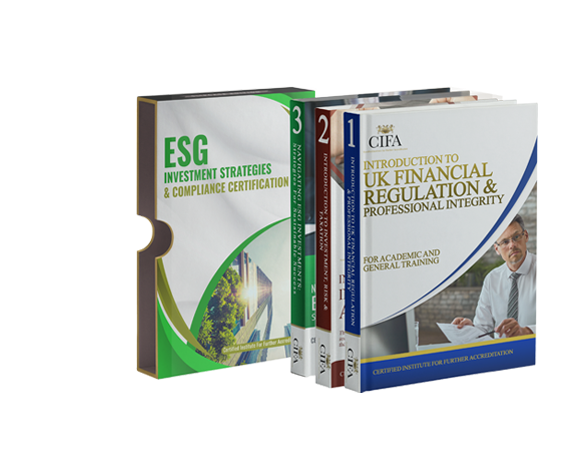
For professionals who want to understand these developments, the ESG Investment Strategies & Compliance Certification from CIFA offers a structured learning pathway combining financial regulation, investment risk and taxation, and sustainable investing.
Whether you are a finance graduate, an investment professional, a compliance practitioner, or someone exploring a new career direction, developing ESG knowledge can help you understand how sustainability considerations connect with investment analysis and responsible financial decision-making.
What Is the ESG Investment Strategies & Compliance Certification?
The ESG Investment Strategies & Compliance Certification is a digital learning bundle from CIFA that brings together three related financial subject areas. It is designed to help learners develop a foundation in regulatory awareness, investment principles, and ESG-focused decision-making.
The programme includes three courses:
-
Introduction to UK Financial Regulation and Professional Integrity: Explores the regulatory environment, professional responsibilities, and ethical conduct within financial services.
-
Introduction to Investment, Risk and Taxation: Introduces investment fundamentals, risk and return, and taxation considerations.
-
Navigating ESG Investments: Strategies for Sustainable Success: Examines ESG principles and their application to investment analysis, portfolio decisions, and responsible investing.
Together, these subjects help learners understand how financial performance, regulatory responsibilities, and sustainability considerations can influence investment decisions.
Why Are ESG Investment Strategies Becoming Important?
1. Understanding Environmental Risks
Environmental factors can affect businesses through climate-related events, resource shortages, changing regulations, and transitions towards lower-carbon operations. These developments may influence costs, business continuity, and long-term investment performance.
ESG analysis encourages investors to consider how environmental issues could affect a company's strategy and financial outlook. However, environmental performance alone does not determine whether an investment will succeed.
2. Recognising Social Responsibilities
Social considerations examine how organisations interact with employees, customers, suppliers, and communities. Issues such as workplace safety, labour practices, product responsibility, and customer privacy can influence business reputation and operational resilience.
Understanding these factors helps learners appreciate why investors may consider social risks alongside financial information.
3. Evaluating Corporate Governance
Governance concerns how organisations are directed, monitored, and held accountable. Board oversight, transparency, shareholder rights, executive incentives, and internal controls can all influence how a business operates.
Strong governance practices may help support accountability, although no governance framework can eliminate every business risk.
4. Responding to Investor Expectations
Some investors want their investment decisions to reflect particular environmental or social objectives. Others focus on ESG information primarily to identify risks that could affect long-term financial performance.
Understanding different investor priorities can help financial professionals recognise why ESG analysis needs to be aligned with investment objectives, risk tolerance, and the evidence available.
Key Learning Areas in the ESG Certification Programme
1. UK Financial Regulation and Professional Integrity
Responsible investing requires more than an understanding of sustainability. Financial professionals must also recognise the regulations and professional standards relevant to their activities.
This part of the programme introduces the importance of UK financial regulation and ethical conduct.
Key concepts include:
Regulatory awareness: Understand why financial services activities are subject to oversight and why professionals need to identify the requirements relevant to their responsibilities.
Professional integrity: Explore the importance of honesty, transparency, fairness, and accountability when working with financial information and clients.
Compliance principles: Recognise how policies, procedures, and appropriate controls can support responsible business practices.
Ethical decision-making: Understand why financial professionals should consider their responsibilities when communicating investment information or explaining risks.
Client trust: Explore how clear communication and responsible conduct can contribute to professional relationships.
These concepts provide useful context for understanding the compliance responsibilities that may arise in investment and ESG-related work.
2. Investment, Risk and Taxation
Investment decisions involve balancing potential returns against uncertainty. Understanding investment fundamentals can help learners evaluate why different assets behave differently and why a particular investment may suit one investor but not another.
This subject area introduces several important concepts.
Investment asset classes: Explore the basic characteristics of assets such as equities, bonds, and investment funds.
Risk and return: Understand that potential returns are uncertain and that investments can lose value. Different assets carry different types and levels of risk.
Portfolio diversification: Learn how holding a range of investments may help reduce exposure to individual risks, while recognising that diversification cannot eliminate market risk.
Investment objectives: Consider why time horizon, financial goals, and risk tolerance matter when evaluating investment choices.
Taxation considerations: Understand that applicable tax rules can affect investment outcomes and that the treatment depends on individual circumstances and current legislation.
A foundation in these areas can help learners understand the financial context in which ESG strategies are assessed.
3. Navigating ESG Investments: Strategies for Sustainable Success
The ESG-focused course explores how environmental, social, and governance considerations can be incorporated into investment research and decision-making.
Rather than treating sustainability as a separate topic, ESG analysis examines how relevant factors may affect business performance, risk exposure, and long-term strategy.
Important themes include:
ESG principles and frameworks: Become familiar with the environmental, social, and governance categories used to organise sustainability-related information.
ESG investment analysis: Explore how ESG information can contribute to an assessment of a company or investment opportunity.
Sustainable investment strategies: Understand that investors may use different approaches, including ESG integration, screening, and impact-oriented investment strategies.
ESG metrics and scoring: Learn why investors use indicators and ratings to compare companies, while recognising that methodologies and data quality can vary.
Corporate governance: Examine the importance of accountability, leadership, oversight, and transparent business practices.
Climate-related investment risks: Consider how environmental developments and the transition to a lower-carbon economy may affect particular sectors and assets.
Disclosure and reporting: Understand why clear, consistent sustainability information matters to investors and other stakeholders.
These learning areas can help students develop a more structured approach to evaluating ESG information without assuming that an ESG label automatically indicates a financially suitable or sustainable investment.
Different Approaches to ESG Investing
ESG investing can involve several approaches, and understanding their differences is important for anyone exploring responsible finance.
ESG Integration
ESG integration involves considering material environmental, social, and governance factors alongside traditional financial analysis. The aim is to understand whether these factors could affect investment risks, opportunities, or expected performance.
Exclusionary Screening
Some investment strategies exclude companies or industries based on defined criteria. The criteria depend on the investment approach and the preferences or requirements of the investor.
Best-in-Class Selection
This approach compares businesses within a particular sector and may favour those demonstrating stronger performance against selected ESG criteria. Results depend on the metrics and methodology used.
Impact Investing
Impact investing seeks measurable positive social or environmental outcomes alongside financial returns. It requires clear objectives and credible methods for evaluating whether the intended impact is being achieved.
These approaches are not interchangeable. Investors should understand the strategy, its limitations, and how it aligns with their objectives before making decisions.
Who Should Consider an ESG Investment Certification?
Finance and Investment Students
Students interested in investment management can use ESG education to explore how sustainability information fits into broader financial analysis.
Investment Analysts and Portfolio Professionals
Professionals working with investment research or portfolio decisions may benefit from developing an understanding of ESG data, material risks, and sustainability-related considerations.
Compliance and Risk Professionals
People working in compliance or risk functions may want to learn how ESG issues intersect with regulatory awareness, disclosure practices, and risk management.
Wealth Managers and Financial Advisers
Professionals involved in financial planning or investment discussions may benefit from understanding ESG terminology and the different priorities that clients can have. Any advice must still comply with the requirements applicable to their role.
Graduates and Career Changers
People exploring a career in sustainable finance may use the programme to develop foundational knowledge and identify further training or experience they need.
Business and Sustainability Professionals
Professionals involved in corporate sustainability, governance, or financial reporting may find ESG investment education useful for understanding how sustainability information is assessed by investors.
Benefits of Online ESG Compliance Training
Flexible Digital Learning
Online study can help learners organise professional development around employment and other commitments. Before enrolling, check the current access arrangements, study expectations, and assessment requirements.
A Broader Understanding of Finance
The programme combines ESG investing with investment fundamentals, taxation, and UK financial regulation. This provides a broader context for understanding sustainable finance rather than studying ESG concepts in isolation.
Support for Professional Development
Learning about ESG principles can help students identify areas for further development, such as investment analysis, sustainability reporting, risk management, or regulatory compliance.
Improved Understanding of ESG Terminology
Sustainable finance uses specialised terminology, frameworks, and metrics. Structured learning can help learners become more familiar with these concepts and ask better questions when reviewing ESG information.
How to Apply ESG Knowledge in Practice
Start with materiality. Not every ESG factor has the same importance for every business. Consider which environmental, social, or governance issues are most relevant to a company's activities and industry.
Examine the evidence. Review the source, quality, and date of ESG information. Ratings from different providers may vary because they use different methodologies and weightings.
Connect ESG factors with financial analysis. Consider whether a sustainability issue could affect costs, revenue, operational resilience, reputation, or long-term strategy.
Avoid unsupported sustainability claims. Terms such as sustainable, responsible, or green should be supported by clear criteria and credible information. This is particularly important when communicating with investors or clients.
Keep regulatory knowledge current. Sustainability-related disclosure requirements and financial regulations can change. Professionals should verify current requirements relevant to their responsibilities rather than relying solely on introductory course material.
Why Explore CIFA's ESG Investment Strategies & Compliance Certification?
Choosing a professional learning programme involves assessing its subject coverage, delivery format, cost, and relevance to your goals.
CIFA offers the ESG Investment Strategies & Compliance Certification as a digital bundle combining UK financial regulation and professional integrity, investment risk and taxation, and ESG investment strategies.
This structure may suit learners who want to understand the relationship between sustainable investing and the wider financial services environment. Before enrolling, review the current programme details, assessment arrangements, examination fees, and any optional study support costs.
It is also important to distinguish between completing a course and meeting any additional professional qualifications or regulatory requirements relevant to a particular job.
Career Development in Sustainable Finance
ESG-related knowledge may be relevant to several areas of financial and business work, depending on a learner's experience and additional qualifications. These include investment research, portfolio support, compliance, risk analysis, sustainability reporting, and responsible investment operations.
The skills and credentials required differ between roles. Some employers may expect practical experience, technical knowledge, or further specialist qualifications. Completing an ESG learning programme does not guarantee employment or authorise someone to undertake regulated activities.
For a more focused career plan, review vacancies in your preferred area and identify the skills employers request. You can then decide whether to pursue additional training, practical projects, or relevant professional experience.
Conclusion: Take the Next Step in ESG Investing
Sustainable finance requires an understanding of investment principles, financial risks, professional conduct, and the environmental, social, and governance factors that may influence organisations.
The ESG Investment Strategies & Compliance Certification from CIFA brings together these themes through three connected learning areas: UK financial regulation and professional integrity, investment risk and taxation, and ESG investment strategies.
For finance students, investment professionals, compliance practitioners, and career changers, the programme offers a structured way to explore responsible investing. By combining ESG knowledge with careful financial analysis and an awareness of relevant rules, learners can build a foundation for further development in the evolving sustainable finance landscape.
Frequently Asked Questions
1. What is the ESG Investment Strategies & Compliance Certification?
It is a CIFA digital learning bundle covering UK financial regulation and professional integrity, investment risk and taxation, and ESG investment strategies.
2. What does ESG stand for in investing?
ESG stands for Environmental, Social and Governance. These factors help investors examine sustainability-related risks, business practices, and governance alongside traditional financial information.
3. Who should consider an ESG investment certification?
It may suit finance students, investment professionals, wealth managers, compliance staff, risk practitioners, sustainability professionals, and career changers interested in sustainable finance.
4. Can ESG investing eliminate investment risk?
No. ESG analysis may help investors identify certain risks and opportunities, but it cannot eliminate market risk or guarantee investment performance.
5. Can this certification help me pursue an ESG career?
It can help you develop foundational knowledge relevant to ESG and sustainable finance. Employment depends on your skills, experience, employer requirements, and any additional qualifications needed.
6. What should I check before enrolling in the CIFA ESG programme?
Review the curriculum, study format, total enrolment cost, examination fees, optional study support, assessment requirements, and certificate conditions.

 English
 Arabic
 French
 Spanish
 Deutsch
 Turkish
 Dutch
Dutch
 Italiano
 Russian
 Romaian
 Portuguese (Brazil)
 Greek
Greek
