


Natural Gemstone Market Forecast to Reach USD 72.8 Billion by 2036
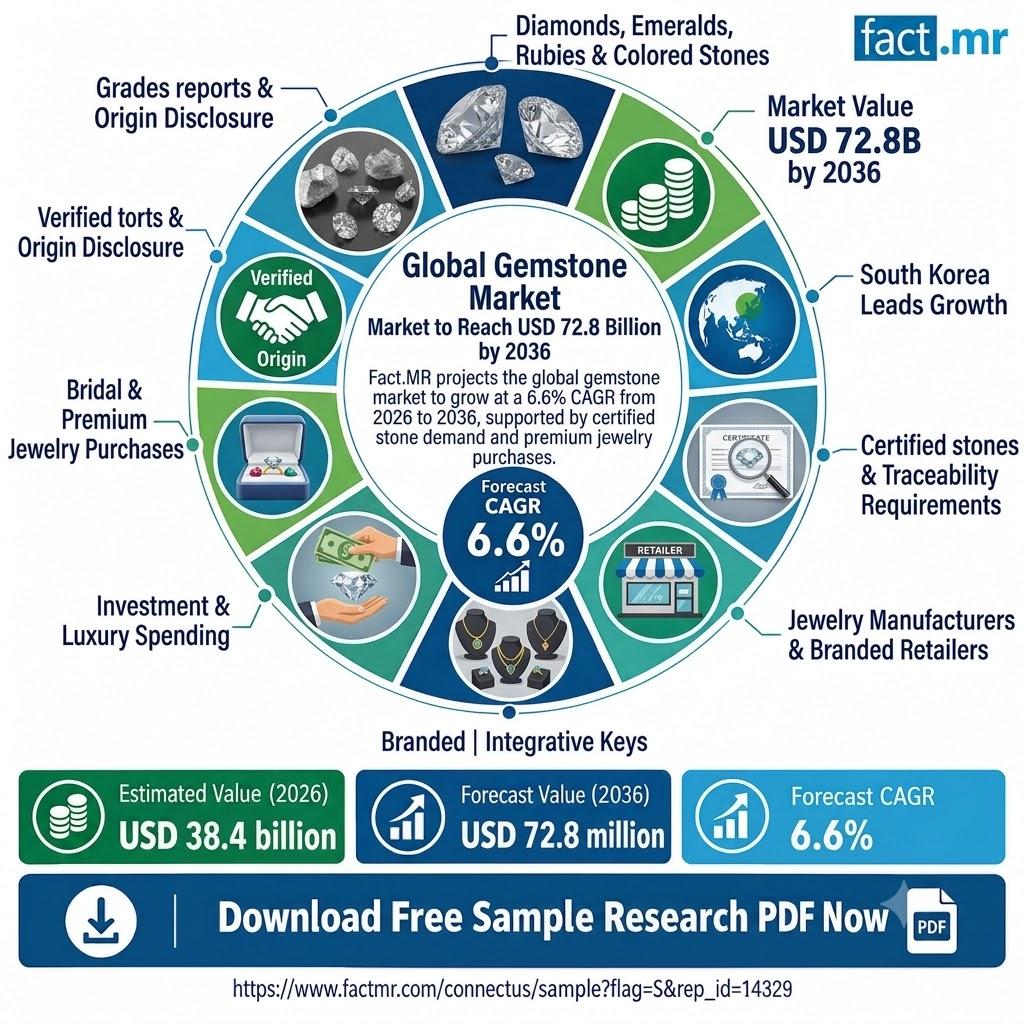
The gemstone market is projected to grow at a 6.6% CAGR from 2026 to 2036, supported by certified stone demand and premium jewelry purchases.
October 16, 2026 — The global gemstone market is projected to reach USD 72.8 billion by 2036, increasing from USD 38.4 billion in 2026 at a compound annual growth rate (CAGR) of 6.6%, according to Fact.MR analysis. The market was valued at approximately USD 36.0 billion in 2025. Growth is expected to reflect demand for certified natural gemstones, premium jewelry purchases, and interest in diamonds and colored stones as alternative investment assets.
The market is forecast to add approximately USD 36.8 billion in value between 2026 and 2036. This expansion reflects higher-value purchasing patterns, with certification, origin disclosure, and ethical sourcing playing an important role in consumer decisions. Jewelry manufacturers and retailers will need to maintain confidence in gemstone quality while responding to changing preferences across luxury and investment-oriented segments.
Get detailed market forecasts, competitive benchmarking, and pricing trends: https://www.factmr.com/connectus/sample?flag=S&rep_id=14329
Gemstone Market Growth Reflects Certification and Premium Demand
The gemstone market covers the mining, cutting, grading, and trade of natural precious and semi-precious stones used primarily in jewelry and ornamental applications. The market excludes synthetic gemstones, laboratory-grown diamonds, and imitation stones such as cubic zirconia, according to the scope defined in the Fact.MR report.
Demand remains closely connected to jewelry purchases for weddings, gifting, and personal adornment. Buyers increasingly rely on grading reports and origin information to evaluate quality and support purchasing decisions. For premium stones, clarity, cut, color, carat weight, rarity, and treatment disclosure can influence pricing and perceived value.
The forecast period is expected to reflect different sources of demand over time. Early growth is associated with the recovery of global jewelry retail and consumer spending in premium segments. During the middle years, traceability requirements and certification adoption are expected to influence sourcing decisions. Later growth is projected to receive greater support from investment-oriented demand for diamonds and colored gemstones, alongside higher prices for ethically sourced and origin-certified stones.
Diamonds Hold 45% Share of the Gemstone Market
Diamonds are estimated to account for approximately 45% of the global gemstone market by product type, based on Fact.MR analysis. Their established position in fine jewelry, standardized grading systems, and broad consumer recognition support demand across international markets.
Certification remains particularly relevant to diamond purchases. Buyers use grading reports to assess stone characteristics, while familiar grading frameworks can support comparisons between products. Bridal jewelry continues to provide an important demand base, alongside purchases motivated by long-term value retention.
Jewelry and ornaments account for an estimated 73% of total gemstone market value by application. The segment benefits from cultural traditions, ceremonial purchases, and demand for personal adornment. Specialty jewelry stores and branded retailers remain important distribution channels, while online platforms provide additional routes for consumers to compare products.
For suppliers, these figures highlight the importance of understanding how product quality and retail positioning influence market value. Businesses serving the jewelry segment must also consider how changing consumer budgets affect demand for premium natural stones.
South Korea Leads Country-Level Growth Through 2036
Fact.MR projects South Korea to record the fastest growth among the five countries highlighted in its forecast, with a CAGR of 7.2% from 2026 to 2036. Rising luxury consumption, premium jewelry retail, and branded jewelry penetration are identified as supporting factors.
The United Kingdom follows at 6.9%, reflecting demand for certified diamonds and colored gemstones across jewelry and investment channels. Germany is projected to grow at 6.7%, supported by luxury retail and demand for high-value craftsmanship. The United States is forecast to expand at 6.3%, with bridal jewelry and interest in gemstone-backed personal investment contributing to demand.
Japan is expected to record a comparatively moderate CAGR of 5.0%. Its mature consumer market, established department-store jewelry channels, and replacement-driven purchasing patterns shape the outlook.
These differences matter for companies planning regional distribution and retail strategies. Markets with faster projected growth may offer opportunities for expanding branded jewelry offerings, while mature markets require close attention to replacement demand and premium customer preferences.
Traceability and Sourcing Shape Competitive Decisions
Competition in the gemstone market extends across mining, processing, grading technology, and branded retail. Companies identified in the Fact.MR analysis include Gem Diamonds Limited, Kiran Gems Private Limited, Gemfields Group Limited, PJSC ALROSA, Anglo American plc (De Beers Group), Pandora A/S, Brilliant Earth Group, Lucara Diamond Corp, and Sarine Technologies.
Their activities span different parts of the value chain. Mining companies supply rough stones, while grading and mapping technologies help assess gemstone characteristics. Branded retailers compete through product positioning, customer trust, and sourcing practices.
Certification credibility and origin traceability are becoming central considerations for businesses seeking to protect pricing integrity. Buyers may also evaluate colored stones alongside diamonds when developing product portfolios for different customer segments.
Shambhu Nath Jha, Principal Consultant at Fact.MR, said, “CXOs will find this report useful for understanding how certification credibility, origin traceability, and discretionary luxury spending patterns shape long-term value realization in the gemstone market.”
Research Methodology and Market Scope
Fact.MR's forecast combines primary interviews with mining operators, gemstone processors, traders, jewelry manufacturers, and wholesalers with desk research based on geological statistics, customs records, national mining registries, company annual reports, and audited disclosures.
The market-sizing model uses a hybrid top-down and bottom-up approach. Mine output, recovery rates, cutting yields, and recorded international trade flows inform estimates of apparent consumption. Production, export, and import records are cross-checked to identify inconsistencies, while pricing ranges are reviewed against available benchmarks.
The analysis covers the 2026–2036 forecast period across Asia Pacific, Europe, North America, Latin America, and the Middle East and Africa. Product segmentation includes diamonds, emeralds, rubies, sapphires, opals, spinels, pearls, and other gemstones. Applications include jewelry and ornaments, luxury art, and other uses, while end-use categories include jewelers, industrial applications, and personal investment.
The findings provide businesses with a framework for evaluating demand patterns, sourcing priorities, and regional growth prospects as the global gemstone market develops over the next decade.
View Related Reports :
https://ayushjadhavblogs.blogspot.com/2026/10/video-intercom-device-market-to-reach.html
About Fact.MR
Fact.MR is a market research and consulting firm that provides industry analysis, market forecasts, and strategic insights to support business planning and decision-making across global markets.

 English
 Arabic
 French
 Spanish
 Portuguese
 Deutsch
 Turkish
 Italiano
 Russian
 Romaian
 Portuguese (Brazil)
 Greek
Greek
