


India Leads Gluten-Free Food Market Growth With an 8.4% CAGR
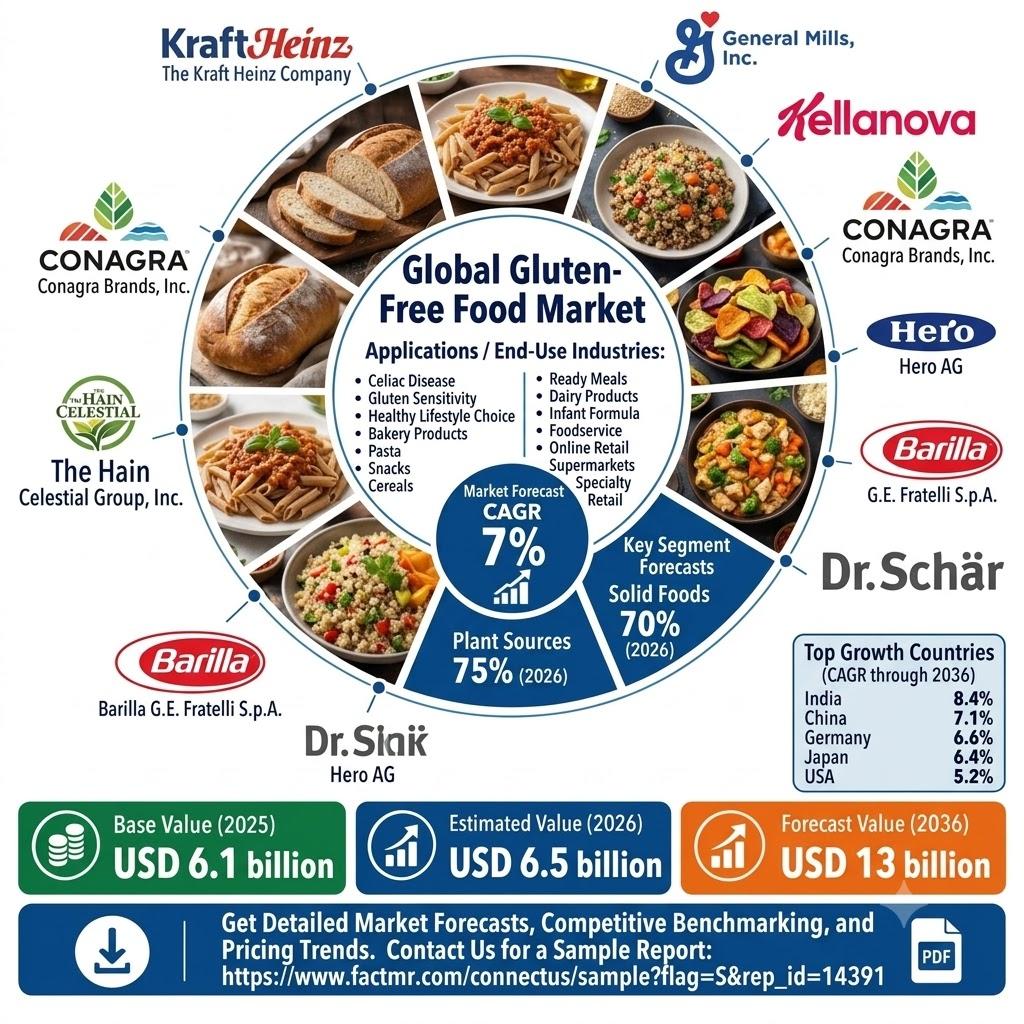
The gluten-free food market is projected to grow at a 7% CAGR through 2036, with India leading country-level growth at 8.4%.
October 16, 2026 — The global gluten-free food market is projected to reach USD 13 billion by 2036, rising from USD 6.5 billion in 2026 at a compound annual growth rate (CAGR) of 7%, according to Fact.MR analysis updated February 25, 2026. The market was valued at USD 6.1 billion in 2025. Growing awareness of celiac disease and gluten sensitivity, combined with wider product availability across mainstream retail channels, is supporting demand for gluten-free alternatives.
The forecast represents an absolute increase of USD 6.5 billion between 2026 and 2036. Food manufacturers are responding to consumers seeking alternatives to conventional wheat-based products, while taste, texture, product pricing and regional availability remain important considerations for wider adoption.
Get detailed market forecasts, competitive benchmarking, and pricing trends: https://www.factmr.com/connectus/sample?flag=S&rep_id=14391
Gluten-Free Food Market Growth Reflects Changing Consumer Demand
The gluten-free food market covers the production and sale of foods made without gluten-containing ingredients such as wheat, barley and rye. These products serve people managing celiac disease or gluten sensitivity, as well as consumers who choose gluten-free diets for lifestyle reasons.
Fact.MR identifies rising health awareness and expanding product availability as key demand drivers. Gluten-free options are increasingly available across bakery products, pasta, cereals, snacks and ready meals. Supermarkets, online platforms and specialty retailers provide distribution channels for manufacturers seeking to reach a broader consumer base.
However, affordability remains a challenge. Higher product costs and limited availability in some regions may restrict adoption, particularly where consumers have fewer retail options. Manufacturers must therefore balance ingredient costs with product quality and pricing to reach more households.
The market's development also reflects changing expectations around everyday food products. Consumers want alternatives that fit familiar eating habits without compromising taste or convenience. Brian Rudolph, Chief Executive Officer and Co-Founder of Banza, highlighted this practical consideration when discussing the company's brown rice pasta: “Our new brown rice pasta holds up the next day, even in soup.”
The comment points to a specific product-performance consideration: maintaining texture after preparation and storage. For manufacturers, these qualities can influence how easily gluten-free products fit into everyday meals.
Solid Foods and Plant Sources Shape Market Segments
Solid-form products are projected to account for 80% of the gluten-free food market by 2026, according to Fact.MR. This segment includes bread, pasta, snacks and baked goods, which offer familiar formats for consumers replacing conventional grain-based foods.
Plant sources are expected to represent 75% of the market by 2026. Ingredients such as rice, corn, quinoa and oats are used in gluten-free formulations across several food categories. Their versatility allows manufacturers to develop different product formats, although individual ingredients and finished products must meet applicable gluten-free requirements.
These segment forecasts provide manufacturers with measurable reference points for product planning. Companies developing new offerings can assess opportunities in solid foods and plant-based formulations while considering consumer preferences for texture, nutritional value and price.
India Leads Country-Level Growth Through 2036
India is projected to record the fastest growth among the five countries highlighted in Fact.MR's analysis, with gluten-free food demand increasing at an 8.4% CAGR through 2036. Growing awareness of gluten sensitivity and rising demand for specialized food products support the country's forecast.
China follows at a projected CAGR of 7.1%, supported by increasing health consciousness and wider availability of gluten-free options. Germany is expected to grow at 6.6%, reflecting established consumer interest in gluten-free products and demand from people with dietary restrictions.
Japan is forecast to register a 6.4% CAGR, while the United States is projected to grow at 5.2%. These figures indicate differing growth rates across established and developing markets, creating distinct opportunities for product distribution and regional expansion.
For companies evaluating international growth, these forecasts offer a basis for comparing potential demand. Distribution strategies will still need to account for local food preferences, retail access and applicable labeling requirements.
Product Development and Regulation Remain Key Considerations
Competition spans established food manufacturers and specialist gluten-free brands. Companies identified in the Fact.MR report include The Kraft Heinz Company, General Mills, Inc., Kellanova, Conagra Brands, Inc., The Hain Celestial Group, Inc., Hero AG and Barilla G.E. Fratelli S.p.A.
Product innovation remains a commercial consideration as manufacturers seek to improve the taste, texture and nutritional characteristics of gluten-free alternatives. Expanding supermarket and online distribution may also help companies reach consumers beyond specialty food retailers.
Regulatory developments add another dimension to market planning. On January 21, 2026, the U.S. Food and Drug Administration issued a Request for Information concerning possible mandatory disclosure of barley, rye and oats on packaged food labels. The request concerns ingredient disclosure and should not be interpreted as a finalized labeling requirement.
Separately, Dr. Schär completed a USD 28 million expansion of its Swedesboro, New Jersey, facility in 2025 to increase domestic gluten-free baked-goods production and consolidate research and development, regulatory and logistics operations. The investment illustrates how production capacity can support regional supply.
Fact.MR Analysis Identifies a Decade of Market Expansion
Shambhu Nath Jha, Principal Consultant at Fact.MR, said, “The gluten-free food market is on a strong growth trajectory, driven by rising awareness of gluten-related disorders and increasing consumer interest in healthier diets. The growing availability of gluten-free products in mainstream retail outlets and foodservice channels is expected to support this continued growth.”
Fact.MR's forecast combines top-down food-consumption trends with bottom-up product and sales data. The research draws on interviews with food manufacturers, nutrition experts and retail buyers, alongside industry reports, consumer surveys and trade association publications. Findings are validated through expert review and comparisons with recent production and trade figures.
The analysis covers product types including bakery products, infant formula, pasta, dairy products and ready meals. It also examines form, ingredient source, distribution channels, regional demand and competition across more than 40 countries.
Businesses can use these findings to evaluate regional opportunities, assess product portfolios and plan distribution strategies through 2036.
View Related Reports :
https://ayushjadhavblogs.blogspot.com/2026/10/video-intercom-device-market-to-reach.html
About Fact.MR
Fact.MR is a market research and consulting firm providing industry analysis, market sizing, forecasts and strategic insights across global sectors. Its research combines primary interviews, secondary sources and quantitative forecasting methods to help businesses assess market opportunities, competitive developments and changing industry conditions.

 English
 Arabic
 French
 Spanish
 Portuguese
 Deutsch
 Turkish
 Dutch
Dutch
 Italiano
 Russian
 Portuguese (Brazil)
 Greek
Greek
