


Industrial Water Recycling Market Report: Technology, Industry and Regional Outlook
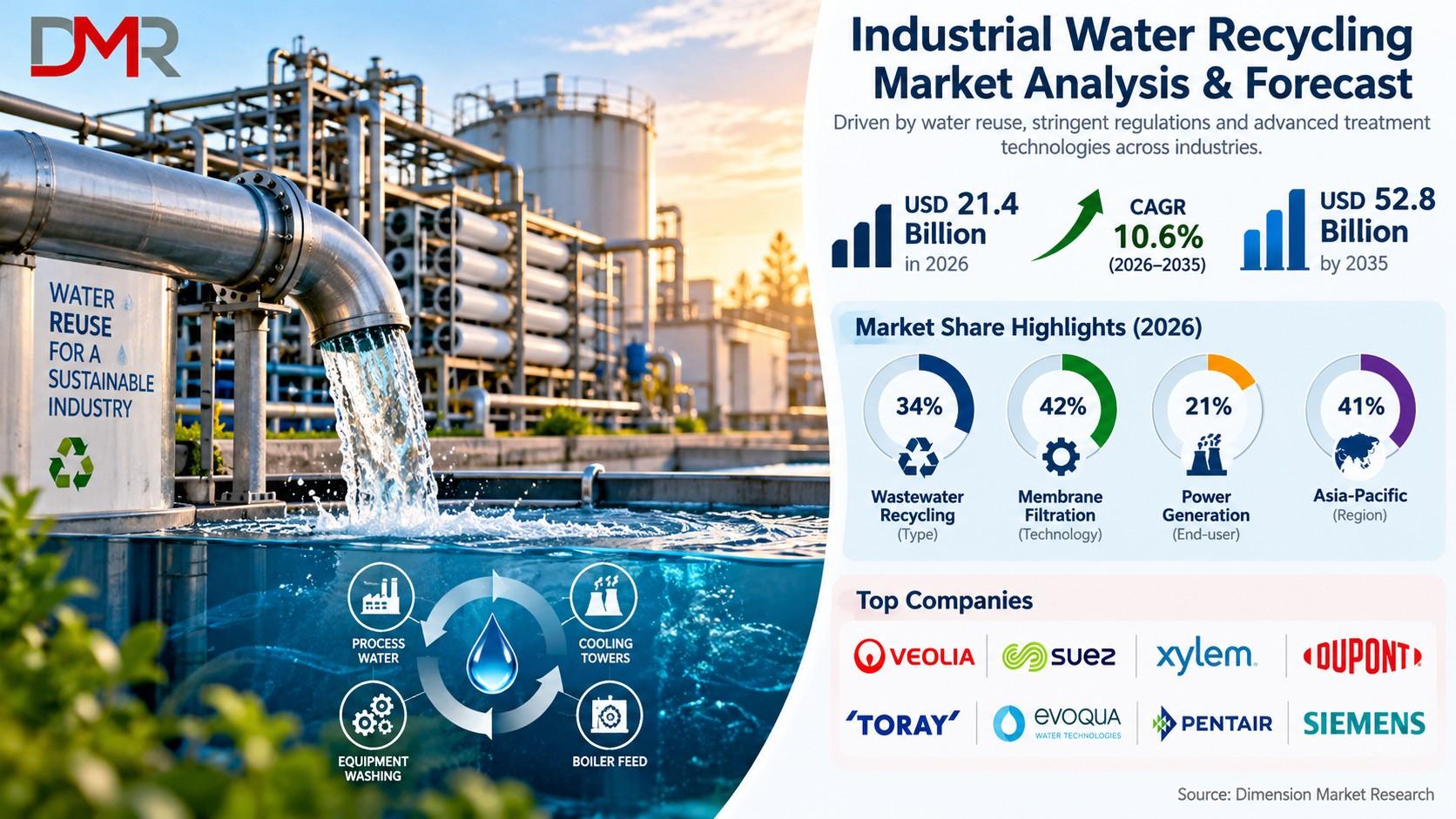
Industrial Water Recycling Market Forecast to Reach USD 52.8 Billion by 2035
The Industrial Water Recycling Market size is valued at USD 21.4 billion in 2026 and is projected to reach USD 52.8 billion by 2035, expanding at a CAGR of 10.6% during the forecast period, according to Dimension Market Research. Rising industrial water demand, freshwater constraints, wastewater discharge regulations and advances in treatment technologies are strengthening investment in industrial water reuse systems worldwide.
Industrial water recycling includes wastewater treatment, membrane filtration, reverse osmosis, biological treatment, chemical processing and zero liquid discharge systems. These solutions help industries recover water for cooling, boiler feed, equipment washing and manufacturing processes. As businesses prioritize water security and operational efficiency, recycling systems are becoming an important part of industrial infrastructure and sustainable resource management.
Industrial Water Recycling Market Snapshot
● Market value is projected at USD 21.4 billion in 2026.
● Market revenue is forecast to reach USD 52.8 billion by 2035.
● The market is expected to grow at a 10.6% CAGR through 2035.
● Wastewater recycling accounted for a 34% share in 2026.
● Membrane filtration held a 42% technology share in 2026.
● Power generation represented 21% of the market in 2026.
● Asia-Pacific captured a 41% revenue share in 2026.
● The US market is forecast to reach USD 9.8 billion by 2035.
● India's market is projected to reach USD 7.6 billion by 2035.
● China's market is expected to reach USD 11.2 billion by 2035.
Get insight you need (request free sample)
Market Research Findings
According to Dimension Market Research, industrial water recycling is gaining importance as manufacturers seek dependable water supplies and more efficient wastewater management. Wastewater recycling led the recycling type segment with a 34% share in 2026, while membrane filtration dominated technology with 42%. Power generation accounted for 21% of end-user demand, reflecting the industry's substantial requirements for cooling and steam-cycle water. Asia-Pacific led regional revenue with 41% in 2026. The study covers recycling types, technologies, equipment, capacity, applications, end-user industries, system configurations and geographical markets. These findings highlight the role of advanced treatment, water recovery and resource efficiency in shaping industrial investment decisions.
Why Is the Industrial Water Recycling Market Growing?
Industrial water recycling is expanding because companies face increasing pressure to reduce freshwater consumption without compromising production. Water shortages, changing discharge requirements, higher wastewater management costs and industrial expansion are encouraging businesses to recover usable water from process effluent. Modern treatment systems also allow facilities to match water quality to specific applications, helping control unnecessary treatment expenses.
Membrane filtration, reverse osmosis, modular treatment plants and automated monitoring are improving the practicality of reuse projects. High-recovery systems and zero liquid discharge solutions are especially relevant where industrial sites face stringent discharge limits or limited disposal options.
Industrial Water Recycling Market Key Growth Drivers
● Increasing freshwater scarcity across industrial manufacturing hubs.
● Growing demand for efficient wastewater treatment and water reuse.
● Stricter industrial effluent management and discharge requirements.
● Advances in membrane filtration and reverse osmosis technologies.
● Expansion of power generation, chemicals and advanced manufacturing.
● Rising interest in zero liquid discharge and high-recovery systems.
● Smart monitoring that improves treatment performance and maintenance.
Industrial Water Recycling Market Research Scope and Leading Segments
Wastewater Recycling
Wastewater recycling held a 34% share of the recycling type segment in 2026. Industrial facilities generate wastewater from manufacturing, cooling, equipment cleaning and process operations. Treating these streams for suitable reuse can reduce freshwater withdrawal and lower the volume of effluent requiring discharge. Adoption depends on contaminant levels, water quality requirements, treatment costs and the intended reuse application.
● Key applications include cooling, washing, utilities and process water recovery.
● Biological treatment and membrane systems support different effluent conditions.
Membrane Filtration
Membrane filtration led the technology segment with a 42% share in 2026. Reverse osmosis removes dissolved salts, while ultrafiltration and microfiltration help separate suspended solids and support pretreatment. Nanofiltration provides selective separation for suitable industrial streams. Membrane systems can also operate alongside biological treatment, chemical conditioning and zero liquid discharge equipment to improve water recovery.
● Key technologies include reverse osmosis, ultrafiltration and nanofiltration.
● Performance depends on pretreatment, membrane fouling control and energy use.
Power Generation
Power generation accounted for 21% of the market in 2026. Power plants require water for cooling, boiler feed, steam generation and other utilities. Recycling cooling water and recovering wastewater can help reduce freshwater demand and manage discharge volumes. Treatment configurations vary according to plant design, feedwater characteristics and operating requirements.
● Applications include cooling-water reuse, boiler feed and wastewater recovery.
● Membranes, chemical treatment and ZLD systems support plant-level reuse.
Read more about this market: https://dimensionmarketresearch.com/report/industrial-water-recycling-market/
Industrial Water Recycling Market Dynamics
Trend: Fit-for-Purpose Treatment and Digital Monitoring
Industrial facilities are increasingly designing treatment systems around the quality needed for each application. Cooling water, boiler feed and equipment washing do not always require identical treatment. This approach can reduce energy consumption, chemical use and unnecessary processing. Sensors and digital monitoring also help operators track pressure, flow, conductivity and membrane performance. Predictive maintenance can identify potential fouling or equipment issues before they interrupt operations.
Opportunity: Modular Systems and High-Purity Water Recovery
Decentralized and modular recycling systems offer opportunities for facilities with limited space or changing production requirements. These installations can be expanded as demand increases and deployed close to wastewater sources. Advanced manufacturing, electronics, pharmaceuticals and specialty chemicals also create demand for high-purity recycled water. Suppliers that combine reliable treatment performance with remote monitoring and lifecycle services can address these specialized requirements.
Challenge: Capital Costs and Concentrate Management
Complex wastewater streams may require several treatment stages, increasing equipment, engineering and operating costs. Membrane fouling, scaling, chemical consumption and concentrated brine disposal can further affect project economics. Zero liquid discharge systems can minimize liquid waste but may require energy-intensive evaporation and crystallization. Smaller facilities can find these investments difficult to justify when freshwater and wastewater charges are relatively low. Improving recovery efficiency and reducing lifecycle costs remain important industry priorities.
Industrial Water Recycling Market Regional and Country Outlook
Asia-Pacific led the global market with a 41% revenue share in 2026. Industrial expansion, manufacturing demand and water constraints support recycling investment across the region. The following country forecasts highlight the projected growth of three major markets.
● United States: USD 4.3 billion in 2026 to USD 9.8 billion by 2035, at a 9.5% CAGR.
● China: USD 4.8 billion in 2026 to USD 11.2 billion by 2035, at a 9.8% CAGR.
● India: USD 2.9 billion in 2026 to USD 7.6 billion by 2035, at an 11.3% CAGR.
China's large industrial base supports demand for wastewater recovery, membrane treatment and high-recovery systems. India's forecast growth reflects expanding industrial activity and water management needs. In the United States, manufacturing investment, water constraints and industrial process requirements support the adoption of advanced recycling solutions.
Industrial Water Recycling Market Key Competitor Companies
● Veolia Water Technologies
● SUEZ Water Technologies & Solutions
● Xylem Inc.
● DuPont Water Solutions
● Aquatech International LLC
● Fluence Corporation Limited
● Kurita Water Industries Ltd.
● Ecolab Inc.
● IDE Technologies Ltd.
● Pentair plc
● Toray Industries Inc.
● VA Tech Wabag Ltd.
● Alfa Laval AB
● Saltworks Technologies Inc.
● Kubota Corporation
Competition centers on treatment efficiency, water recovery rates, energy consumption, membrane durability, automation and lifecycle service capabilities. Integrated treatment providers and specialized technology suppliers compete to deliver solutions suited to different industrial water quality and discharge requirements.
Get 10% instant discount on report purchase
Explore more report:
● Wind Power Generators Market
● Wide Bandgap Semiconductor Market
● Waterproofing Chemical Admixture Market
Report Also Covers: Industrial Water Recycling Market Questions
1. What is the Industrial Water Recycling Market size in 2026?
The market is valued at USD 21.4 billion in 2026, according to Dimension Market Research.
2. What is the Industrial Water Recycling Market forecast through 2035?
The market is projected to reach USD 52.8 billion by 2035, growing at a 10.6% CAGR.
3. Which technology leads the Industrial Water Recycling Market?
Membrane filtration leads the technology segment with a 42% share in 2026.
4. Which recycling type dominates the market?
Wastewater recycling leads the recycling type segment with a 34% share in 2026.
5. Which end-user industry holds the largest reported share?
Power generation accounts for 21% of the market in 2026.
6. Which region leads the Industrial Water Recycling Market?
Asia-Pacific leads with a 41% revenue share in 2026.
7. What is India's market growth forecast through 2035?
India is projected to reach USD 7.6 billion by 2035 at an 11.3% CAGR.
8. What factors are driving industrial water recycling demand?
Water scarcity, discharge requirements, industrial expansion and treatment technology advances drive demand.
9. What are the major challenges facing industrial water recycling?
High capital costs, membrane fouling, energy consumption and concentrate disposal remain key challenges.
10. Which companies compete in the Industrial Water Recycling Market?
Major participants include Veolia, SUEZ, Xylem, DuPont Water Solutions and Aquatech International.
About Us
Dimension Market Research (DMR) is a global market intelligence and consulting firm delivering data-driven insights that help organizations make informed strategic decisions. With expertise across 12+ industries and global markets, DMR provides syndicated reports, custom research, competitive analysis, white space analysis, and business strategy consulting.
Our research solutions combine analytical rigor, industry expertise, and forward-looking intelligence to identify opportunities, reduce risks, and support sustainable growth. Trusted by clients across diverse sectors, DMR is committed to delivering accurate, actionable insights that enable businesses to navigate evolving market landscapes with confidence.
Contact Us
Phone USA: +17323699777
Phone India: +919310023843
E-mail: enquiry@dimensionmarketresearch.com
Address USA: 957 Route 33, Suite 12 #308, Hamilton Square, NJ-08690
Address India: D44, Sector 6, Noida 201301, India

 Arabic
 French
 Spanish
 Portuguese
 Deutsch
 Turkish
 Dutch
Dutch
 Italiano
 Russian
 Romaian
 Portuguese (Brazil)
 Greek
Greek
