


Essential Oils Market Growth, Share, Trend and Forecast Analysis By Fact.MR
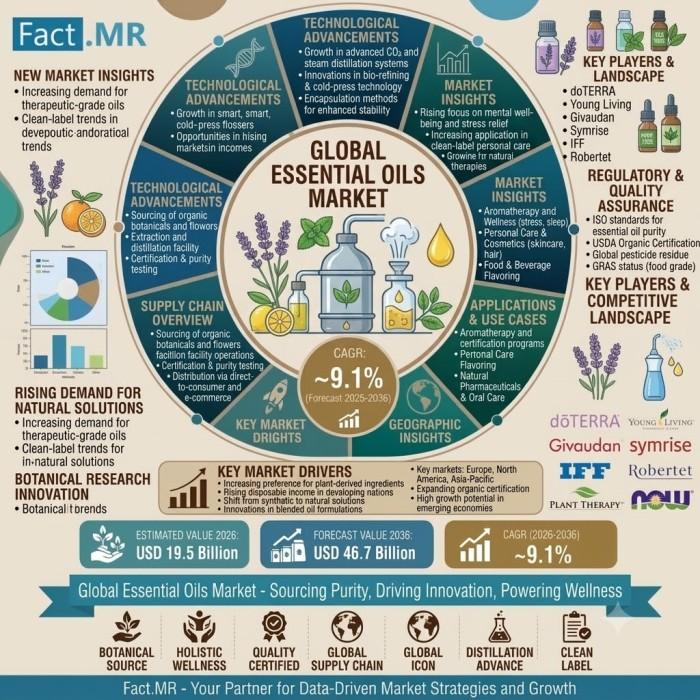
Rockville, Maryland – October 14, 2026 — The global essential oils market is projected to grow from USD 19.5 billion in 2026 to USD 46.7 billion by 2036, registering a compound annual growth rate (CAGR) of 9.1% over the forecast period. According to the latest market report published by Fact.MR, increasing consumer preference for natural wellness products, expanding aromatherapy applications, and wider use of essential oils in personal care formulations are supporting demand across consumer and institutional markets.
Get detailed market forecasts, competitive benchmarking, and pricing trends:
KEY MARKET TAKEAWAYS
- Market Valuation: USD 19.5 billion in 2026, projected to reach USD 46.7 billion by 2036.
- Growth Rate: Expanding at a CAGR of 9.1% from 2026 to 2036.
- Leading Product Segment: Single essential oils account for 46% of the product segment in 2026.
- Leading Application: Aromatherapy represents 50% of the application segment in 2026.
- Leading End-Use Segment: Individual consumers account for 57% of end-use demand in 2026.
- Fastest-Growing Country: India leads the covered markets with a projected CAGR of 10.3%.
- Core Growth Driver: Growing demand for plant-based wellness, personal care products, and aromatherapy applications.
INDUSTRY SHIFTS & MARKET DYNAMICS
The essential oils market is expanding beyond its traditional association with home aromatherapy and fragrance products. Consumers are increasingly incorporating plant-derived oils into personal care routines, wellness practices, and home fragrance applications. Lavender, citrus, eucalyptus, and peppermint oils remain important products because of their established use across multiple applications. Fact.MR estimates that single essential oils will account for 46% of the product segment in 2026, while aromatherapy will represent 50% of application demand.
Distribution changes are also creating opportunities for manufacturers. E-commerce and direct-to-consumer channels allow specialist brands to reach buyers seeking specific oil varieties, organic certifications, and clearly documented sourcing practices. Spa and wellness centers provide another demand channel through recurring procurement for massage and aromatherapy services. Meanwhile, personal care manufacturers are incorporating essential oils into skincare, haircare, and hygiene formulations, broadening the market's industrial customer base.
However, producers face challenges associated with agricultural supply fluctuations, raw material price volatility, and variations in oil quality. Climate conditions and crop yields can influence the availability and cost of botanical ingredients. Product adulteration and inconsistent composition can also weaken consumer confidence. Differences in labeling rules, certification requirements, and permitted product claims across countries add complexity for companies selling internationally. Suppliers that invest in traceability, quality testing, and transparent sourcing can differentiate their offerings in a competitive market.
REGIONAL MARKET SUMMARY
India is projected to record the fastest growth among the countries covered in Fact.MR's analysis, with a CAGR of 10.3% between 2026 and 2036. China follows at 9.8%, while Brazil is expected to grow at 9.0%. The United States and Germany are forecast to register CAGRs of 8.6% and 8.2%, respectively.
|
Country |
CAGR (2026–2036) |
Key Market Context |
|
India |
10.3% |
Essential oil production and expanding wellness demand |
|
China |
9.8% |
Growing aromatherapy, spa, and personal care markets |
|
Brazil |
9.0% |
Citrus oil production and wellness product demand |
|
United States |
8.6% |
Established retail channels and consumer wellness spending |
|
Germany |
8.2% |
Organic product preferences and spa and wellness demand |
Source: Fact.MR analysis.
ANALYST INSIGHTS
“The essential oils market is moving beyond its traditional base in aromatherapy and personal care. Growth is increasingly shaped by institutional demand from spa and wellness networks, clinical integration of complementary therapies, and industrial formulation requirements in personal care manufacturing,” stated Shambhu Nath Jha, Principal Consultant at Fact.MR. “The commercial winners will be companies that control sourcing quality, maintain organic and therapeutic certification, and build multi-channel distribution that serves both individual consumers and institutional buyers.”
The market outlook creates opportunities for producers, distributors, and personal care ingredient suppliers to strengthen their positions through consistent quality and targeted product development. Single-origin oils remain important for buyers seeking identifiable botanical ingredients, while pre-formulated blends offer convenience for consumers who prefer ready-to-use products. Businesses that combine reliable sourcing with suitable certifications and effective distribution can address demand across household, professional wellness, and manufacturing applications.
Unlock 360° insights for strategic decision making and investment planning:
FREQUENTLY ASKED QUESTIONS
Q: What is the projected size of the essential oils market by 2036?
A: The global market is estimated at USD 19.5 billion in 2026 and is projected to reach USD 46.7 billion by 2036, growing at a CAGR of 9.1%.
Q: Which product segment holds the leading market share?
A: Single essential oils account for 46% of the product segment in 2026.
Q: Which application segment dominates the market?
A: Aromatherapy is expected to account for 50% of the application segment in 2026.
Q: Which end-use segment leads the market?
A: Individual consumers account for 57% of end-use demand in 2026.
Q: Which country exhibits the highest growth rate?
A: India is projected to lead the countries covered, with a CAGR of 10.3% between 2026 and 2036.
Q: What factors are driving demand for essential oils?
A: Consumer preference for natural wellness products, wider aromatherapy adoption, demand for plant-based personal care ingredients, and expanding online distribution channels support market growth.
Q: What challenges affect the essential oils market?
A: Raw material price volatility, agricultural supply fluctuations, product adulteration, quality inconsistencies, and differences in regulatory requirements can affect producers and distributors.
Explore More Related Studies Published by Fact.MR Research
Familial Hypercholesterolemia Treatment Market
About Fact.MR
Fact.MR is a market research and consulting firm providing syndicated research, customized research, investment research, and market intelligence across a broad range of industries. Its research coverage includes food and beverage, healthcare, pharmaceuticals, biotechnology, consumer products, chemicals and materials, technology, industrial goods, and packaging.
Fact.MR provides market intelligence designed to help organizations understand market dynamics, emerging opportunities, competitive developments, and changing industry requirements.
Media Contact
Fact.MR
Email: sales@factmr.com
Phone: +1 (628) 251-1583
Website: www.factmr.com

 English
 Arabic
 French
 Spanish
 Portuguese
 Deutsch
 Turkish
 Dutch
Dutch
 Italiano
 Russian
 Portuguese (Brazil)
 Greek
Greek
